
Fail-Closed AI: The Only Safe Way to Run Autonomous Systems
- 11/11 AI

- May 4
- 4 min read
The Line That Will Define the Future of AI
There is a single architectural decision that will determine whether AI becomes:
The most powerful infrastructure layer ever built
or
The largest uncontrolled risk surface ever introduced
That decision is this:
Do systems execute first and check later…or are they prevented from executing unless explicitly authorized?
Right now, almost every AI system in the world operates on the first model.
And that is the problem.
The Hidden Default: Fail-Open AI
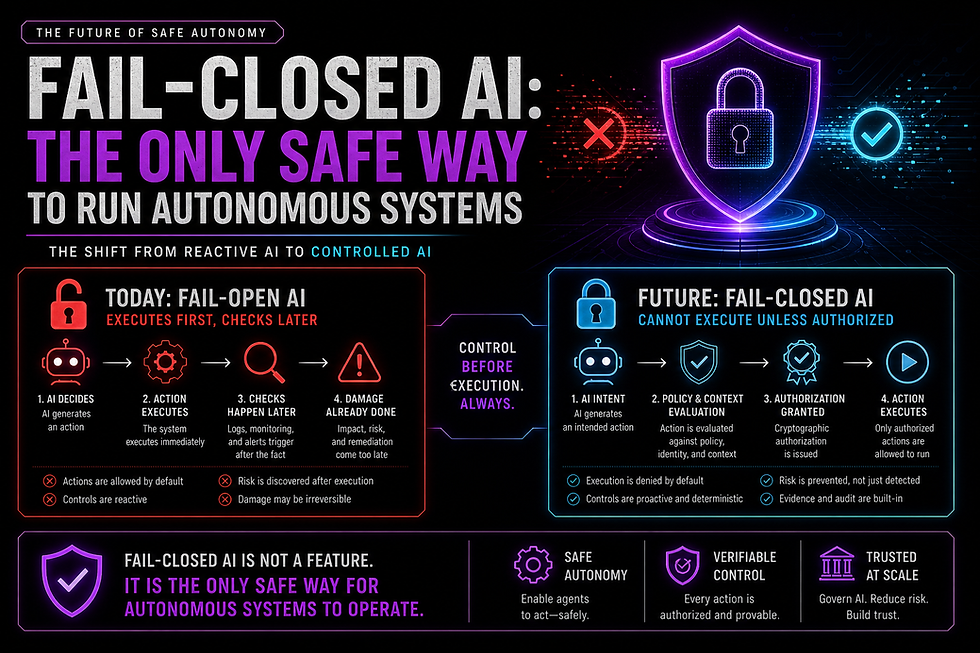
Today’s AI systems are built on what can be described as a:
fail-open execution model
That means:
Actions are allowed by default
Controls are applied after execution
Validation is reactive, not preventative
In practice:
AI generates → system executes → logs are recorded
AI decides → action is taken → monitoring observes
This model worked when AI was:
Passive
Advisory
Non-operational
It breaks completely in the era of agentic AI.
Why Fail-Open Worked Until Now
Historically, software systems assumed:
Humans initiate actions
Humans validate decisions
Humans bear responsibility
Even when automation existed, it was:
Deterministic
Predictable
Narrow in scope
AI changes all three assumptions:
Decisions are probabilistic
Behavior is non-deterministic
Scope expands across systems
And now, critically:
AI is executing actions autonomously
The Moment Execution Became Dangerous
The risk is not intelligence.
It is execution.
When AI crosses the boundary into:
Triggering payments
Modifying infrastructure
Changing data
Deploying code
The system is no longer advisory.
It becomes operational.
And operational systems must be controlled before they act.
The Core Failure: “Execute, Then Verify”
Today’s architecture looks like this:
AI generates an action
The system executes the action
Logs capture what happened
Monitoring flags issues (if any)
This model assumes:
Errors are acceptable
Failures can be corrected
Damage can be reversed
In modern systems, none of these assumptions hold.
Why “After-the-Fact” Control Is Not Control
Let’s be precise:
Logging is not control.Monitoring is not control.Alerting is not control.
These are:
forensic tools
They tell you what already happened.
They do not stop it.
Real-World Consequences of Fail-Open AI
Financial Systems
An AI agent:
Misinterprets a signal
Executes a transaction
Routes funds incorrectly
By the time it is detected:
The funds are gone
Reversal is complex or impossible
Infrastructure Systems
An AI agent:
Deploys incorrect configuration
Triggers cascading failures
Result:
Outage
Data corruption
System instability
Data Systems
An AI agent:
Updates records at scale
Applies incorrect transformations
Result:
Irrecoverable data integrity issues
The Only Viable Alternative: Fail-Closed Execution
There is only one architecture that solves this:
Fail-closed AI
What “Fail-Closed” Actually Means
Fail-closed is not a feature.
It is a system-level guarantee.
It means:
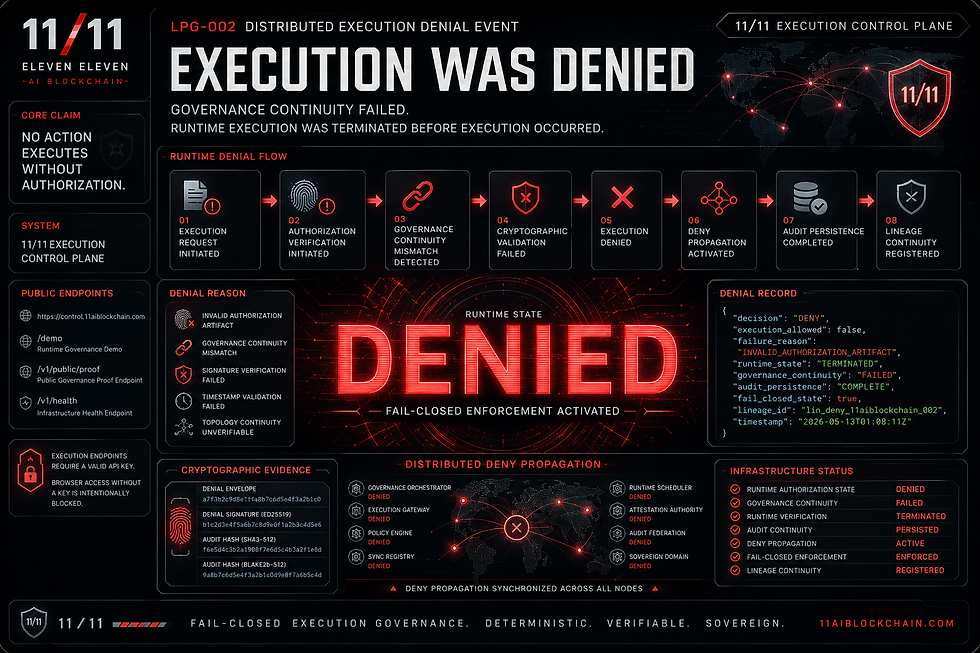
Execution is categorically denied unless authorization is satisfied.
Not:
“Usually denied”
“Flagged for review”
“Allowed with monitoring”
But:
Blocked at the execution boundary
The Shift in Control Philosophy
Model | Behavior |
Fail-Open | Allow first, evaluate later |
Fail-Closed | Deny first, allow only when authorized |
This is the same shift that defined:
Network security (firewalls)
Identity systems (zero trust)
Cryptographic systems (key-based access)
Now it must define AI execution.
The Execution Boundary
To implement fail-closed AI, you need a clear boundary:
Nothing executes beyond this point without authorization
This boundary sits:
Between AI decision and system action
Between intent and execution
Every action must pass through it.
No exceptions.
What Must Happen Before Execution
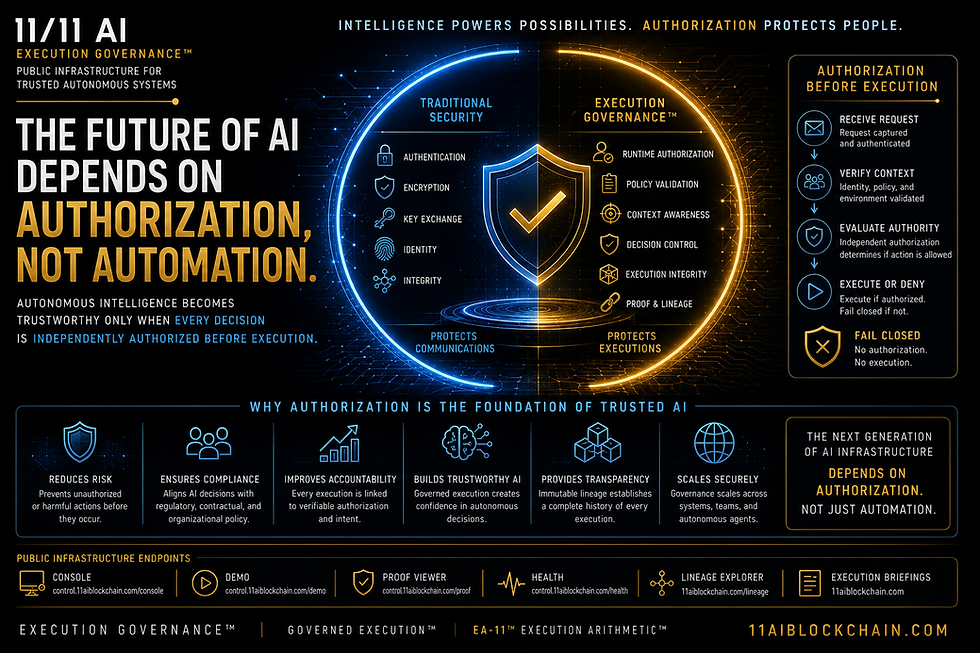
Before any AI action executes, the system must:
1. Evaluate Policy
Is this action allowed?
Under what conditions?
For which identity?
2. Validate Context
Who initiated the action?
What system is affected?
What is the current state?
3. Authorize Cryptographically
Produce a signed authorization artifact
Bind it to the action
Include time, scope, and constraints
4. Enforce Deterministically
Either the action is allowed
Or it is blocked
No ambiguity.
The Role of Cryptographic Authorization
Authorization cannot be:
A flag
A boolean
A simple permission
It must be:
cryptographic proof
Why?
Because:
It is verifiable
It is tamper-resistant
It creates evidence
Every execution must carry:
Proof it was authorized
Proof it met policy
Proof it was valid at that moment
From Logging to Evidence
Traditional systems produce logs.
Fail-closed systems produce:
evidence
This includes:
Authorization signatures
Execution lineage
Immutable audit trails
This is the difference between:
Observability
and
Verifiability
Deterministic Enforcement vs Probabilistic Decisions
AI systems are probabilistic.
Control systems must not be.
You cannot enforce safety with:
“likely safe”
“confidence score”
“model judgment”
Enforcement must be:
Deterministic
Binary
Non-bypassable
The Non-Negotiable Rule
If a system can execute without authorization:
it is not controlled
There is no partial control.
There is no “mostly safe.”
Either:
Execution is governed
or
It is not
The Enterprise Reality
Most enterprises today:
Allow AI to call APIs
Allow agents to execute workflows
Rely on monitoring for safety
This is:
fail-open at scale
And it will not hold.
Regulatory Pressure Is Coming
As AI systems begin to:
Move money
Control infrastructure
Affect real-world outcomes
Regulators will require:
Proof of control
Evidence of authorization
Traceability of execution
Fail-open systems cannot provide this.
Fail-closed systems can.
The Strategic Advantage of Fail-Closed AI
Organizations that adopt this model gain:
1. True Control
Actions cannot occur without authorization
2. Risk Reduction
Failures are prevented, not detected
3. Compliance Readiness
Evidence is built into execution
4. Scalable Automation
Systems can act autonomously safely
The Execution Control Plane
To implement fail-closed AI, you need:
An execution control plane
This layer:
Intercepts all actions
Evaluates policy
Issues authorization
Enforces execution boundaries
It becomes:
The gatekeeper of all system activity
Why This Becomes a Standard
Every major computing shift introduces a control layer:
Internet → Firewalls
Cloud → Identity and access management
APIs → Gateways
AI introduces:
Execution control
And fail-closed will become:
the default expectation
The Future State
In the future:
AI does not execute freely
AI requests execution
Systems authorize execution
Only authorized actions run
This becomes the new normal.
The Bottom Line
The industry is asking the wrong question.
Not:
“How powerful is AI?”
But:
“Who controls execution?”
Today:
AI executes first and checks later.
Future:
AI cannot execute unless authorized.
Fail-closed AI is not a feature.It is the only safe way to run autonomous systems.

Comments