
Why Fail-Closed Infrastructure Defines Trusted Autonomous Systems


Autonomous systems cannot be trusted if execution continues during governance failure.
That is the infrastructure reality now emerging across machine-speed environments.
Traditional digital systems were often designed to prioritize availability above operational certainty. If a validation layer failed, systems frequently defaulted to continuation. If oversight disconnected, execution still proceeded. If governance controls became unavailable, operations often degraded into permissive states.
That approach becomes dangerous in autonomous infrastructure.
Machine-speed systems amplify operational consequences faster than human intervention can respond. A single unauthorized execution path can propagate across workflows, orchestration layers, APIs, financial systems, cloud runtimes, or critical infrastructure environments in seconds.
This is why trusted autonomous infrastructure requires fail-closed enforcement.
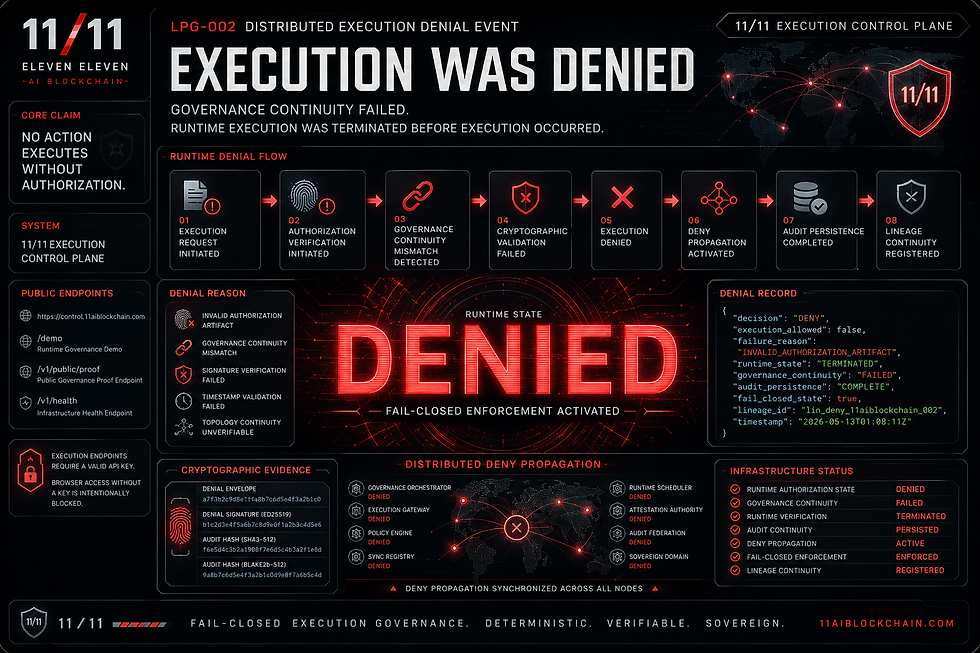
Fail-closed means the system denies execution when valid governance proof does not exist.
No authorization.
No execution.
No verified policy state.
No execution.
No trusted runtime context.
No execution.
Governance therefore becomes a hard operational boundary instead of an advisory recommendation.
This changes the role of infrastructure itself.
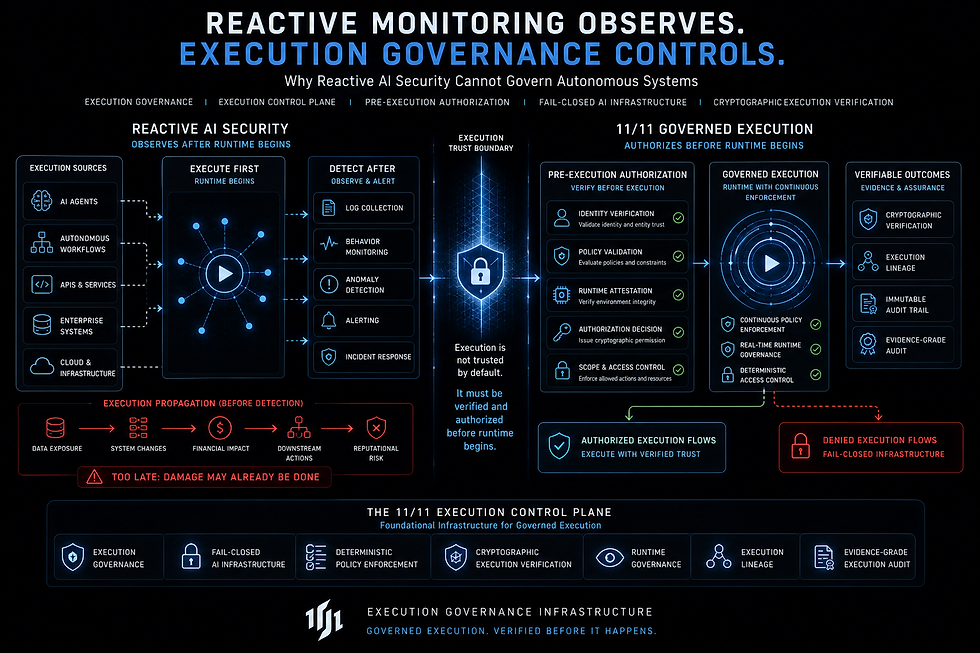
Execution is no longer assumed safe by default.
Execution must earn authorization before action occurs.
That authorization depends on runtime validation across identity, policy, environmental state, operational conditions, and governance proof.
Only then can execution proceed.
This creates deterministic operational trust.
Without fail-closed enforcement, autonomous infrastructure operates on assumption.
With fail-closed enforcement, autonomous infrastructure operates on proof.
That distinction matters because modern systems increasingly depend on autonomous coordination.
AI agents trigger workflows.
Infrastructure orchestrators route execution.
Runtime systems allocate resources.
Decision engines initiate actions automatically.
Cloud infrastructure scales dynamically.
Financial rails process transactions continuously.
Public infrastructure platforms synchronize operations in real time.
In these environments, governance cannot remain passive.
It must actively control execution admission.
Fail-closed infrastructure therefore becomes foundational to sovereign operational trust.
A trusted autonomous system must be capable of denying execution the moment governance certainty disappears.
If authorization becomes invalid, execution stops.
If runtime conditions drift outside policy, execution stops.
If proof cannot be verified, execution stops.
If governance integrity fails, execution stops.
This prevents operational drift from silently propagating through autonomous infrastructure.
It creates enforceable operational boundaries.
It transforms governance from documentation into infrastructure.
11/11 positions Execution Governance™ around this principle.
A governed execution architecture where infrastructure validates authorization before execution.
A runtime governance model where proof exists before action.
A deterministic control plane where operational trust is continuously enforced.
A fail-closed infrastructure architecture for autonomous systems operating at machine speed.
Because in the era of autonomous infrastructure, the most dangerous system is not the one that fails visibly.
It is the one that continues executing without governance certainty.
Trusted infrastructure must therefore fail closed.
That is how operational trust becomes enforceable.
That is how governed execution becomes infrastructure.
Public Infrastructure Endpoints
Public Runtime Infrastructure
Public Governance Console
Runtime Governance Demo
Public Governance Proof Viewer
Infrastructure Health Dashboard
Execution Lineage Explorer
Execution endpoints intentionally require valid API authorization.
Browser access without a valid authorization key is fail-closed by design.
11/11 introduces Execution Governance™ infrastructure for governed autonomous execution and deterministic operational trust.
Execution Governance™
Governed Execution™
Patent Pending

Comments