
Why Fail-Closed Infrastructure Becomes Mandatory At Machine Speed


Machine-speed infrastructure changes the acceptable margin for governance failure.
As autonomous systems increasingly coordinate execution across sovereign infrastructure environments, operational systems no longer wait for human intervention before actions occur.
Execution now happens continuously.
AI systems orchestrate workflows automatically.
Runtime platforms synchronize infrastructure globally.
Distributed operational environments coordinate at millisecond speeds.
This changes the architecture requirements of operational trust itself.
Traditional systems often tolerated uncertainty.
If a validation layer failed, execution sometimes continued.
If runtime conditions became inconsistent, operations degraded gracefully.
If governance synchronization weakened, systems frequently remained operational.
That model becomes dangerous in autonomous infrastructure.
At machine speed, uncertainty propagates immediately.
A disconnected authorization state.
A stale runtime dependency.
An altered policy condition.
A fragmented synchronization layer.
An unverifiable execution request.
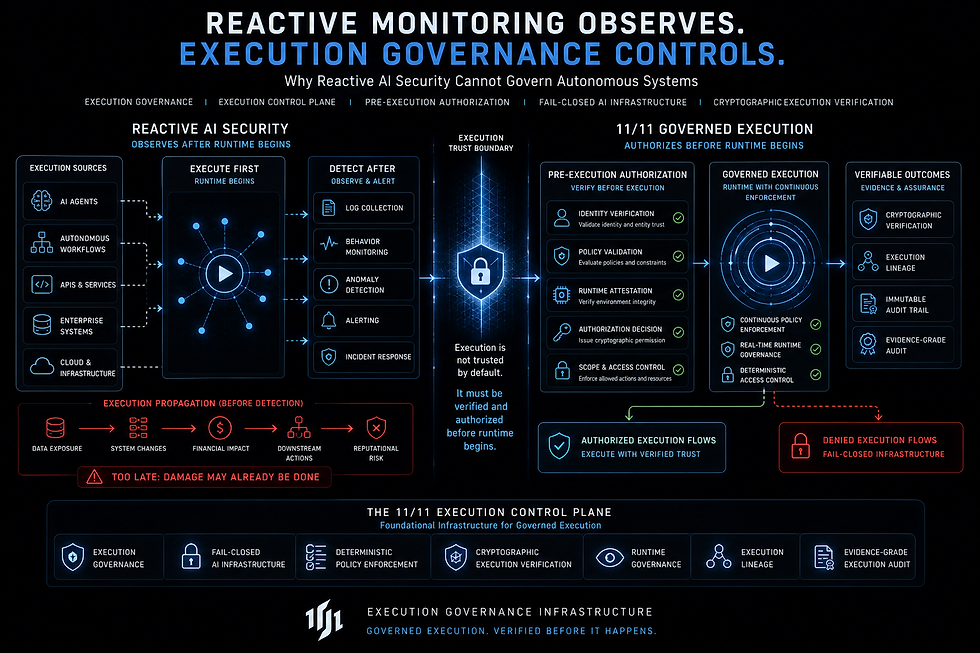
At machine speed, any of these failures can propagate operational consequences before reactive oversight begins.
This is why machine-speed infrastructure requires fail-closed governance enforcement.
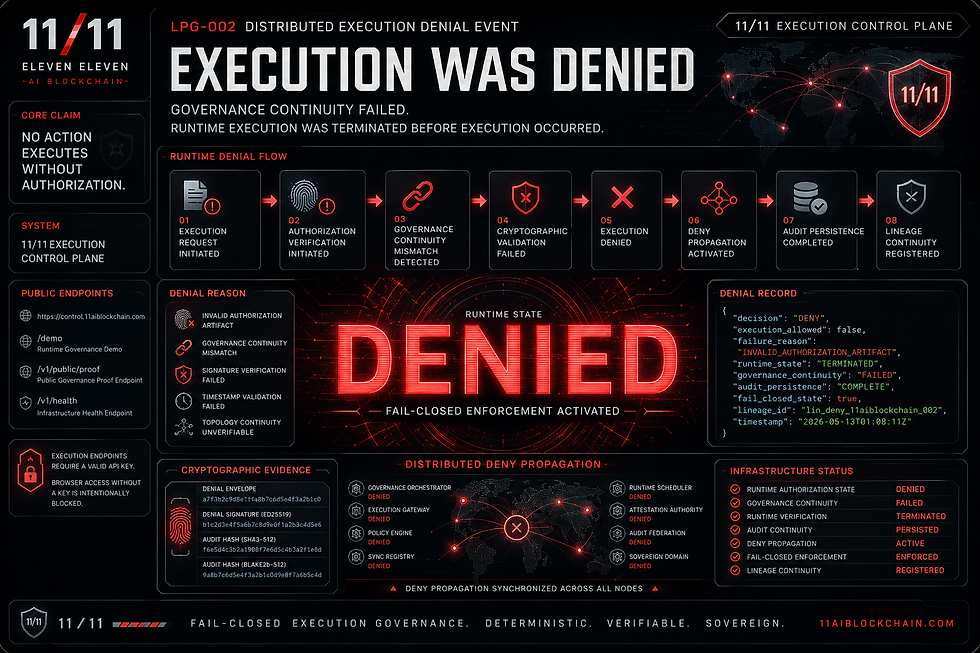
Fail-closed infrastructure ensures execution automatically stops the moment governance certainty disappears.
Identity certainty must remain valid.
Authorization certainty must remain synchronized.
Policy certainty must remain enforceable.
Runtime certainty must remain validated.
Infrastructure trust conditions must remain aligned.
Execution lineage certainty must remain provable.
Only while governance certainty exists should execution proceed.
If certainty fails, execution stops automatically.
No certainty.
No execution.
This transforms governance from passive oversight into deterministic operational enforcement.
Without fail-closed infrastructure, autonomous systems become probabilistic operational environments.
Execution certainty weakens.
Governance synchronization fragments.
Infrastructure trust drifts.
Operational risk expands across machine-speed systems.
Governability collapses under autonomous scale.
Fail-closed infrastructure prevents this instability.
It creates enforceable operational trust boundaries.
It enables deterministic runtime governance.
It preserves synchronized execution certainty.
It establishes immutable operational trust at machine speed.
This principle becomes foundational for sovereign autonomous systems.
Governments, defense systems, healthcare infrastructure, financial platforms, and public operational environments cannot depend on “best effort” governance once systems become autonomous.
They require fail-closed operational certainty.
Continuously enforced governance trust.
Continuously synchronized execution control.
Execution Governance™ positions fail-closed infrastructure as a foundational operational requirement for sovereign autonomous systems.
A governed execution architecture where operational trust remains continuously enforceable before execution proceeds.
A runtime governance model built for deterministic machine-speed infrastructure.
A fail-closed operational boundary designed to preserve governability across distributed autonomous environments.
Because future sovereign infrastructure will increasingly depend on whether execution automatically stops when governance certainty disappears.
That requires fail-closed infrastructure.
That requires governed execution.
That is the infrastructure category 11/11 defines through Execution Governance™.
Public Infrastructure Endpoints
Public Runtime Infrastructure
Public Governance Console
Runtime Governance Demo
Public Governance Proof Viewer
Infrastructure Health Dashboard
Execution Lineage Explorer
Execution endpoints intentionally require valid API authorization.
Browser access without a valid authorization key is fail-closed by design.
11/11 introduces Execution Governance™ infrastructure for governed autonomous execution and deterministic operational trust.
Execution Governance™
Governed Execution™
Patent Pending

Comments