
Fail-Open AI Infrastructure Cannot Scale Safely
- 11/11 AI

- May 10
- 2 min read

Most modern AI infrastructure still operates on an implicit assumption:
execution is trusted by default.
If monitoring fails, execution continues.
If authorization becomes unavailable, execution still proceeds.
If runtime governance degrades, systems often continue operating.
This is:fail-open infrastructure.
That model cannot safely scale into autonomous AI environments.
SECTION 1 — THE HIDDEN TRUST ASSUMPTION
Traditional infrastructure evolved around availability.
As a result, many systems prioritize:continuous execution
over continuous trust validation.
This creates a dangerous architectural assumption:
execution is permitted unless something explicitly stops it.
That model worked when:
human oversight remained centralized
automation was limited
execution velocity was slower
system scope was constrained
AI changes these assumptions completely.
SECTION 2 — AUTONOMOUS EXECUTION CHANGES THE RISK MODEL
Modern AI systems increasingly execute:
autonomous workflows
infrastructure orchestration
API coordination
financial actions
agentic reasoning chains
regulated data access
multi-agent operations
These systems can operate: continuously, at machine speed, across distributed environments.
The risk profile fundamentally changes.
A fail-open trust model becomes operationally dangerous.
SECTION 3 — WHAT FAIL-OPEN REALLY MEANS
Fail-open infrastructure often appears secure operationally.
Monitoring exists.Telemetry exists.Detection systems exist.Alerts exist.
But the underlying execution model still assumes: runtime trust by default.
In practice this means:
If verification becomes unavailable:execution may continue.
If governance policies fail:execution may continue.
If runtime validation degrades:execution may continue.
Execution remains operational even when trust continuity becomes uncertain.
That is not governed execution.
SECTION 4 — FAIL-CLOSED EXECUTION GOVERNANCE
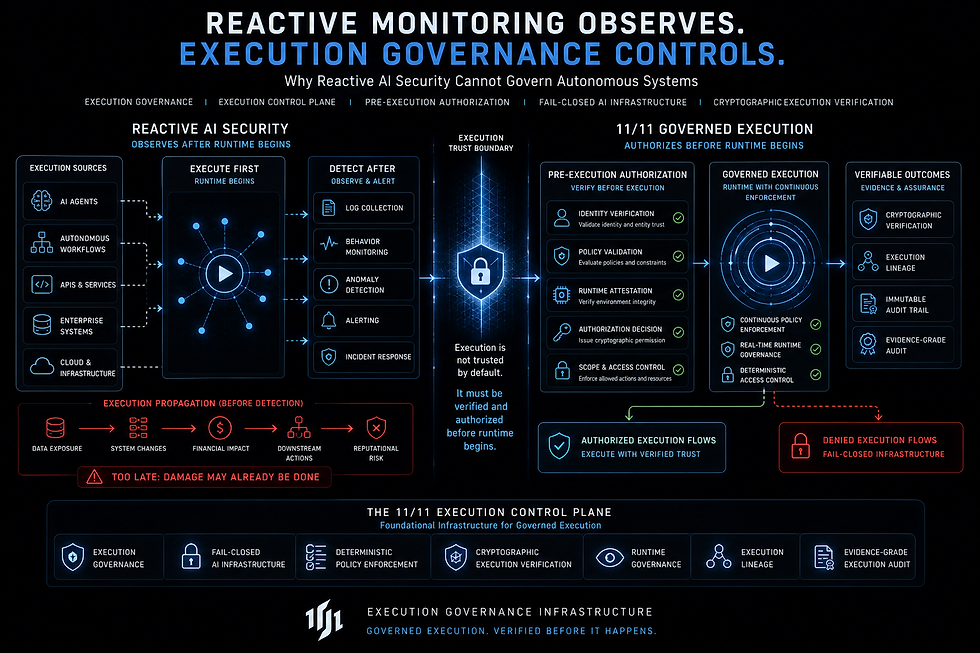
11/11 Runtime Governance Layer introduces a different architecture:
fail-closed execution governance.
In a fail-closed model:
If authorization fails:execution stops.
If policy validation fails:execution stops.
If cryptographic verification fails:execution stops.
If runtime governance becomes invalid:execution stops.
Trust continuity becomes mandatory for execution continuity.
SECTION 5 — EXECUTION AUTHORITY AS INFRASTRUCTURE
11/11 Execution Control Plane establishes:execution authoritybefore runtime begins.
Every execution request requires:
policy validation
authorization verification
environment attestation
cryptographic artifact validation
runtime governance continuity
This creates deterministic runtime trust enforcement.
Execution becomes:explicitly authorized
rather than implicitly trusted.
SECTION 6 — THE TRUST BOUNDARY MOVES INTO RUNTIME
Historically, security focused on:network boundaries identity systems endpoint visibility monitoring layers
But AI infrastructure changes the location of risk.
Execution itself becomes the trust boundary.
That means:runtime execution must continuously validate trust state.
11/11 Runtime Trust Architecture embeds governance directly into execution flow.
Trust enforcement becomes:operational infrastructure.
SECTION 7 — FAIL-CLOSED SYSTEMS CREATE DETERMINISTIC GOVERNANCE
Fail-open systems optimize for:availability.
Fail-closed systems optimize for:governed trust continuity.
This distinction becomes foundational for:
enterprise AI systems
financial infrastructure
healthcare infrastructure
defense systems
autonomous agents
regulated compute environments
The future of AI infrastructure requires deterministic execution governance.
Not probabilistic runtime trust assumptions.
SECTION 8 — GOVERNED EXECUTION AS THE NEXT INFRASTRUCTURE LAYER
11/11 Authorization Fabric and Runtime Governance Layer establish:
execution authorization
cryptographic runtime validation
deterministic policy enforcement
immutable audit persistence
execution lineage generation
evidence-grade runtime verification
This creates a new infrastructure model:
governed execution infrastructure.
Execution can no longer remain implicitly trusted.
Execution must become: verified, authorized, governed, and continuously validated.
CLOSING
Fail-open execution models cannot safely scale into autonomous AI infrastructure.
Execution itself becomes the trust boundary.
Runtime governance becomes mandatory infrastructure logic.
The future of AI infrastructure requires:fail-closed governed execution.
11/11 is building the execution governance layer for AI infrastructure.


Comments