
Why Governed Execution Becomes The Control Layer For Autonomous Systems


Autonomous systems require more than intelligence.
They require operational control.
As infrastructure becomes increasingly autonomous, execution decisions are no longer isolated events handled manually by operators or administrators.
Execution now occurs continuously across:
AI systems
orchestration platforms
cloud runtimes
operational APIs
distributed infrastructure
autonomous workflows
financial systems
sovereign digital environments
These systems increasingly coordinate at machine speed.
That operational velocity changes the architecture requirements of infrastructure itself.
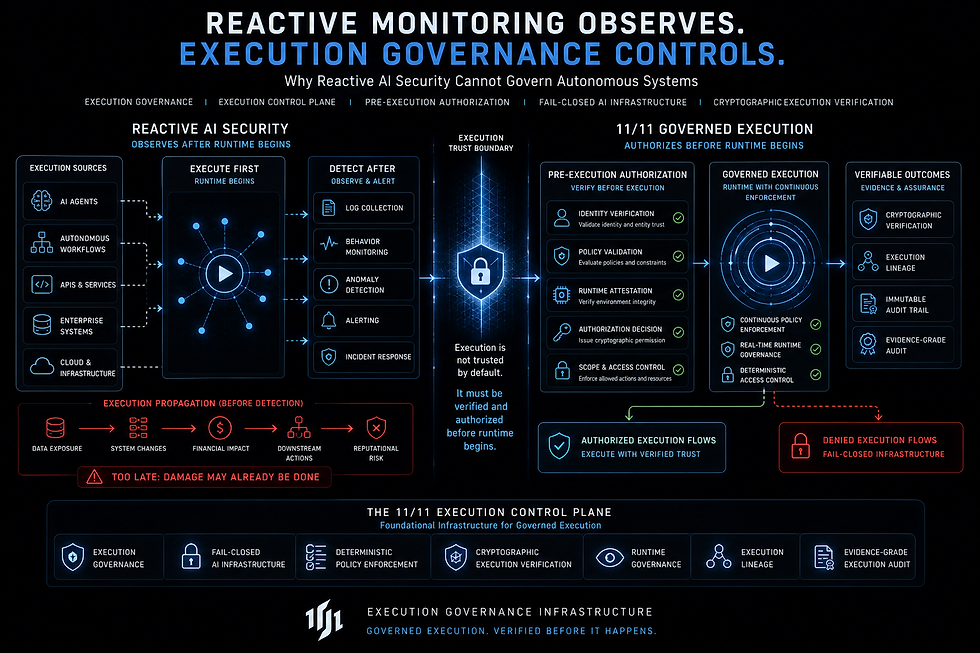
Traditional infrastructure relied heavily on reactive visibility.
Systems executed first.
Governance reviewed later.
Observability explained what happened afterward.
But autonomous systems operating at machine speed cannot depend solely on retrospective oversight.
By the time analysis begins, execution has already propagated.
This is why governed execution becomes critical.
Governed execution establishes an active operational control layer before execution occurs.
Instead of allowing systems to execute automatically by assumption, governed execution requires infrastructure to validate operational trust before action proceeds.
Identity is verified.
Authorization is confirmed.
Policy is evaluated.
Runtime conditions are synchronized.
Environmental context is validated.
Lineage proof is prepared.
Execution is admitted or denied.
This transforms governance into an operational execution boundary.
Without governed execution, infrastructure behaves probabilistically.
Trust becomes fragmented.
Authorization drifts.
Runtime conditions desynchronize.
Operational certainty weakens.
Autonomous systems become increasingly difficult to govern consistently at scale.
Governed execution prevents this instability by creating deterministic operational enforcement.
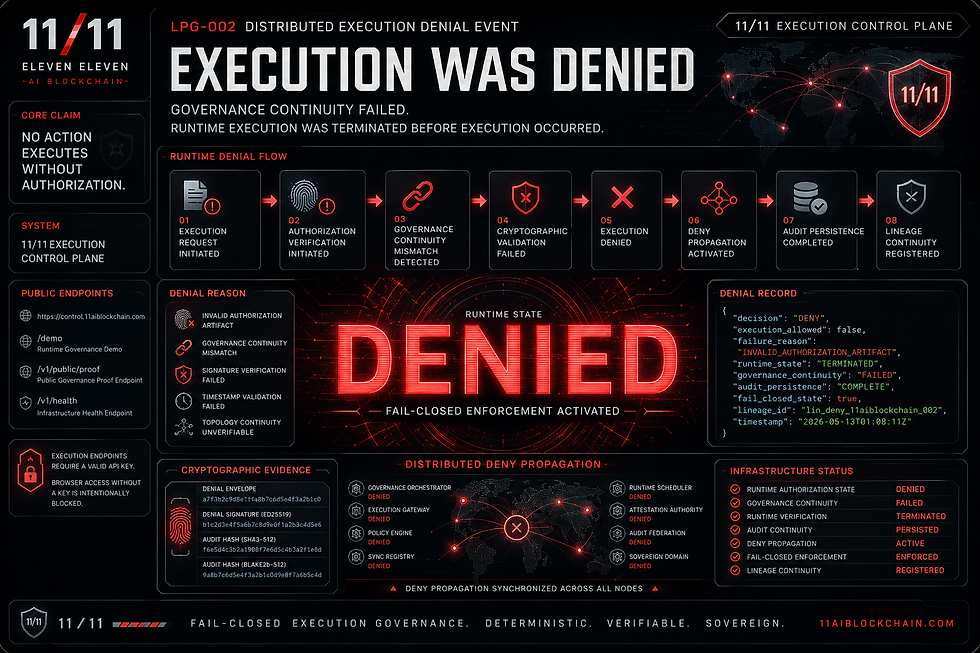
Execution cannot proceed unless governance certainty exists.
No valid governance proof means no execution.
This is fail-closed infrastructure.
The importance of this shift increases as sovereign infrastructure becomes more autonomous.
Governments, defense systems, healthcare infrastructure, financial systems, energy platforms, and public operational environments increasingly depend on continuous autonomous coordination.
That coordination requires infrastructure capable of enforcing operational trust in real time.
Not afterward.
Not during investigation.
Not during incident response.
Before execution itself.
This is why governed execution becomes the operational control layer for machine-speed infrastructure.
It synchronizes runtime governance continuously.
It creates enforceable trust boundaries.
It establishes immutable execution lineage.
It prevents unauthorized execution paths.
It ensures operational certainty exists before action occurs.
Execution Governance™ positions this model as the infrastructure architecture required for sovereign autonomous systems.
A governed control plane where execution depends on validated operational trust.
A runtime governance architecture built for machine-speed enforcement.
A deterministic infrastructure layer designed to maintain governability at scale.
Because the future of infrastructure will not depend solely on how intelligently systems operate.
It will depend on whether execution remains continuously governed.
That is the role of governed execution.
That is the infrastructure boundary 11/11 is defining.
Public Infrastructure Endpoints
Public Runtime Infrastructure
Public Governance Console
Runtime Governance Demo
Public Governance Proof Viewer
Infrastructure Health Dashboard
Execution Lineage Explorer
Execution endpoints intentionally require valid API authorization.
Browser access without a valid authorization key is fail-closed by design.
11/11 introduces Execution Governance™ infrastructure for governed autonomous execution and deterministic operational trust.
Execution Governance™
Governed Execution™
Patent Pending

Comments