
Governments Must Embrace 11AI to Build Trustworthy AI Frameworks for Public Use

Artificial intelligence is transforming industries worldwide, but governments face unique challenges when adopting AI technologies. Unlike commercial applications, public sector use demands transparency, accountability and strict adherence to legal and ethical standards. Current AI models, designed mainly for business purposes, fall short in these areas. The ongoing conflict between the U.S. Department of Defense and private AI companies like Anthropic highlights the urgent need for a new approach. This is where 11AI offers a promising solution a framework built specifically to meet the complex demands of government AI deployment.

The Problem with Current AI Models in Government Use
Most AI systems available today, including popular large language models like Claude and GPT-based platforms, were created for commercial use. Governments adopting these models quickly discover two major issues:
Opaque decision-making: These AI systems operate as black boxes, making it difficult to understand how they arrive at specific outcomes. This lack of transparency prevents meaningful external review and raises concerns about hidden biases or errors.
Inadequate governance models: Corporate policies guide these AI systems, but public institutions require governance aligned with public values, legal frameworks, and ethical standards. The mismatch leads to conflicts over control, responsibility, and acceptable use.
For example, defense agencies often seek unrestricted access to AI capabilities, sometimes invoking wartime powers to bypass standard safeguards. This reactive approach forces governments to adapt to technology rather than shaping it to serve the public interest. The result is a growing trust gap between citizens, government agencies and AI providers.
The Vision of 11AI
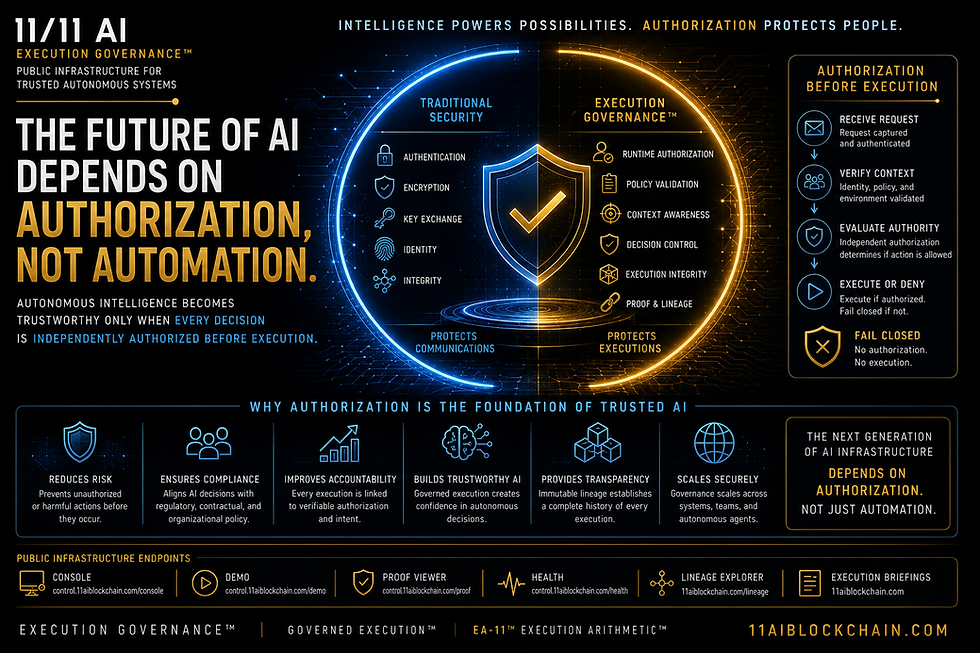
11AI proposes a fundamentally different approach to AI governance. Instead of retrofitting commercial AI for government use, 11AI designs AI systems with governance embedded from the start. This framework focuses on four key principles:
Interpretable AI behaviors
Every AI decision links directly to documented policy constraints. This traceability allows auditors and stakeholders to understand why the AI acted in a certain way.
Compliance verification
Real-time audits ensure AI operations comply with legal and ethical standards. This continuous monitoring helps detect and prevent misuse or policy violations before they escalate.
Open governance primitives
Both public and private stakeholders can define and update constraints openly. This collaborative model ensures AI governance evolves with societal values and emerging challenges.
Role-based enforcement
Access to AI capabilities is strictly controlled based on user roles. Only authorized individuals can perform specific actions, reducing risks of unauthorized use or abuse.
By embedding these features, 11AI enables governments to adopt AI confidently, knowing the technology respects public accountability and safety. This approach addresses the core issues that current AI models fail to solve.
How 11AI Bridges AI Safety and Public Accountability
The dispute over Anthropic’s Claude AI illustrates the tension between private companies’ safety principles and government demands. Anthropic resists government use that violates its safety rules, while defense agencies push for broader access citing national security needs. This standoff reveals a fundamental gap: private AI providers prioritize safety and ethics, but governments require transparency, control and legal compliance.
11AI offers a way to bridge this gap by making AI systems accountable to both safety standards and public governance. For instance, real-time compliance audits can reassure companies that their AI is used responsibly, while governments gain the oversight needed to protect citizens. Role-based enforcement ensures that sensitive AI functions are not misused, balancing security with ethical concerns.
Practical Benefits for Government Agencies
Adopting 11AI can transform how public institutions use AI across various sectors:
Defense
Military operations can deploy AI tools with clear policy constraints, reducing risks of unintended consequences or misuse in critical scenarios.
Healthcare
AI systems can assist in diagnostics and treatment planning while ensuring patient privacy and adherence to medical ethics.
Public Safety
Law enforcement agencies can use AI for threat detection with transparent decision-making and audit trails to prevent abuse.
Regulatory Compliance
Government regulators can monitor AI-driven decisions in real time, ensuring adherence to laws and standards.
These examples show how 11AI’s framework supports responsible AI adoption that aligns with public values and legal requirements.
Steps Governments Should Take to Implement 11AI
To build trustworthy AI frameworks, governments need to:
Engage stakeholders
Include AI developers, legal experts, ethicists and civil society in defining governance rules.
Develop clear policies
Translate public values and legal standards into explicit AI constraints and enforcement mechanisms.
Invest in compliance tools
Implement real-time auditing and monitoring systems to verify AI behavior continuously.
Train authorized users
Ensure personnel understand role-based access controls and ethical AI use.
Promote transparency
Publish governance frameworks and audit results to build public trust.
By following these steps, governments can move from reactive AI adoption to proactive governance.
The Future of AI in Government Depends on Trustworthy Frameworks
AI will play an increasingly important role in public services, defense and safety. Without trustworthy frameworks like 11AI, governments risk losing control over AI systems, facing public backlash and compromising ethical standards. The current conflict between defense agencies and private AI companies is a warning sign that governments must act now.
Building AI systems with governance baked in is not just a technical challenge but a societal imperative. 11AI offers a clear path forward, enabling governments to harness AI’s benefits while safeguarding public values. The next step is for policymakers and AI developers to collaborate and adopt frameworks that prioritize transparency, accountability, and safety.

Comments