
11/11 Core: The Missing Execution Governance Layer for AI, Quantum and Global Infrastructure
- 11/11 AI

- Mar 10
- 6 min read
Updated: Mar 10
Artificial intelligence and autonomous computing systems are rapidly crossing a critical threshold. For decades, software primarily acted as a decision-support tool for humans. Systems analyzed data, produced recommendations and helped people make informed choices. Human oversight remained firmly in the loop.
That model is now changing.

Modern AI systems are increasingly capable of executing actions independently. They can initiate financial transactions, manage infrastructure, access sensitive data environments, and coordinate complex distributed systems without continuous human supervision. This transition from advisory systems to autonomous execution environments represents one of the most important shifts in computing history.
Yet as these systems become more powerful, a fundamental problem has emerged.
The technology stack governing modern computing environments was never designed to control autonomous execution at scale. Current models rely heavily on monitoring, logging, and post-event analysis to understand system behavior. In many cases, policy enforcement happens outside the execution boundary itself. Systems are observed after they act and corrective measures are applied later.
For autonomous systems operating in critical environments, that model is no longer sufficient.
Execution must be governed before it occurs.
This is where the concept behind 11/11 Core becomes essential.
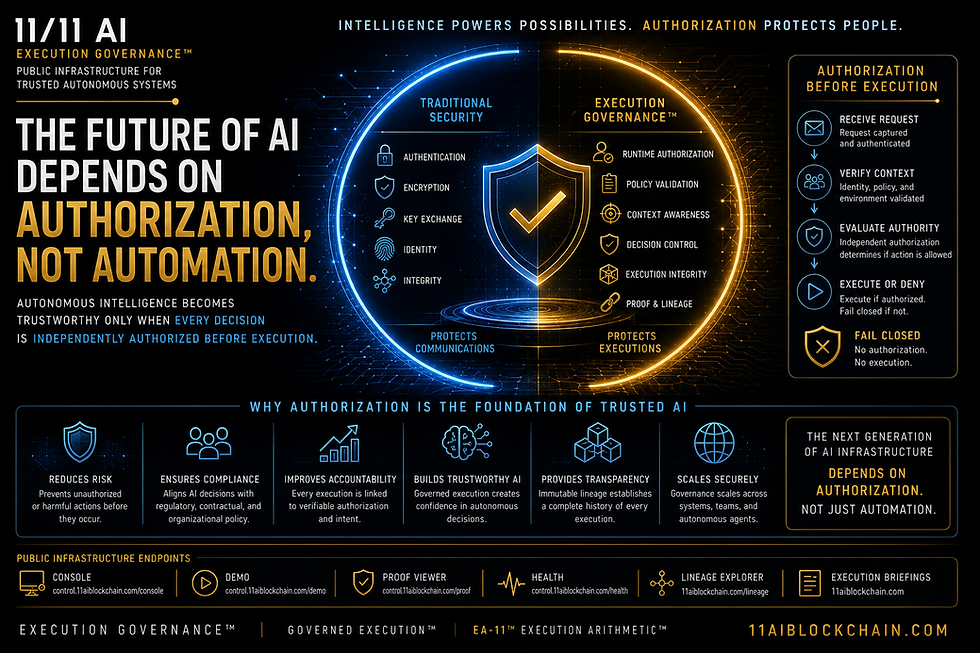
11/11 Core introduces a deterministic governance layer designed to sit beneath artificial intelligence systems, financial transaction networks and regulated data environments. Instead of relying on monitoring after actions occur, the architecture enforces policy at the moment of execution itself.
In doing so, it establishes a new category of infrastructure for the autonomous computing era.
The Execution Problem in Modern Computing
To understand the importance of execution governance, it is necessary to look at how most computing systems operate today.
Traditional software architectures separate three major layers:
Application logic
Infrastructure services
Monitoring and governance frameworks
Application code performs actions. Infrastructure layers handle resources such as compute, storage, and networking. Governance systems operate above these layers, often through monitoring tools, compliance checks, or security reviews.
This architecture works well when human operators are responsible for initiating actions. Humans evaluate information and decide when systems should act.
However, as artificial intelligence systems become increasingly autonomous, that model begins to break down.
Consider environments where AI systems:
Initiate financial settlements
Control industrial systems
Access regulated medical records
Execute autonomous trading strategies
Coordinate distributed compute environments
In these scenarios, actions may occur thousands or millions of times per second. Waiting to analyze behavior after execution is no longer a viable governance strategy.
The control boundary must move inside the execution environment itself.
Autonomous systems require infrastructure capable of enforcing rules before actions occur.
Deterministic Governance at the Execution Layer
11/11 Core addresses this challenge by introducing deterministic governance directly into the execution layer.
Rather than acting as an application or monitoring system, the architecture functions as a control layer that governs how execution occurs across distributed environments.
At its core, the design centers around several key principles:
Policy Before Execution
Execution environments must verify policy conditions before allowing actions to proceed. If required conditions are not met, the system must block execution entirely.
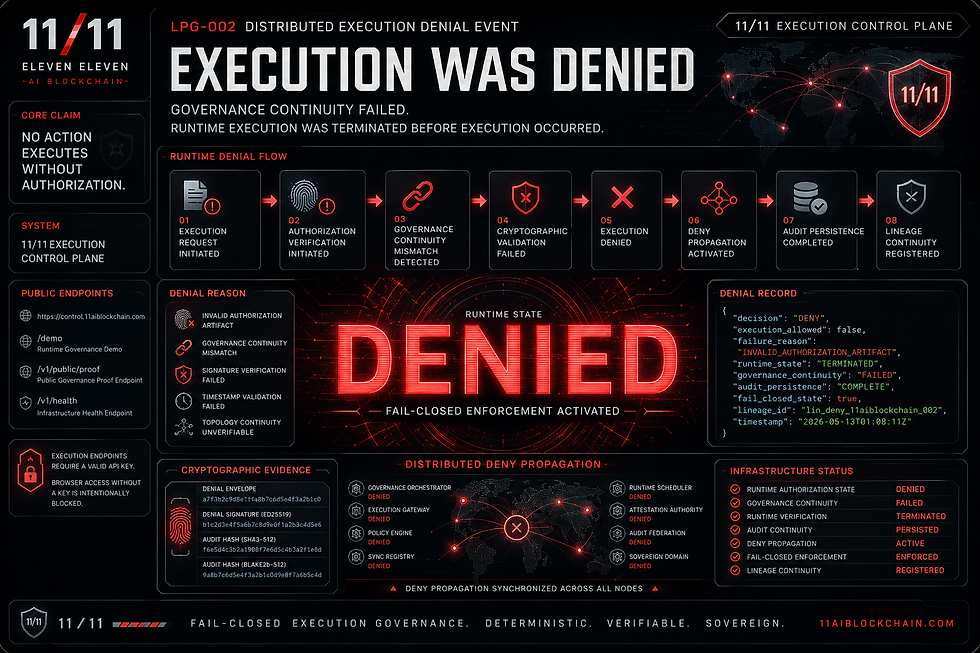
This fail-closed model ensures that autonomous systems cannot act outside defined parameters.
Deterministic Enforcement
Policies must be enforced deterministically. This means that the same input conditions always produce the same governance outcome. Deterministic enforcement eliminates ambiguity in how execution decisions are made.
Cryptographic Runtime Evidence
In addition to enforcing policy, systems must produce verifiable proof of execution behavior. Cryptographic evidence allows organizations to demonstrate how decisions were made, which rules were applied and whether execution complied with governance frameworks.
Permission and Key Control
Access to execution environments must be governed through controlled key issuance and permission frameworks. By regulating how credentials and execution permissions are issued, systems can maintain strict control over autonomous operations.
Together, these principles form the foundation of deterministic execution governance.
Why Execution Governance Matters Now
The need for deterministic governance is becoming increasingly urgent as several technology trends converge.
The Rise of Autonomous AI
Artificial intelligence is evolving from static models to continuously operating agents capable of interacting with complex systems. These agents are beginning to make decisions that carry financial, operational, and regulatory consequences.
Without strong execution controls, autonomous AI systems may operate outside intended policy boundaries.
Financial Automation
Financial infrastructure is rapidly shifting toward automated settlement systems, stablecoin-based payment networks, and algorithmic financial services. These environments involve high-value transactions executed at machine speed.
Deterministic governance ensures that financial actions occur within verifiable policy frameworks.
Regulated Data Environments
Healthcare, government, and enterprise data systems increasingly require strict control over how sensitive information is accessed and processed. Autonomous analytics systems must operate within clearly defined regulatory boundaries.
Execution governance provides the infrastructure necessary to enforce these boundaries programmatically.
Distributed Infrastructure
Modern computing environments span multiple cloud providers, edge systems, and decentralized networks. Coordinating governance across these distributed systems is extremely difficult using traditional monitoring frameworks.
Execution-layer governance provides a unified control boundary across distributed infrastructure.
Positioning Within the Technology Stack
The easiest way to understand the role of 11/11 Core is to compare it with other foundational infrastructure layers.
Certain technologies fundamentally changed how computing environments are governed:
AWS Nitro introduced hardware-level isolation for secure cloud computing.
Secure Enclave and TPM systems created trusted execution environments for devices.
CUDA established a control layer for GPU-based computation.
Each of these technologies operates below the application layer. They govern how computing resources behave rather than what applications do.
11/11 Core follows a similar architectural pattern.
However, instead of governing a single device or cloud stack, it focuses on governing execution across distributed AI systems, financial infrastructure and regulated data environments.
It acts as a deterministic control layer for autonomous computing.
Governance as Infrastructure
Historically, governance has been treated as an external compliance function. Organizations rely on policy documents, audits and monitoring frameworks to ensure systems behave appropriately.
But autonomous systems require a different model.
Governance must become part of the infrastructure itself.
When governance operates at the execution layer, systems can enforce policy automatically. Instead of detecting violations after the fact, infrastructure prevents violations from occurring.
This shift fundamentally changes how organizations manage risk.
Rather than asking whether a system complied with policy after execution, organizations can prove that non-compliant actions were impossible.
Implications for Global Technology Infrastructure
As artificial intelligence and distributed systems become central to global infrastructure, execution governance will play an increasingly strategic role.
Control over compute resources alone will not determine technological leadership. The ability to govern autonomous systems safely and reliably will become equally important.
Countries and organizations that develop strong execution governance frameworks will be better positioned to deploy autonomous systems across critical sectors.
These sectors include:
Financial infrastructure
Healthcare systems
National security environments
Industrial automation networks
Public infrastructure management
In each of these domains, autonomous systems must operate within clearly defined control boundaries.
Deterministic governance provides the mechanism to enforce those boundaries.
A New Category of Infrastructure
The emergence of autonomous systems creates the need for a new infrastructure category.
Just as operating systems once provided foundational control for computing devices, and cloud infrastructure later provided scalable compute resources, the next generation of systems will require governance infrastructure capable of controlling autonomous execution.
11/11 Core represents an early example of this category.
It focuses on enabling organizations to deploy powerful autonomous technologies while maintaining deterministic control over how those technologies behave.
By integrating governance directly into the execution layer, the architecture helps ensure that autonomous systems operate within enforceable and verifiable boundaries.
The Road Ahead
The coming decade will see rapid advances in artificial intelligence, quantum technologies, financial automation and distributed infrastructure. These technologies promise enormous benefits but also introduce new forms of systemic risk.
Managing those risks requires more than stronger monitoring tools or expanded compliance frameworks.
It requires infrastructure designed to control execution itself.
Deterministic governance systems will likely become foundational components of next-generation computing environments. They will help organizations ensure that increasingly autonomous systems remain aligned with defined policy frameworks.
In that context, execution governance is not merely a technical feature.
It is a structural requirement for the safe operation of autonomous infrastructure.
Conclusion
The evolution of computing is entering a new phase. Systems are becoming capable of executing actions independently, making decisions that directly affect financial systems, infrastructure and data environments.
As this transition accelerates, governance must move closer to the point where those actions occur.
11/11 Core introduces a deterministic governance layer designed to operate at that boundary.
By enforcing policy before execution, failing closed when conditions are not met, and producing cryptographic proof of runtime behavior, the architecture provides a foundation for governing autonomous systems at scale.
The next generation of computing will not be defined solely by faster processors or larger models.
It will be defined by how effectively we control execution in an increasingly autonomous world.
Deterministic governance will become a cornerstone of that future.

Comments