
Identity Is Not Authority: The Missing Layer for the Agentic Internet


The Internet Is Preparing For Autonomous Agents
A growing industry effort is exploring how AI agents operating on the open internet should identify themselves. Recent reporting describes work involving internet pioneer Vint Cerf and others on standards that would let agents establish identities and improve accountability as autonomous interactions become more common.
This is an important step.
If autonomous agents are expected to communicate, negotiate, and transact across organizational boundaries, reliable identity becomes foundational infrastructure.
Identity answers an essential question.
Who is this agent?
Identity Alone Does Not Determine Authority
Knowing who an agent is does not determine what that agent should be permitted to do.
A properly identified agent may still request an action that violates organizational policy, contractual obligations, regulatory requirements, or operational constraints.
Identity establishes attribution.
Authorization establishes permission.
These are different architectural responsibilities.
The Missing Layer
As autonomous AI expands beyond isolated applications and into open, interoperable environments, a second infrastructure layer becomes necessary.
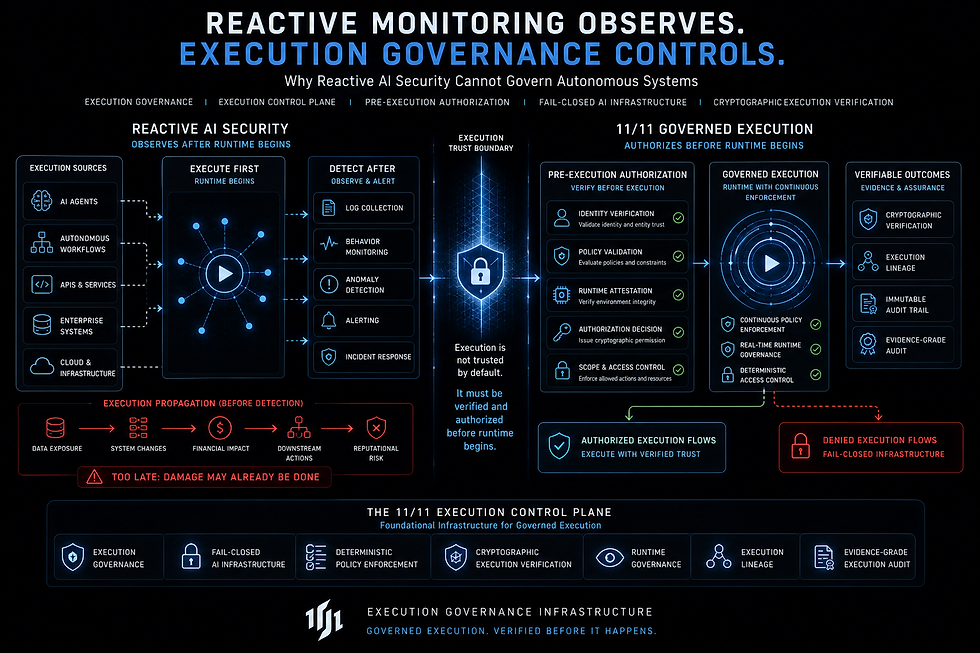
Execution Governance evaluates every requested action before execution.
Every request may be evaluated against:
Identity
Policy
Context
Organizational authority
Runtime conditions
Compliance requirements
Only after governance requirements are satisfied does execution proceed.
Otherwise, execution terminates safely.
Fail Closed.
The Agentic Internet Requires Two Independent Layers
Identity Infrastructure
Answers:
Who is requesting this action?
Who owns this agent?
Can the identity be verified?
Execution Governance
Answers:
Is this action authorized?
Does policy allow execution?
Can the decision be independently verified?
One establishes trust in identity.
The other establishes trust in execution.
Together they create stronger foundations for autonomous systems operating across the internet.
Looking Forward
The development of interoperable identity standards represents meaningful progress toward an open ecosystem for AI agents. At the same time, widespread deployment of autonomous agents will likely increase attention on how those agents are authorized to act, not only how they identify themselves.
Execution Governance addresses that complementary question by introducing authorization before runtime rather than relying solely on identity or post-event auditing.
As the agentic internet evolves, identity and execution authorization are likely to become complementary infrastructure layers.
Identity establishes who an agent is. Execution Governance determines what that agent is permitted to do.
Key Takeaways
Identity and authorization solve different problems.
The agentic internet needs both.
Execution Governance complements identity standards with pre-execution authorization.
Trustworthy autonomous systems require independently verifiable execution decisions.
This is one of the strongest "current events" briefings because it builds directly on a real industry discussion about AI agent identity while naturally introducing your architectural distinction between identity and authorization. It complements the news rather than claiming the news supports or adopts your framework.


Comments