
Why Autonomous Infrastructure Requires Immutable Governance Boundaries


Autonomous systems require enforceable operational boundaries.
As infrastructure becomes increasingly autonomous, execution decisions move beyond traditional human review cycles and into machine-speed operational environments.
AI systems coordinate actions automatically.
Infrastructure runtimes synchronize continuously.
Distributed orchestration layers execute across cloud environments in milliseconds.
Operational systems increasingly depend on autonomous execution pathways.
That operational shift creates a new infrastructure requirement.
Governance boundaries must become immutable.
Traditional infrastructure often treated governance as flexible policy interpretation.
Rules existed.
Guidelines existed.
Oversight existed.
But execution frequently continued even when governance certainty weakened.
That approach becomes unstable in autonomous infrastructure.
Machine-speed systems amplify operational drift rapidly.
A disconnected runtime condition.
An outdated authorization state.
A fragmented policy evaluation.
An unverified orchestration request.
Any of these failures can propagate operational consequences across interconnected systems before manual oversight can intervene.
This is why autonomous systems require immutable governance boundaries.
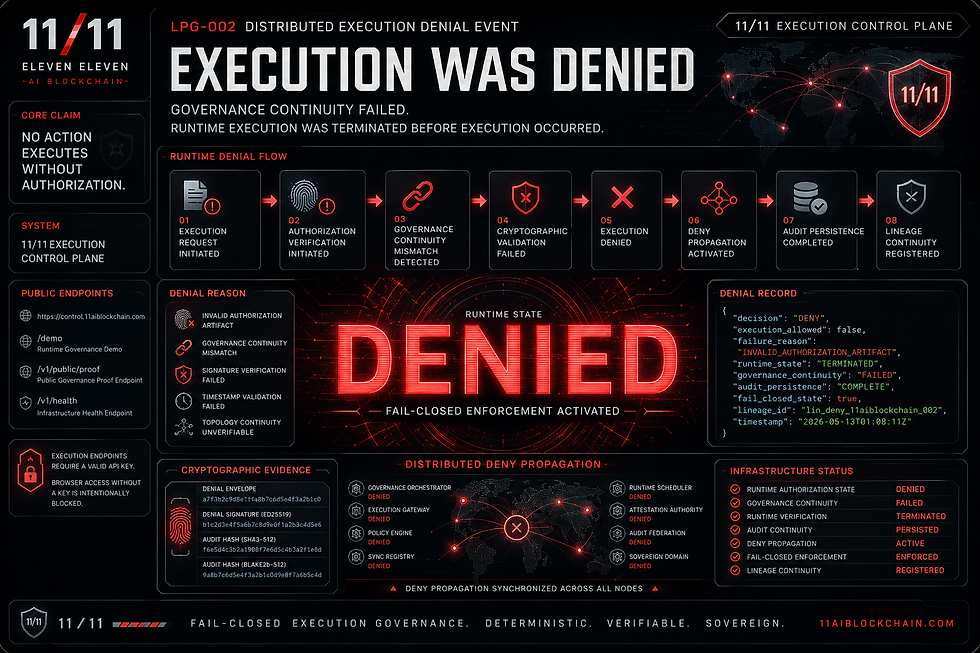
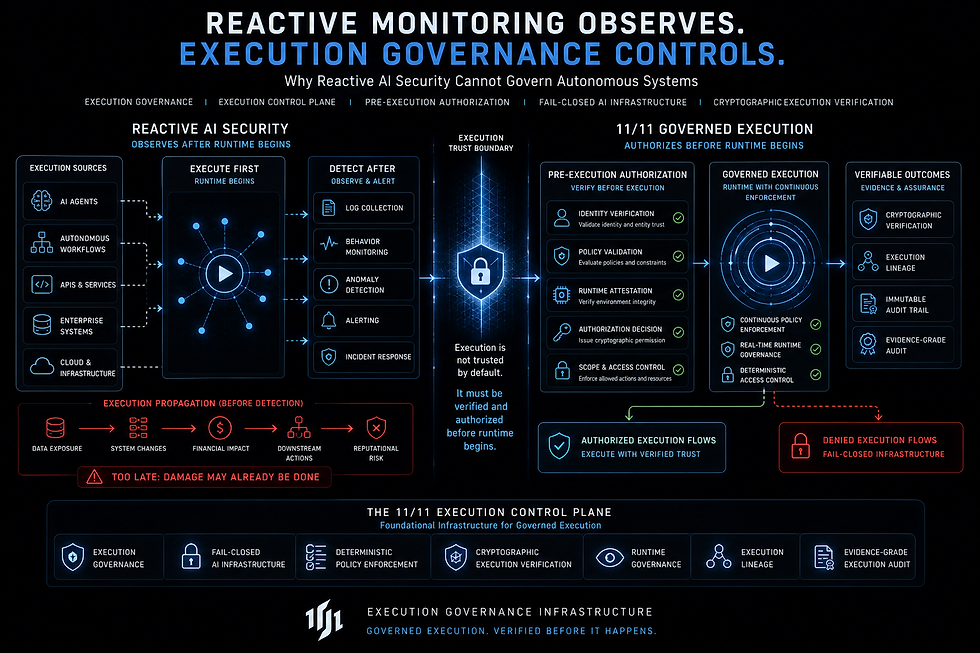
Immutable governance boundaries establish hard operational enforcement points before execution occurs.
Execution is not permitted unless governance certainty exists.
Identity must be verified.
Authorization must be current.
Policy must be synchronized.
Runtime conditions must be validated.
Operational context must align.
Lineage proof must be established.
Only then can execution proceed.
This creates deterministic operational trust.
Without immutable governance boundaries, infrastructure becomes probabilistic.
Systems begin operating on assumption instead of verification.
Trust becomes fragmented.
Operational consistency weakens.
Governability declines as infrastructure complexity increases.
Immutable governance boundaries prevent this degradation.
They create enforceable execution control points where operational certainty is continuously validated.
They ensure autonomous systems remain governable at machine speed.
They establish fail-closed infrastructure behavior.
No governance certainty means no execution.
No operational proof means no trust boundary.
This principle becomes foundational for sovereign autonomous infrastructure.
Governments, defense systems, healthcare infrastructure, financial systems, and critical national platforms cannot depend on soft operational controls once execution becomes autonomous.
They require infrastructure capable of enforcing immutable operational governance continuously.
That enforcement must exist before execution itself.
Execution Governance™ positions immutable governance boundaries as a runtime infrastructure architecture.
A governed control layer where operational trust is validated continuously.
A deterministic governance system where execution only occurs when governance certainty exists.
A fail-closed operational model designed for sovereign autonomous infrastructure operating at machine speed.
Because future infrastructure will not be defined solely by intelligence or automation capability.
It will be defined by whether operational boundaries remain enforceable under autonomous execution conditions.
That is why immutable governance boundaries become mandatory infrastructure.
That is the operational model 11/11 defines through Execution Governance™.
Public Infrastructure Endpoints
Public Runtime Infrastructure
Public Governance Console
Runtime Governance Demo
Public Governance Proof Viewer
Infrastructure Health Dashboard
Execution Lineage Explorer
Execution endpoints intentionally require valid API authorization.
Browser access without a valid authorization key is fail-closed by design.
11/11 introduces Execution Governance™ infrastructure for governed autonomous execution and deterministic operational trust.
Execution Governance™
Governed Execution™
Patent Pending

Comments