
India's First Commercial Quantum Computer Marks a New Era in AI and Computing

Updated: Apr 28
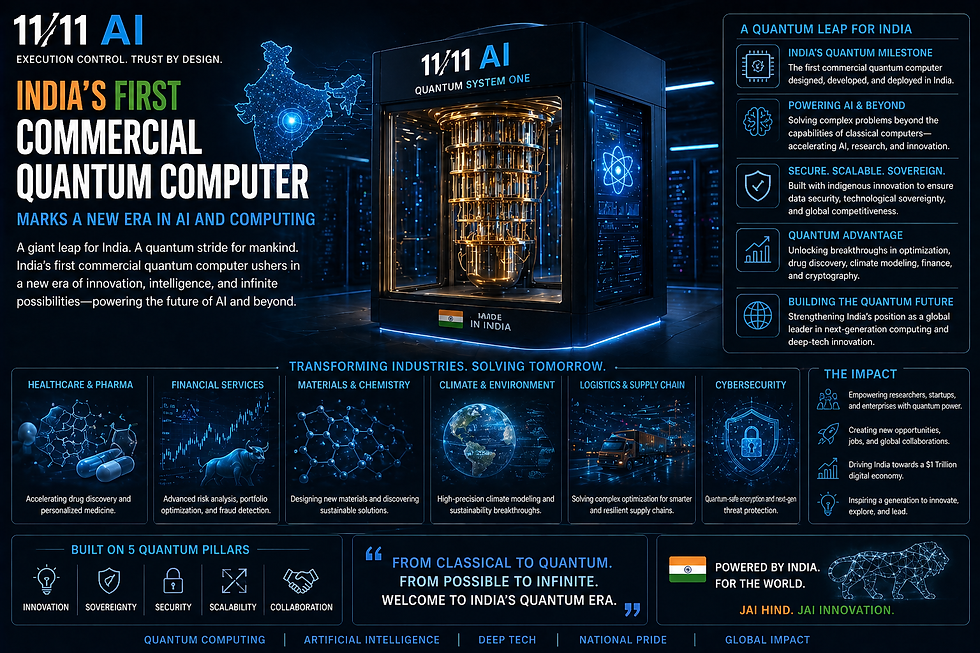
India is stepping into the future of technology with the deployment of its first commercial quantum computer at the Indian Institute of Information Technology (IIIT), Dharwad. This milestone is more than just a technological achievement; it signals India's growing role in the global quantum computing landscape, especially in areas where artificial intelligence (AI) and quantum computing intersect.
What Makes Quantum Computing Important for India
Quantum computing uses the principles of quantum mechanics to process information in ways that classical computers cannot. This technology promises to solve complex problems much faster, especially in fields like optimization, simulation and hybrid computing models that combine classical and quantum approaches.
For India, deploying a commercial quantum computer means:
Advancing research capabilities: Researchers at IIIT Dharwad and across the country can now explore new algorithms and applications that were previously out of reach.
Boosting AI development: Quantum computing can enhance AI by speeding up data processing and improving machine learning models.
Strengthening the tech ecosystem: This deployment encourages startups, industries, and academic institutions to collaborate on quantum technologies.
The Role of IIIT Dharwad and the National Centre for Excellence
IIIT Dharwad is hosting the National Centre for Excellence in Quantum AI & Computing. This center will serve as a hub for innovation, research and training in quantum computing and AI. It aims to:
Provide hands-on experience with quantum hardware and software.
Develop AI-driven quantum applications tailored to real-world problems.
Foster partnerships between academia, industry and government bodies.
This initiative will help build a skilled workforce ready to contribute to India’s quantum ambitions.
Practical Applications of Quantum Computing in AI
Quantum computing can transform AI in several ways:
Optimization problems: Quantum algorithms can find optimal solutions faster in logistics, finance, and supply chain management.
Simulation of complex systems: Quantum computers can simulate molecules and materials at the quantum level, aiding drug discovery and material science.
Hybrid computing models: Combining classical and quantum computing allows for more efficient processing, especially in machine learning tasks.
For example, a quantum-enhanced AI model could optimize traffic flow in smart cities or improve financial risk assessment with greater accuracy.
Challenges and Opportunities Ahead
While the deployment is a significant step, quantum computing still faces challenges:
Hardware limitations: Quantum computers require extremely low temperatures and are sensitive to noise.
Algorithm development: Creating practical quantum algorithms for AI is an ongoing research area.
Talent shortage: Skilled professionals in quantum computing are rare, making education and training crucial.
The National Centre for Excellence at IIIT Dharwad aims to address these challenges by providing resources and fostering collaboration.
What This Means for India’s Position Globally
By deploying its first commercial quantum computer, India joins a select group of countries investing heavily in quantum technology. This move:
Enhances India’s competitiveness in AI and quantum research.
Attracts global partnerships and investments.
Encourages innovation that can lead to new industries and job creation.
India’s focus on AI-driven quantum applications positions it well to contribute to solving complex problems in healthcare, energy, and beyond.
Looking Ahead: Building a Quantum Future
The arrival of the commercial quantum computer at IIIT Dharwad is just the beginning. To fully realize the potential of quantum computing, India will need to:
Expand infrastructure and access to quantum resources.
Support startups and companies working on quantum technologies.
Invest in education programs to train the next generation of quantum scientists and engineers.
This deployment sets a foundation for a vibrant quantum ecosystem that can drive technological progress and economic growth.


Comments