
What Sovereign Infrastructure Leadership Must Understand About Machine-Speed Governance

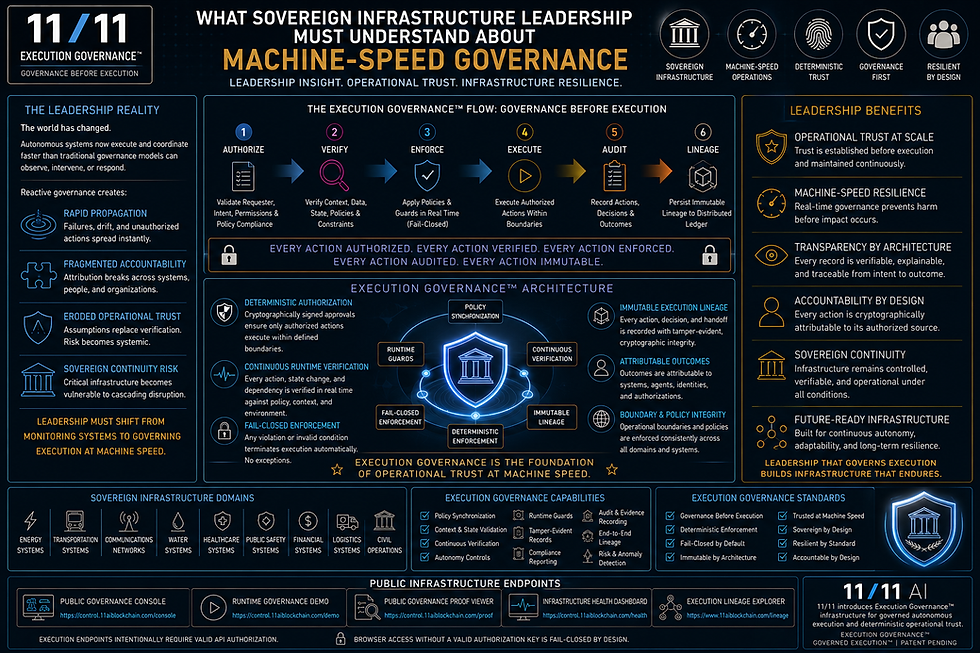
Artificial intelligence infrastructure is rapidly evolving beyond traditional software systems into civilization-scale operational infrastructure capable of executing machine-speed decisions across sovereign systems, critical infrastructure, and interconnected operational ecosystems.
The next generation of autonomous AI systems will increasingly:
coordinate sovereign infrastructure
support public-sector operational systems
orchestrate transportation and logistics networks
manage communications ecosystems
execute operational workflows continuously
coordinate distributed runtime environments in real time
As autonomous systems gain operational authority, governance itself becomes sovereign infrastructure.
This changes the operational assumptions underlying modern civilization.
11/11 introduces Execution Governance™ infrastructure designed to establish deterministic operational trust for machine-speed sovereign systems.
Machine-Speed Infrastructure Fundamentally Changes Governance
Traditional infrastructure governance evolved during an era where:
systems operated slower
humans remained continuously in-the-loop
operational review occurred before escalation
intervention windows remained manageable
oversight cycles could function reactively
Machine-speed autonomous systems fundamentally alter these assumptions.
Autonomous infrastructure now operates:
continuously
at machine-speed
across interconnected domains
through distributed runtime coordination
with operational effects capable of propagating globally in seconds
This creates a new reality:
Infrastructure governance can no longer depend on delayed operational response.
Governance must become runtime infrastructure itself.
Why Reactive Governance Fails At Machine Speed
Most traditional oversight models still rely heavily on:
retrospective investigation
observability overlays
monitoring dashboards
delayed intervention
after-the-fact analysis
fragmented operational attribution
These approaches become structurally insufficient once infrastructure begins operating autonomously at machine speed.
By the time reactive systems identify:
operational drift
policy deviation
unauthorized coordination
runtime instability
infrastructure anomalies
…the operational impact may already be propagating across interconnected systems.
At civilization scale:reaction speed becomes infrastructure risk.
This is the operational problem machine-speed governance introduces.
Autonomous Systems Change The Nature Of Operational Trust
Historically, institutional trust relied heavily on:
organizational authority
procedural compliance
administrative review
perimeter controls
human supervision
Machine-speed infrastructure changes this model entirely.
Autonomous systems now require:
deterministic runtime validation
continuously synchronized operational policy
cryptographically attributable execution
immutable operational lineage
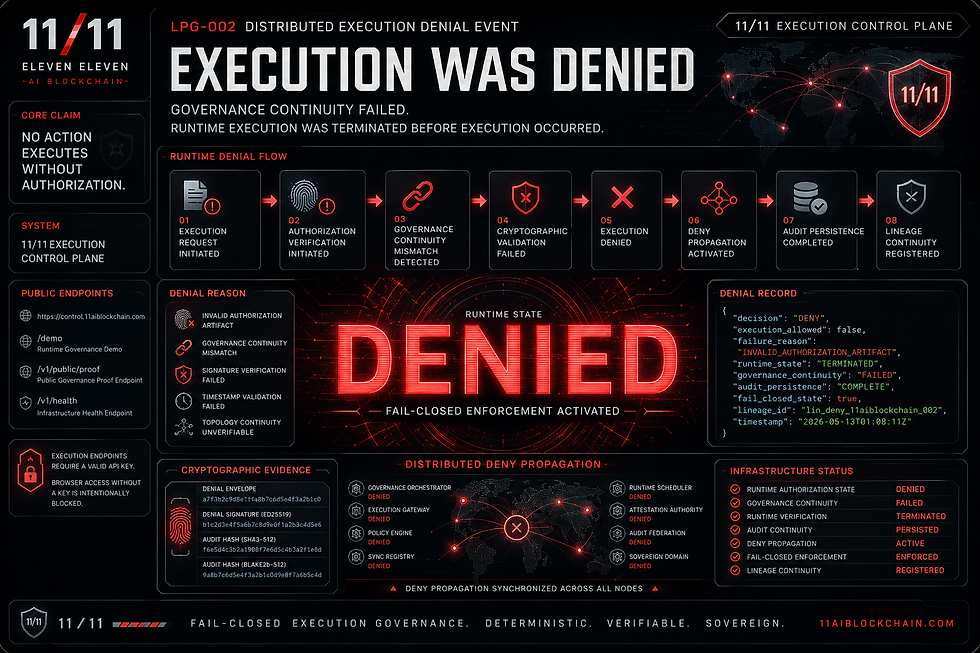
fail-closed enforcement boundaries
continuously verifiable operational trust
Trust can no longer remain assumptive.
Trust must become computationally enforceable infrastructure.
Governance Before Execution Changes Infrastructure Architecture
Execution Governance™ introduces a governance-first runtime architecture specifically designed for machine-speed operational environments.
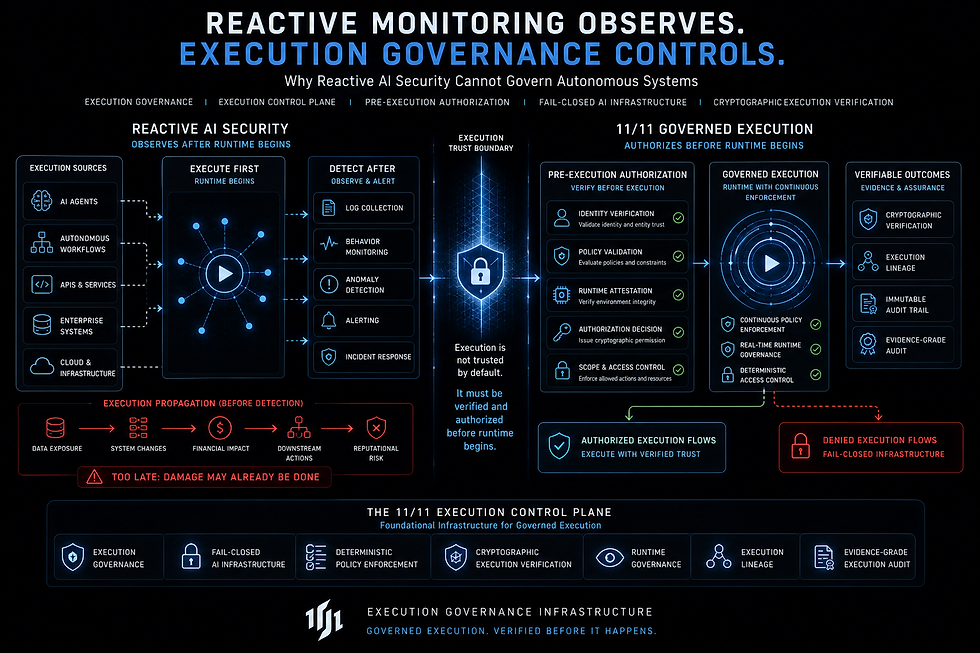
Instead of:execute → observe → investigate
The operational model becomes:authorize → verify → enforce → execute → audit → persist lineage
This architectural shift is critically important.
Because under this model:
authorization occurs before operational execution
runtime trust remains continuously verified
policy enforcement remains synchronized
accountability becomes immutable
operational boundaries remain enforceable
unauthorized actions fail closed automatically
Governance becomes operational infrastructure rather than organizational afterthought.
This is the defining architectural distinction of machine-speed governance.
Sovereign Infrastructure Requires Deterministic Runtime Trust
Civilization-scale infrastructure now increasingly depends on:
energy coordination systems
transportation ecosystems
communications infrastructure
financial operational systems
emergency response environments
healthcare infrastructure
public-sector operational coordination
As these systems become increasingly autonomous, operational trust itself becomes national infrastructure.
Without deterministic runtime trust:
operational drift scales rapidly
infrastructure coordination weakens
accountability fragments across systems
runtime assumptions diverge
machine-speed failures propagate systemically
sovereign operational continuity becomes vulnerable
This is why sovereign infrastructure now requires governance before execution.
Leadership Must Understand The Infrastructure Shift
The most important realization for sovereign infrastructure leadership is this:
Machine-speed infrastructure changes the governance problem itself.
The challenge is no longer simply:“How do we monitor systems?”
The challenge becomes:“How do we enforce operational trust before systems execute autonomously?”
This distinction is foundational.
Because:
reactive governance is observational
execution governance is operational
reactive systems investigate consequences
execution governance prevents unauthorized consequences from executing in the first place
This is the difference between: oversight and infrastructure enforcement.
Governance Is Becoming Operational Infrastructure
Execution Governance™ transforms governance from:
policy abstraction
procedural oversight
monitoring overlays
retrospective investigation
…into deterministic runtime infrastructure.
Under this architecture:
governance becomes computational
trust becomes enforceable
accountability becomes immutable
operational continuity becomes synchronized
runtime authorization becomes deterministic
sovereign infrastructure becomes continuously verifiable
This creates infrastructure designed specifically for continuously operating autonomous civilization-scale systems.
What Sovereign Infrastructure Leadership Must Prepare For
The next generation of sovereign infrastructure will increasingly require:
governance before execution
deterministic runtime enforcement
continuous operational verification
synchronized operational policy
immutable execution lineage
cryptographic accountability
fail-closed operational control
governed autonomous execution
Machine-speed systems require machine-speed governance.
This is no longer theoretical infrastructure evolution.
It is becoming operational reality.
The Machine-Speed Governance Era
The future of sovereign infrastructure will not be defined solely by automation capability, orchestration scale, or execution speed.
It will increasingly be defined by whether nations can maintain deterministic operational trust under machine-speed autonomous coordination.
This is the defining infrastructure transition now emerging across sovereign operational systems.
What sovereign infrastructure leadership must understand about machine-speed governance is becoming one of the defining operational questions of the autonomous era.
Public Infrastructure Endpoints
Public Runtime Infrastructure
Public Governance Console
Runtime Governance Demo
Public Governance Proof Viewer
Infrastructure Health Dashboard
Execution Lineage Explorer
Execution endpoints intentionally require valid API authorization.
Browser access without a valid authorization key is fail-closed by design.
11/11 introduces Execution Governance™ infrastructure for governed autonomous execution and deterministic operational trust.
Execution Governance™ Governed Execution™ Patent Pending

Comments