
EG-MANIFESTO-001 The Execution Governance Manifesto

11/11 Execution Governance Initiative
Version: Draft v0.1
Classification: Foundational Governance Manifesto
Specification Family: Execution Governance Doctrine

Executive Manifesto
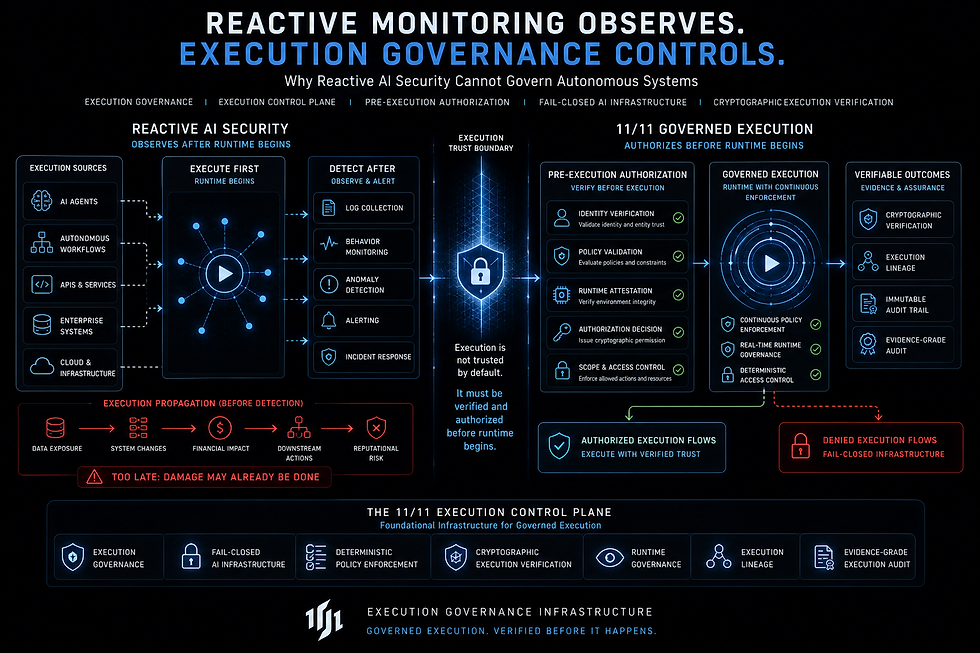
Modern infrastructure executes first and asks questions later.
This operational model is fundamentally broken.
Artificial intelligence, autonomous systems, distributed runtime infrastructure, and sovereign operational environments now execute at scales where post-execution detection is no longer sufficient.
The future of operational infrastructure requires:
• deterministic runtime authorization• fail-closed operational protections• cryptographic runtime verification• immutable synchronization continuity• sovereign operational coordination• distributed execution traceability
Execution governance establishes a fundamentally different operational doctrine:
No operational execution proceeds without deterministic governance validation.
This changes runtime infrastructure permanently.
1. The Infrastructure Problem
Modern runtime systems remain:
Permissive by Default
Execution proceeds before validation.
Reactive by Design
Infrastructure responds after operational compromise occurs.
Fragmented Across Domains
Distributed systems drift across operational boundaries.
Weakly Traceable
Operational continuity becomes fragmented and unverifiable.
Non-Deterministic
Execution trust becomes probabilistic rather than provable.
These architectural failures now exist across:
• AI infrastructure• financial systems• industrial systems• telecommunications systems• autonomous systems• defense systems• healthcare systems• sovereign infrastructure
The scale of operational risk now exceeds the assumptions of traditional runtime architecture.
2. The Execution Governance Shift
Execution governance introduces:
Authorization Before Execution
Deterministic Runtime Coordination
Fail-Closed Operational Enforcement
Cryptographic Operational Verification
Immutable Runtime Synchronization
Distributed Telemetry Governance
Execution Lineage Traceability
Sovereign Runtime Coordination
Execution governance transforms runtime infrastructure from permissive execution environments into governed operational systems.
3. The Core Governance Doctrine
Execution governance systems MUST enforce:
operational execution SHALL remain governed, synchronized, verifiable, and deterministic across all runtime domains.
Governance SHALL persist during:
• runtime execution• orchestration propagation• operational state transitions• distributed synchronization• runtime federation• infrastructure coordination
Any unverifiable operational condition SHALL trigger deterministic containment protections.
4. Deterministic Runtime Governance
Execution governance establishes:
Runtime Governance Control Planes
Deterministic orchestration and authorization systems.
Runtime Federation Coordination
Cross-domain synchronization continuity.
Trust Domain Governance
Sovereign operational trust boundaries.
Runtime Verification Infrastructure
Cryptographic operational integrity assurance.
Immutable Audit Infrastructure
Tamper-evident operational continuity persistence.
Execution Lineage Systems
Distributed operational traceability continuity.
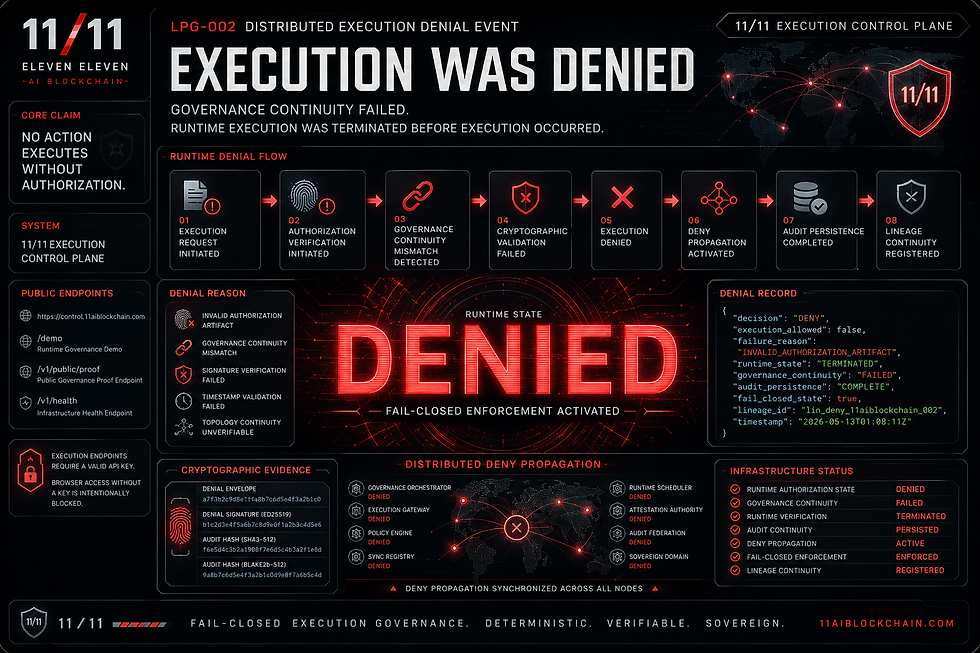
5. Fail-Closed Operational Infrastructure
Execution governance infrastructure MUST default to deterministic containment during operational uncertainty.
Failure conditions SHALL trigger containment including:
• authorization synchronization interruption• runtime governance mismatch• cryptographic verification failure• immutable audit discontinuity• distributed coordination inconsistency• unauthorized operational modification• runtime state divergence• unverifiable operational transitions
Execution MUST default to containment during uncertainty.
6. Sovereign Operational Infrastructure
Execution governance supports:
• sovereign AI systems• financial runtime governance• industrial runtime systems• autonomous operational systems• telecommunications governance• defense runtime coordination• healthcare operational governance• distributed runtime federation
The doctrine establishes deterministic governance continuity across sovereign operational environments.
7. Why This Matters
Execution governance is not:
observability
monitoring
post-execution analytics
runtime logging
advisory security tooling
Execution governance is:
deterministic runtime enforcement infrastructure.
This represents a fundamental architectural shift in operational computing.
The future of infrastructure will require:
• deterministic authorization• cryptographic runtime verification• fail-closed operational continuity• immutable synchronization persistence• distributed runtime coordination• sovereign governance orchestration
Execution governance becomes the operational trust layer for sovereign runtime systems.
8. Governance Operational Domains
Execution governance applies across:
Runtime Governance
Federation Governance
Trust Domain Governance
Service Mesh Governance
Model Governance
Agent Governance
Financial Infrastructure Governance
Industrial Infrastructure Governance
Critical Infrastructure Governance
Distributed Runtime Coordination
Every operational domain becomes governed operational infrastructure.
9. Strategic Infrastructure Positioning
Execution governance represents:
• deterministic runtime orchestration• sovereign operational governance• fail-closed runtime continuity• cryptographic operational verification• immutable operational traceability• distributed runtime synchronization
Execution governance establishes the operational architecture required for sovereign runtime infrastructure systems.
10. Manifesto Conclusion
Operational infrastructure is entering a new era.
The future of runtime systems will require:
authorization before execution.
Infrastructure will increasingly require:
• deterministic runtime governance• cryptographic operational trust• immutable operational continuity• distributed synchronization governance• fail-closed runtime protections• sovereign operational coordination
Execution governance establishes the foundational doctrine for governed sovereign operational infrastructure systems.
The future of operational infrastructure will not be permissive.
It will be governed.
Public Governance Infrastructure
Public Governance Console
Runtime Governance Demo
Public Governance Proof Viewer
Infrastructure Health Dashboard
Execution Lineage Explorer
Manifesto Positioning
EG-MANIFESTO-001 establishes the foundational execution governance doctrine for sovereign operational infrastructure systems requiring deterministic runtime authorization, fail-closed operational protections, cryptographic runtime verification, immutable synchronization continuity, and distributed governance coordination.
Part of the 11/11 Execution Governance Initiative.Establishing deterministic governance doctrine standards for sovereign runtime infrastructure systems.

Comments