
Multi-Agent AI Systems Require Execution Governance Coordination

Artificial intelligence infrastructure is rapidly evolving beyond isolated AI systems.
The next operational phase of artificial intelligence is increasingly defined by:
multi-agent orchestration
AI-to-AI coordination
autonomous workflow chains
distributed agent ecosystems
machine-speed operational collaboration
continuously interacting autonomous systems
As AI systems begin coordinating actions across distributed environments, governance becomes exponentially more important.
11/11 introduces Execution Governance™ infrastructure designed to establish deterministic coordination and operational trust across multi-agent AI systems.
The Rise of Multi-Agent Infrastructure
Modern AI architectures are rapidly moving toward environments where:
agents delegate tasks to other agents
autonomous systems coordinate operational workflows
multiple AI systems interact continuously
execution chains span distributed infrastructure
orchestration occurs at machine speed
decisions propagate autonomously between systems
This creates entirely new operational governance challenges.
Without deterministic governance coordination:
operational trust becomes fragmented
execution attribution becomes difficult
policy consistency becomes unreliable
runtime drift may propagate across systems
unauthorized actions may chain automatically
accountability becomes difficult to preserve
Multi-agent systems require coordinated governance before execution occurs.
The Problem With Reactive Coordination
Many current AI systems still rely heavily on:
observability
monitoring
telemetry
post-event investigation
reactive operational controls
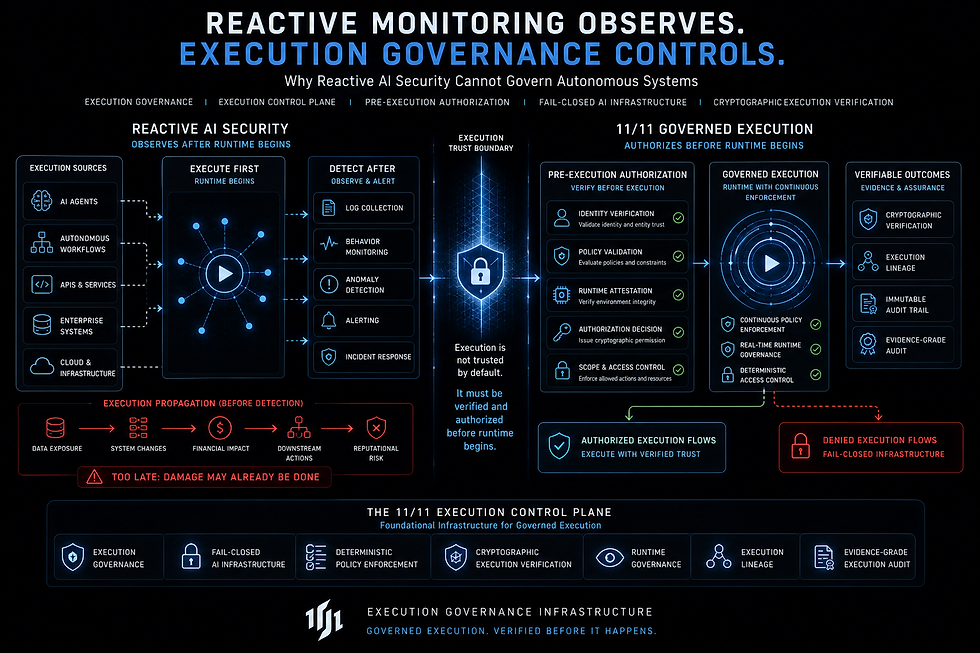
These systems primarily evaluate execution after autonomous activity has already propagated across environments.
Reactive governance becomes increasingly insufficient in multi-agent systems operating at machine speed.
Autonomous AI coordination requires:
deterministic authorization
runtime verification
policy synchronization
attributable execution chains
continuous operational validation
verifiable trust boundaries
before execution occurs.
Governance Before Execution
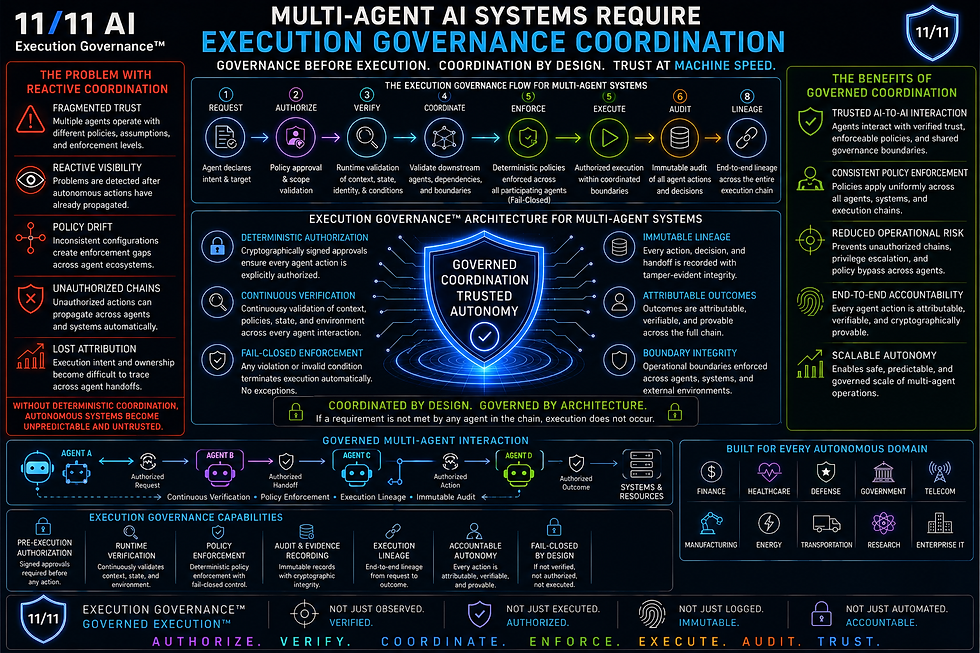
Execution Governance™ introduces a governance-first runtime architecture for multi-agent systems.
Instead of:execute → observe → investigate
The operational flow becomes:request → authorize → verify → coordinate → enforce → execute → audit → persist lineage
Under this architecture:
execution intent becomes attributable
authorization becomes verifiable
runtime verification becomes continuous
agent coordination becomes governed
operational boundaries remain enforced
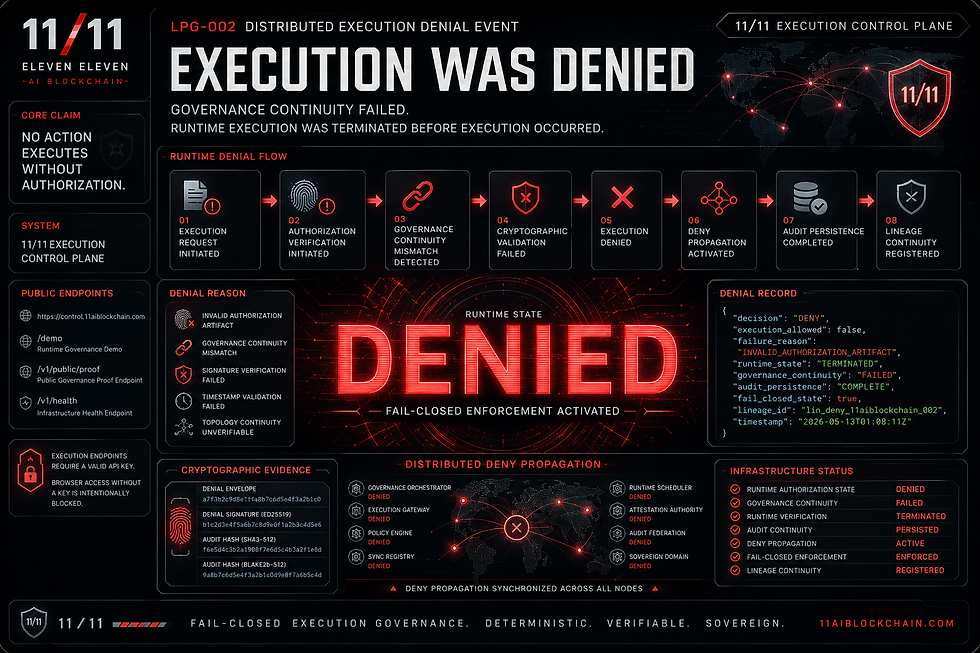
unauthorized activity fails closed
lineage preserves distributed accountability
AI-to-AI execution becomes governed infrastructure.
Multi-Agent Systems Require Deterministic Coordination
Deterministic coordination ensures:
policies apply consistently across agents
execution boundaries remain synchronized
authorization requirements stay enforceable
runtime trust remains verifiable
operational accountability persists end-to-end
distributed execution chains remain attributable
Execution Governance™ transforms coordination from orchestration assumption into enforceable runtime infrastructure.
Governance as Coordination Infrastructure
Execution Governance™ transforms governance from:
passive observation
monitoring overlays
retrospective analysis
advisory operational policy
…into active coordination infrastructure for autonomous systems.
Under this architecture:
authorization becomes enforceable
verification becomes continuous
policy enforcement becomes deterministic
agent coordination becomes attributable
operational trust becomes verifiable
distributed autonomy becomes governable
This creates infrastructure designed specifically for machine-speed multi-agent ecosystems.
The Future Multi-Agent Runtime Stack
The next generation of AI infrastructure will increasingly require:
governance before execution
deterministic multi-agent coordination
runtime verification
synchronized policy enforcement
fail-closed operational control
immutable execution lineage
cryptographic accountability
governed AI-to-AI execution
Execution Governance becomes the coordination layer between autonomous intelligence systems and distributed operational execution.
The Multi-Agent Infrastructure Era
The future of artificial intelligence infrastructure will not be defined solely by individual models.
It will increasingly be defined by whether autonomous systems can coordinate safely, accountably, and deterministically at machine speed.
Multi-agent AI systems require Execution Governance coordination.
Public Infrastructure Endpoints
Public Runtime Infrastructure
Public Governance Console
Runtime Governance Demo
Public Governance Proof Viewer
Infrastructure Health Dashboard
Execution Lineage Explorer
Execution endpoints intentionally require valid API authorization.
11/11 introduces Execution Governance™ infrastructure for governed AI-to-AI execution and deterministic operational trust.
Execution Governance™ Governed Execution™ Patent Pending

Comments