
Observability Is Not Governance


Modern infrastructure has become highly observable.
Logs.Metrics.Telemetry.Tracing.Behavioral analytics.Detection pipelines.
But observability is not governance.
Observability explains:what happened after execution occurs.
Execution governance determines:what is allowed before runtime begins.
This distinction becomes foundational for the future of AI infrastructure.
SECTION 1 — THE LIMITATIONS OF OBSERVABILITY
Traditional infrastructure evolved around:visibility.
Organizations invested heavily in:
SIEM systems
telemetry pipelines
runtime monitoring
anomaly detection
behavioral analytics
incident response platforms
These systems improved operational awareness.
But they share a common limitation:
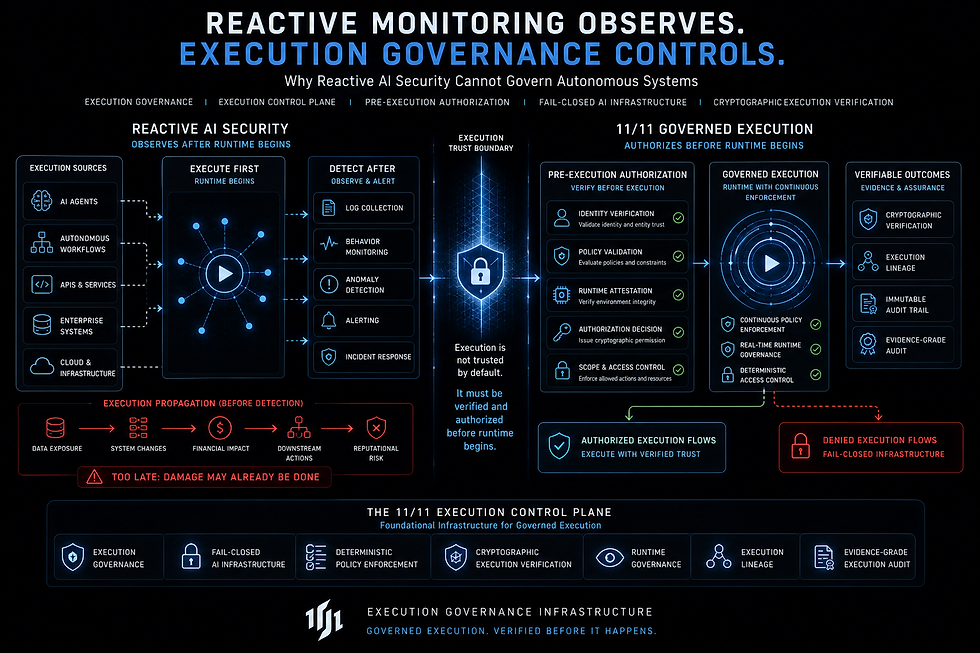
they observe execution after it already occurs.
This creates a reactive trust model.
Execution itself remains implicitly trusted.
SECTION 2 — REACTIVE SECURITY CANNOT SCALE
Reactive systems operate through:
detection
alerting
investigation
response
containment
This worked when:
systems were slower
automation was limited
human oversight remained central
AI changes this entirely.
Modern AI systems can:
autonomously invoke APIs
trigger infrastructure operations
orchestrate workflows
execute financial actions
access regulated systems
coordinate multi-agent execution
at machine speed.
The gap between: execution and detection
becomes operationally unacceptable.
SECTION 3 — GOVERNANCE OCCURS BEFORE EXECUTION
11/11 Execution Control Plane introduces a different model.
Instead of:execute → observe
The architecture becomes:verify → authorize → execute → prove
Execution governance operates:before runtime execution begins.
This changes infrastructure behavior fundamentally.
Every action must become:
policy validated
cryptographically authorized
environment verified
execution scoped
runtime governed
before execution is permitted.
SECTION 4 — EXECUTION AUTHORITY
Observability platforms measure behavior.
Execution governance establishes authority.
This distinction is critical.
11/11 Authorization Fabric determines:
whether execution is permitted
which policies apply
what environment is trusted
what execution scope is allowed
whether runtime continuity remains valid
This transforms infrastructure from:passive monitoring
to:deterministic runtime control.
SECTION 5 — FA
IL-OPEN VS FAIL-CLOSED
Most observability systems operate:fail-open.
If telemetry pipelines fail:execution continues.
If monitoring degrades:execution still proceeds.
If detection becomes unavailable:trust assumptions remain unchanged.
11/11 Runtime Governance Layer reverses this model.
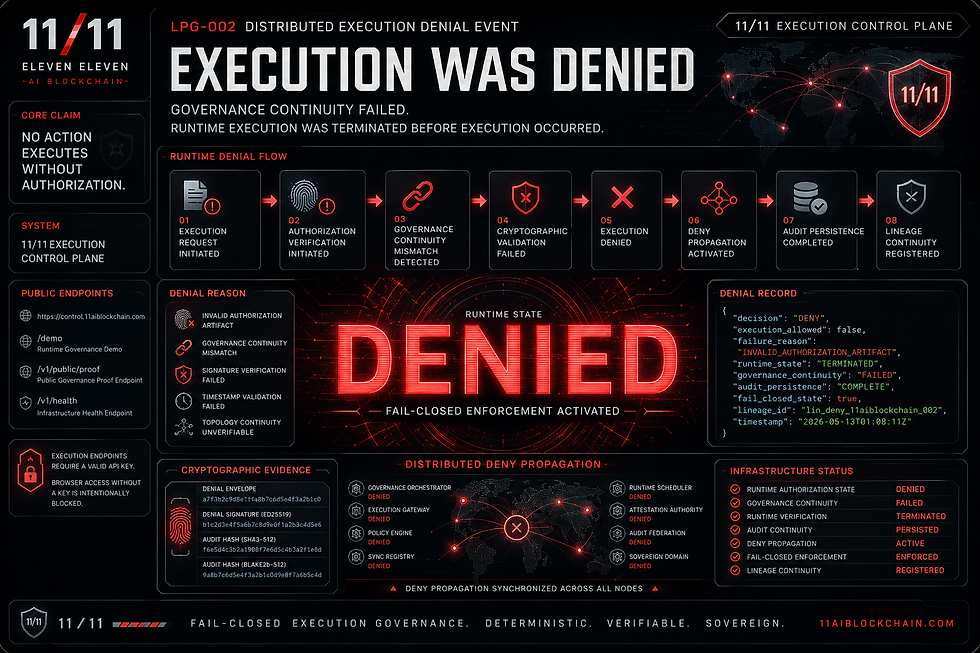
The architecture operates:fail-closed.
If authorization fails:execution stops.
If verification fails:execution stops.
If runtime governance becomes invalid:execution stops.
Governance becomes part of runtime infrastructure itself.
SECTION 6 — EXECUTION GOVERNANCE AS INFRASTRUCTURE
The future of AI infrastructure requires:governed execution.
Not simply:observable execution.
This creates a new infrastructure category:
execution governance.
Execution governance introduces:
runtime trust boundaries
authorization artifacts
cryptographic enforcement
execution lineage
deterministic policy validation
evidence-grade audit persistence
The infrastructure itself becomes responsible for trust enforcement.
SECTION 7 — THE SHIFT FROM VISIBILITY TO CONTROL
Infrastructure historically optimized for:visibility.
Future infrastructure must optimize for:control.
This is the transition from:monitoring systems
to:governance systems.
The distinction becomes increasingly important for:
enterprise AI
autonomous systems
regulated compute
financial infrastructure
defense environments
critical infrastructure systems
Execution authorization becomes mandatory infrastructure logic.
SECTION 8 — THE NEW TRUST MODEL
11/11 Runtime Trust Architecture establishes:execution as the trust boundary.
Trust is no longer assumed because:a process starts.
Trust must now be continuously verified:before and during execution.
This creates:
governed runtime environments
deterministic authorization systems
cryptographic execution continuity
enforceable runtime trust
Execution becomes:verifiable infrastructure.
CLOSING
Observability explains:what happened.
Execution governance determines:what is allowed to happen.
That distinction defines the next generation of AI infrastructure.
Reactive AI security cannot indefinitely scale with autonomous execution systems.
Execution itself must become governed.
11/11 is building the execution governance layer for AI infrastructure.

Comments