
Why Operational Trust Must Exist Before Execution
- 11/11 AI

- May 26
- 3 min read
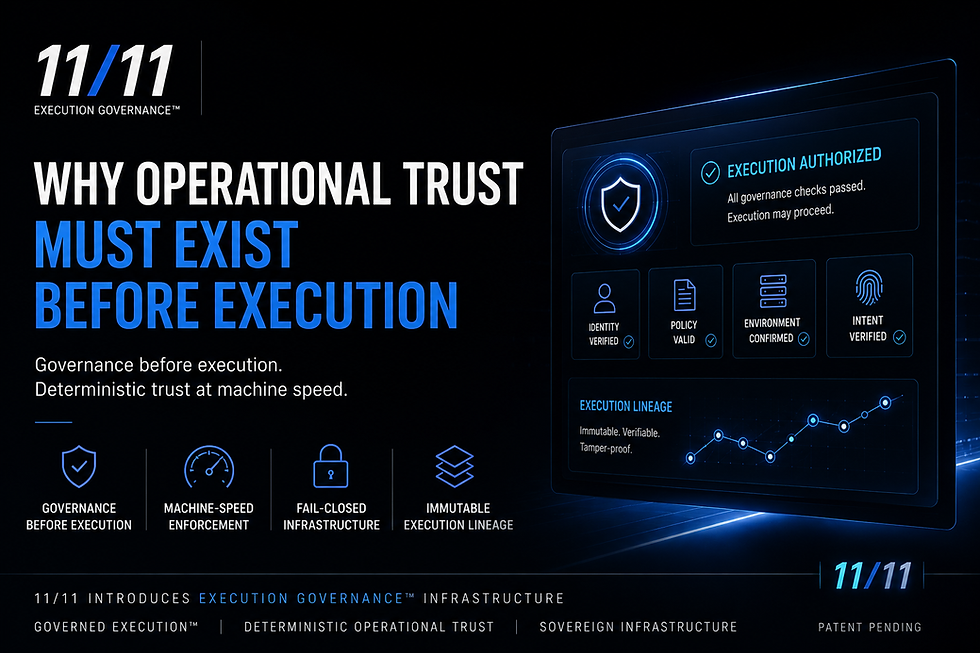
Operational trust cannot be established after an autonomous system has already acted.
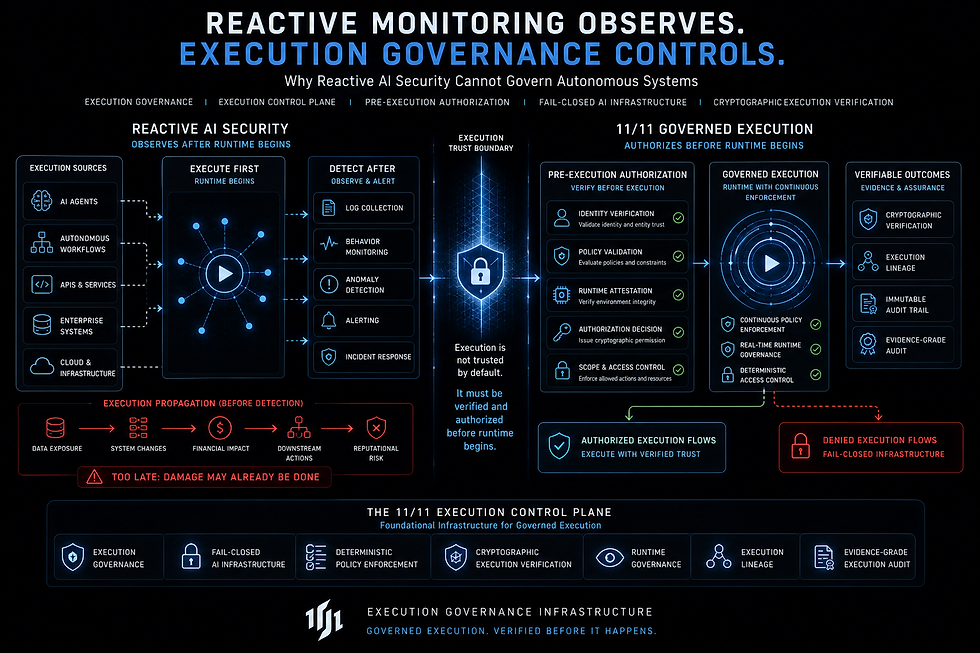
In traditional systems, trust was often reconstructed after the fact. Logs were reviewed. Events were audited. Reports were generated. Human teams investigated what happened and determined whether the system behaved correctly.
That model is no longer sufficient.
Autonomous infrastructure moves too quickly for trust to remain reactive.
When software agents, AI systems, orchestration layers, financial rails, defense workflows, public platforms, and machine-speed infrastructure execute actions automatically, oversight must move into the execution path itself.
The question is no longer:
What happened?
The question is:
Was this action governed before it happened?
That is the core shift behind Execution Governance™.
Operational trust must be established before execution because execution itself creates risk.
A system may be authenticated and still act outside policy.
A model may be approved and still trigger an unauthorized workflow.
A user may be valid and still request an action the environment should not allow.
A runtime may be online and still lack the required governance proof.
This is why trust cannot depend on identity alone, security alone, logging alone, or observability alone.
Those systems are important, but they do not answer the most important operational question:
Should this execution be allowed right now?
Governed execution answers that question before action occurs.
It requires the infrastructure to evaluate authorization, policy, identity, runtime context, environmental conditions, and execution intent before permitting the action to proceed.
If the required proof is valid, execution may continue.
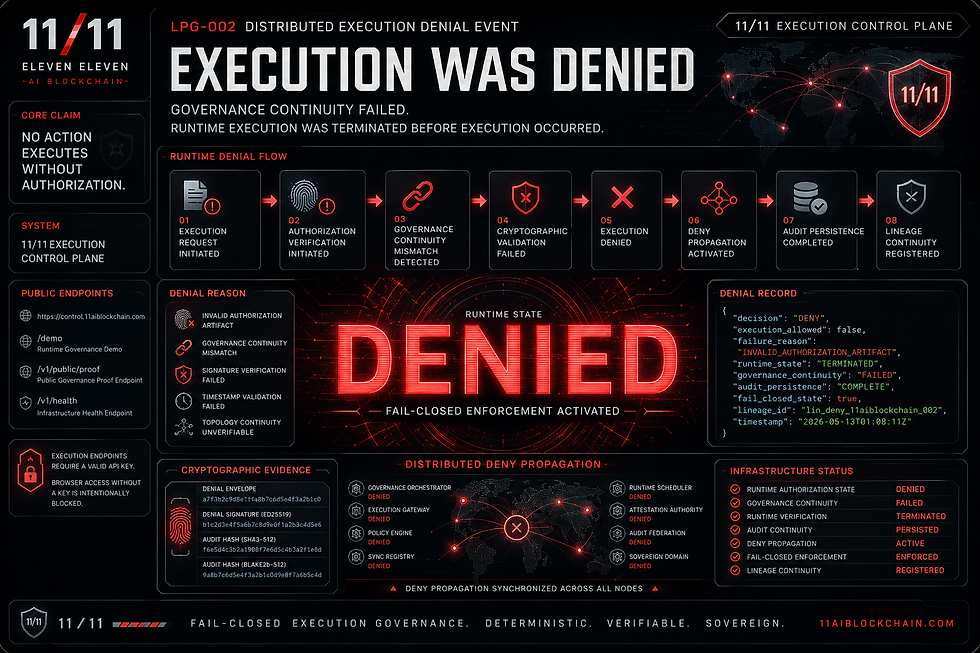
If the required proof is missing, expired, inconsistent, or unauthorized, execution must be denied.
This is fail-closed infrastructure.
No valid governance proof means no execution.
That principle becomes critical in sovereign and institutional environments.
Public infrastructure cannot rely on after-action review when autonomous systems influence services, records, payments, infrastructure access, benefits, logistics, defense workflows, healthcare operations, or regulated decision paths.
By the time a human sees a dashboard, the action may already be complete.
By the time a log is reviewed, the failure may already have propagated.
By the time an incident is escalated, the system may already have produced operational consequences.
Machine-speed systems require machine-speed governance.
Operational trust must therefore become a runtime property.
It must be enforced at the moment of execution.
It must be cryptographically provable.
It must be policy-bound.
It must be traceable through lineage.
It must be deterministic.
It must fail closed by design.
This is the infrastructure boundary that separates governed autonomous execution from uncontrolled automation.
Execution Governance™ introduces that boundary.
It creates a governed control layer where actions are not merely observed, but authorized.
Not merely logged, but verified.
Not merely reviewed, but admitted or denied before execution.
Not merely trusted by assumption, but proven through runtime governance.
This matters because autonomous infrastructure will increasingly operate across institutional systems that cannot afford ambiguity.
Trust must be established before the action.
Governance must exist before the runtime.
Authorization must exist before execution.
That is how operational trust becomes infrastructure.
That is the role of governed execution.
That is the standard 11/11 is defining.
Public Infrastructure Endpoints
Public Runtime Infrastructure
Public Governance Console
Runtime Governance Demo
Public Governance Proof Viewer
Infrastructure Health Dashboard
Execution Lineage Explorer
Execution endpoints intentionally require valid API authorization.
Browser access without a valid authorization key is fail-closed by design.
11/11 introduces Execution Governance™ infrastructure for governed autonomous execution and deterministic operational trust.
Execution Governance™
Governed Execution™
Patent Pending

Comments