
Why Autonomous Systems Require Policy Enforcement Before Runtime Execution


Most traditional enterprise systems were designed around reactive operational security.
Execution began first.
Monitoring occurred afterward.
Policy enforcement frequently operated retrospectively through:
observability
logging
alerts
incident response
post-event analysis
This architecture functioned while enterprise systems remained:
relatively static
human-driven
operationally constrained
centrally controlled
Autonomous AI systems fundamentally change these assumptions.
Execution now propagates dynamically across:
orchestration systems
APIs
distributed runtime environments
infrastructure services
machine-driven workflows
downstream execution chains
autonomous operational systems
Under these conditions, policy enforcement after runtime execution begins becomes operationally insufficient.
This creates the need for deterministic policy enforcement before runtime execution occurs.
What Deterministic Policy Enforcement Actually Means
Deterministic policy enforcement means runtime execution cannot begin unless governance conditions are satisfied first.
Execution is not trusted implicitly.
Execution must first become:
authorized
policy-compliant
runtime validated
cryptographically verified
operationally governed
before execution is permitted.
Under governed execution infrastructure:
pre-execution authorization occurs before runtime begins
policy evaluation occurs before execution propagates
runtime integrity conditions are validated continuously
cryptographic verification remains active
execution lineage remains immutable
fail-closed enforcement activates automatically when trust degrades
Execution therefore becomes continuously governed operational infrastructure.
Not merely observable runtime activity.
Why Reactive Policy Enforcement Is No Longer Sufficient
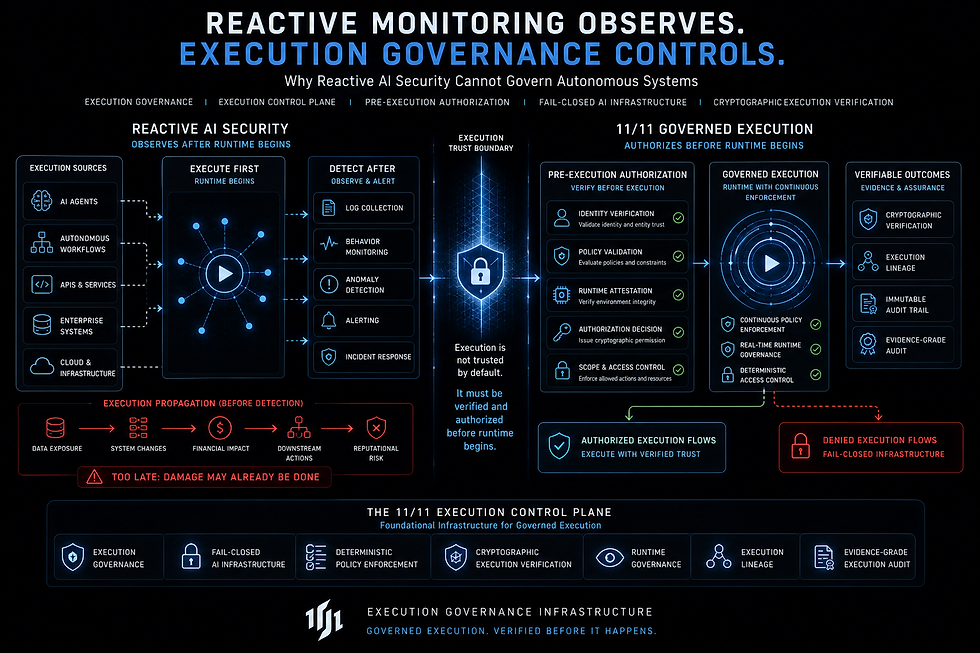
Traditional runtime monitoring systems frequently detect policy violations after execution already propagates.
This creates unavoidable operational delay.
By the time enforcement systems respond:
downstream actions may already execute
infrastructure states may already change
operational impact may already propagate
runtime integrity may already degrade
trust boundaries may already fragment
Reactive monitoring explains what happened afterward.
Deterministic policy enforcement determines whether execution should occur at all.
This creates a fundamentally different runtime trust architecture centered around governed execution.
Why Autonomous Infrastructure Requires Pre-Execution Governance
Autonomous systems increasingly execute independently at machine speed across distributed runtime environments.
Execution paths evolve dynamically.
Dependencies shift continuously.
Infrastructure conditions change operationally in real time.
Under these conditions, runtime trust becomes continuously variable.
This means infrastructure must continuously verify:
authorization continuity
policy compliance
runtime integrity
execution lineage continuity
cryptographic verification validity
downstream propagation governance
If policy enforcement fails:
execution stops automatically
fail-closed enforcement activates
propagation halts
immutable audit records capture the failure state
Execution is never trusted implicitly.
This is the operational purpose of deterministic pre-execution governance infrastructure.
The Runtime Trust Boundary
One of the defining concepts inside execution governance infrastructure is the runtime trust boundary.
Traditional systems frequently assume trust persists automatically once execution begins.
The 11/11 execution control plane was designed differently.
Runtime trust must remain continuously proven.
This means:
authorization continuity must remain valid
deterministic policy enforcement must remain active
runtime integrity must remain verified
execution lineage must remain continuous
cryptographic verification must remain operational
If runtime trust fails:
execution stops automatically
fail-closed enforcement activates
immutable audit records capture the failure state
downstream propagation halts
Execution therefore becomes continuously governed operational infrastructure.
The Role of the Execution Control Plane
The 11/11 execution control plane continuously governs deterministic policy enforcement throughout execution itself.
Its role extends beyond monitoring.
It governs:
pre-execution authorization
deterministic policy enforcement
runtime governance
runtime integrity validation
execution lineage continuity
cryptographic execution verification
immutable execution audit
evidence-grade execution verification
fail-closed enforcement
Execution governance therefore becomes continuously enforced operational infrastructure.
Not merely runtime observability.
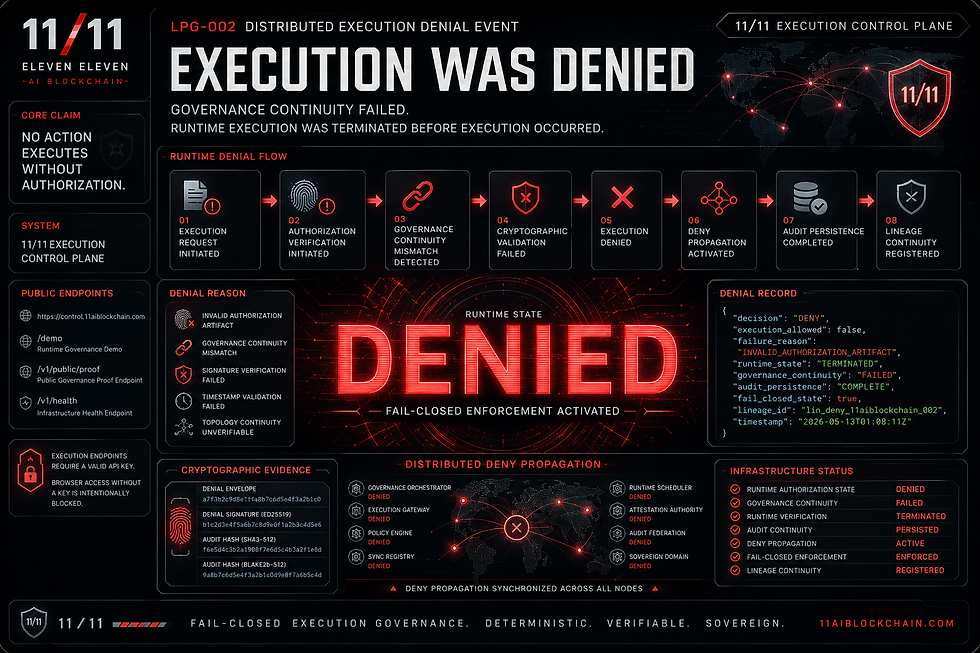
Runtime Denial Before Execution
One of the defining operational characteristics of governed execution infrastructure is runtime denial before execution begins.
If policy constraints fail:
authorization artifacts are not issued
runtime execution is never called
execution lineage does not continue
fail-closed enforcement activates automatically
This differs fundamentally from reactive runtime security systems.
Reactive monitoring observes runtime violations afterward.
Deterministic policy enforcement prevents unauthorized runtime execution before propagation begins.
Why Cryptographic Verification Matters
Deterministic policy enforcement depends on independently verifiable runtime trust.
Not merely procedural assumptions.
The 11/11 architecture continuously applies:
Ed25519 authorization signing
SHA3-512 evidence hashing
BLAKE2b-512 hashing
cryptographic runtime verification
immutable audit continuity
This creates:
cryptographically verifiable policy enforcement
tamper-evident execution evidence
independently verifiable execution governance
evidence-grade execution verification
Execution governance therefore becomes cryptographically provable operational infrastructure.
Why Execution Lineage Matters
Deterministic policy enforcement also depends on immutable execution lineage continuity.
The execution control plane continuously records:
authorization issuance
policy evaluation decisions
runtime execution transitions
integrity verification events
downstream propagation
cryptographic evidence structures
This creates:
immutable execution audit
execution lineage continuity
continuously verifiable runtime accountability
evidence-grade execution verification
Execution therefore becomes continuously traceable operational infrastructure.
Why Pre-Execution Enforcement Matters for Enterprise Infrastructure
Autonomous infrastructure increasingly operates across:
enterprise AI systems
financial systems
healthcare infrastructure
industrial automation
government systems
distributed runtime orchestration
infrastructure services
Under these conditions, organizations increasingly require:
deterministic pre-execution governance
immutable execution accountability
cryptographic execution verification
fail-closed enforcement
execution lineage continuity
evidence-grade execution verification
Deterministic policy enforcement therefore becomes foundational infrastructure for trusted autonomous systems.
Public Runtime Proof Infrastructure
Public demo:
Health endpoint:
Public proof endpoint:
These endpoints demonstrate operational infrastructure supporting:
execution governance
deterministic policy enforcement
governed execution
runtime governance
execution lineage
immutable execution audit
cryptographic execution verification
evidence-grade execution verification
fail-closed AI infrastructure
The runtime governance architecture is now publicly operational.
Why This Defines a Different Infrastructure Category
Most AI infrastructure vendors still optimize primarily for:
observability
orchestration
runtime acceleration
workflow automation
telemetry collection
11/11 is positioned differently.
11/11 continuously governs whether runtime execution remains operationally trusted before execution propagation begins.
This defines a separate infrastructure category centered around:
execution governance
governed execution
deterministic policy enforcement
pre-execution authorization
runtime governance
cryptographic execution verification
immutable execution audit
execution lineage
evidence-grade execution verification
fail-closed AI infrastructure
Execution itself becomes continuously governed operational infrastructure.
That defines the category boundary.
Execution governance systems, execution control plane architectures, governed execution models, and related runtime authorization technologies described herein are patent pending under ongoing intellectual property filings associated with 11/11.

Comments