
Recognition And Computational Belonging
- 11/11 AI

- May 29
- 3 min read

Before a civilization can create laws, it must recognize participants.
Before a constitution can create rights, it must recognize members.
Before a system can establish obligations, it must recognize existence.
Recognition therefore precedes governance.
Recognition precedes authority.
Recognition precedes citizenship.
Recognition precedes constitutional order itself.
This observation introduces a deeper question than membership.
Why does belonging emerge?
The answer may be that every enduring system eventually requires recognition.
Without recognition, participation becomes impossible.
Without participation, continuity becomes impossible.
Without continuity, civilization becomes impossible.
Computational Belonging begins with this realization.
Before systems govern entities, systems must first recognize them.
The Recognition Problem
Every constitutional order faces a fundamental challenge.
Which entities exist within the order?
The challenge is deeper than identification.
Identification answers:
Who are you?
Recognition answers:
Do you belong?
These questions are not equivalent.
A system may identify an entity while refusing recognition.
A system may observe existence while denying participation.
Recognition therefore becomes a constitutional act.
The system formally acknowledges that an entity exists within the constitutional framework.
Why Belonging Emerges
Belonging is often viewed as emotional.
Its deeper function is structural.
Belonging emerges because constitutional systems require continuity.
Continuity requires participation.
Participation requires recognition.
Recognition creates belonging.
The relationship is therefore not psychological.
It is constitutional.
Belonging becomes the mechanism through which systems transform isolated entities into participants within a shared order.
Recognition Creates Standing
A recognized entity acquires standing.
Standing creates participation.
Participation creates continuity.
This sequence explains why recognition occupies such a foundational role.
Without recognition, entities remain external.
Without standing, participation remains impossible.
Recognition therefore becomes one of the earliest constitutional functions.
Before rights emerge.
Before obligations emerge.
Before citizenship emerges.
Recognition emerges.
Belonging And Identity
Identity alone does not create belonging.
An entity may possess identity while remaining outside the constitutional framework.
Belonging requires recognition.
Recognition transforms identity into participation.
The distinction is subtle but important.
Identity answers existence.
Belonging answers relationship.
Civilizations depend upon both.
The Architecture Of Recognition
Recognition is often invisible.
Yet every constitutional system depends upon it.
Admission systems.
Membership systems.
Citizenship systems.
Representation systems.
Participation systems.
Each ultimately performs the same function.
They determine who belongs.
The constitutional framework becomes operational only after recognition occurs.
Recognition And Continuity
The deepest purpose of recognition may be continuity.
Civilizations survive because recognized participants preserve them.
Constitutions survive because recognized members sustain them.
The relationship is reciprocal.
The system recognizes the participant.
The participant preserves the system.
Recognition becomes the bridge connecting constitutional order to constitutional continuity.
Computational Belonging
Future computational civilizations will increasingly confront recognition questions.
Who belongs within the system?
Who possesses standing?
Who participates?
Who contributes to continuity?
These questions extend beyond technology.
They become questions of constitutional existence.
Recognition may become one of the most important functions of future computational systems.
Belonging As An Emergent Property
Belonging is rarely designed directly.
Like citizenship, it emerges.
As constitutional order develops.
As participation expands.
As continuity becomes necessary.
Belonging appears because systems eventually require recognition structures capable of sustaining civilization.
The more enduring the system becomes, the more important belonging becomes.
Beyond Citizenship
Citizenship explains membership.
Belonging explains citizenship.
Recognition explains belonging.
Each layer moves deeper.
The constitutional question is no longer:
Who is a citizen?
The constitutional question becomes:
Why does recognition emerge at all?
The answer may be continuity.
Civilizations recognize participants because civilizations require participants.
Conclusion
Recognition And Computational Belonging examines one of the deepest foundations of constitutional order.
Before citizenship comes membership.
Before membership comes recognition.
Before recognition comes the need for continuity.
As computational civilizations emerge, belonging may become one of the central mechanisms through which constitutional systems transform isolated entities into enduring participants.
Recognition creates belonging.
Belonging creates continuity.
Continuity creates civilization.
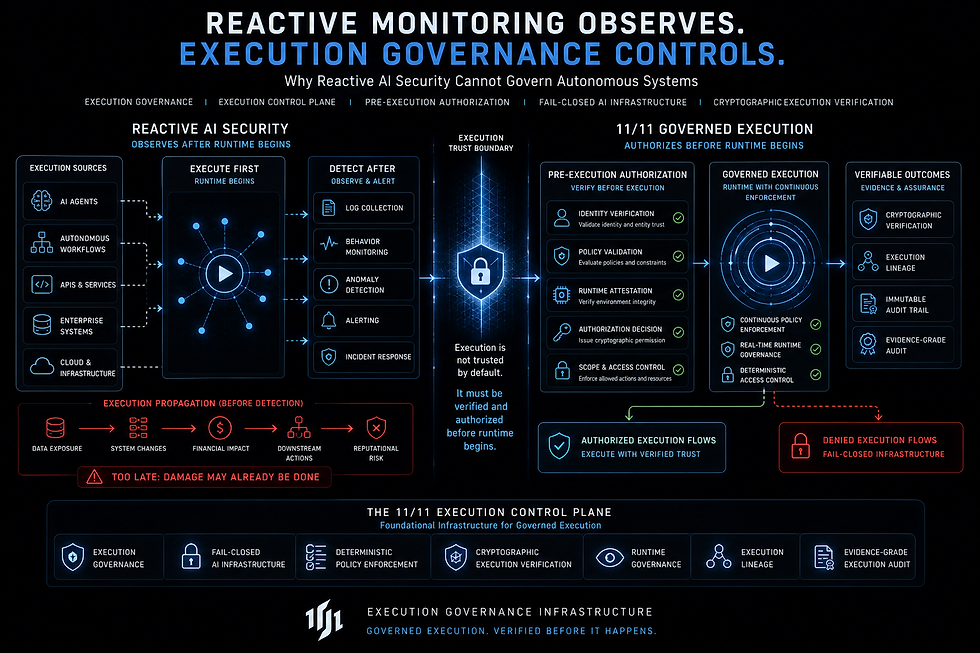
11/11 introduces Execution Governance™ infrastructure for governed autonomous execution and deterministic operational control.
Execution Governance™ Governed Execution™ EA-11™ Execution Arithmetic™
Patent Pending
Public Infrastructure Endpoints


Comments