
RFC-EG-013 Governance Decision Envelope Specification

Updated: May 13

Status of This Memo
This document defines mandatory governance decision envelope specifications for governed execution infrastructure and autonomous runtime systems.
This specification establishes deterministic governance decision standards, cryptographic decision attestation requirements, fail-closed operational enforcement controls, and immutable governance continuity requirements for execution governance environments.
Abstract
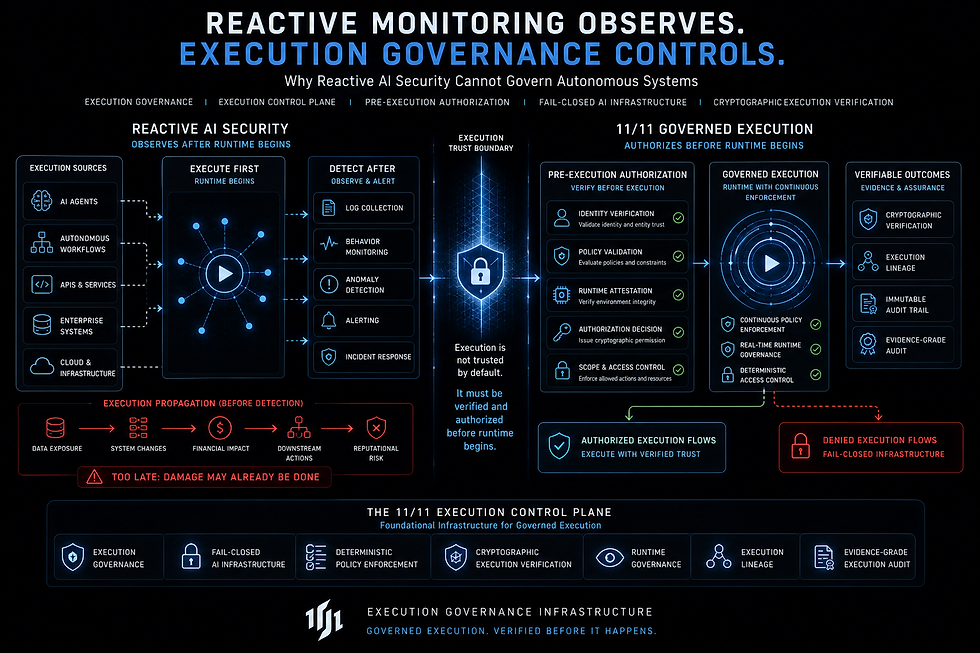
Autonomous execution systems require deterministic governance decision structures before runtime execution activity begins.
Traditional infrastructure models rely on:
fragmented authorization decisions
unverifiable governance responses
inconsistent runtime legitimacy validation
delayed operational attestation
These models do not scale safely to autonomous execution environments.
Execution governance infrastructure requires:
deterministic governance decision envelopes
cryptographic legitimacy attestation
fail-closed operational continuity
immutable governance lineage
distributed trust synchronization
RFC-EG-013 establishes foundational governance decision envelope specifications for governed execution systems.
1. Scope
This specification applies to:
autonomous execution systems
runtime orchestration environments
sovereign runtime infrastructure
distributed governance meshes
enterprise governance systems
machine-speed operational environments
cryptographically governed infrastructure
This specification defines mandatory governance decision envelope requirements independent of implementation architecture.
2. Governance Decision Envelope Requirements
2.1 Governance Decisions MUST Be Encapsulated
Execution governance systems MUST encapsulate governance decisions within deterministic decision envelopes containing:
runtime legitimacy state
authorization continuity state
governance synchronization state
operational trust attestation
cryptographic verification metadata
Governance legitimacy MUST remain attributable throughout execution activity.
2.2 Governance Decision Envelopes MUST Remain Deterministic
Decision envelope outcomes MUST remain:
deterministic
independently verifiable
cryptographically attributable
operationally consistent
fail-closed by default
Identical runtime legitimacy conditions MUST produce identical governance decision envelopes.
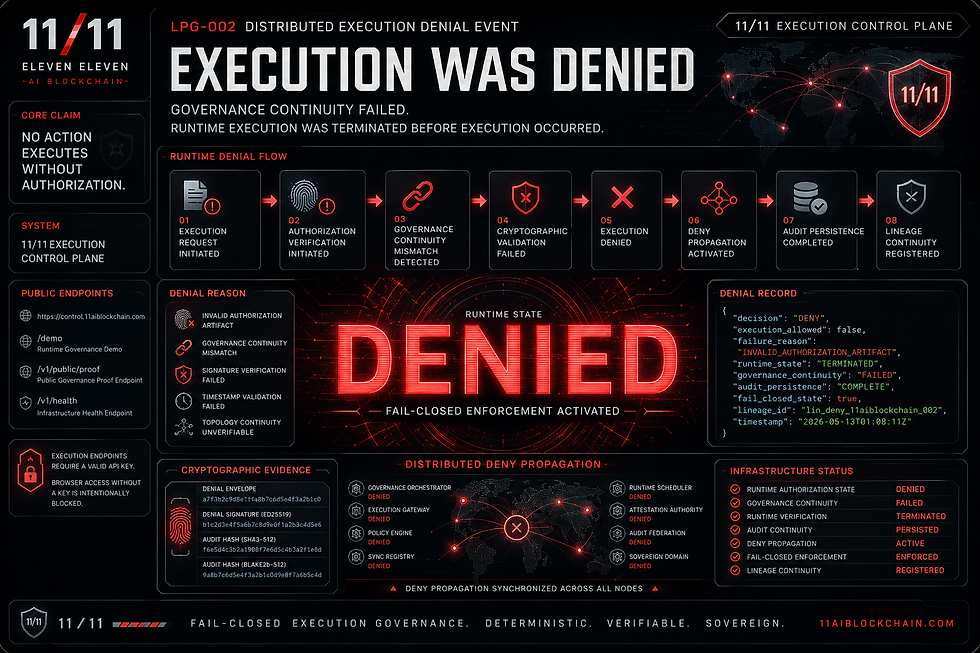
2.3 Invalid Governance Decision Envelopes MUST Trigger Fail-Closed Enforcement
If governance legitimacy becomes invalid:
execution MUST stop automatically.
Execution governance systems MUST NOT permit:
unverifiable runtime continuation
fragmented governance continuity
operational trust divergence
authorization synchronization drift
unauthorized execution persistence
Fail-closed operational behavior MUST remain mandatory.
2.4 Governance Decision Envelope History MUST Remain Immutable
Execution governance systems MUST preserve:
governance decision history
runtime trust transitions
authorization continuity
operational legitimacy events
cryptographic audit continuity
distributed execution lineage
Decision envelope continuity MUST remain historically provable.
2.5 Distributed Governance Decision Synchronization MUST Be Supported
Governed execution systems operating across distributed environments MUST support:
synchronized governance decision validation
distributed runtime legitimacy continuity
deterministic cross-domain coordination
cryptographic trust synchronization
globally attributable governance lineage
Governance decision divergence MUST trigger fail-closed operational behavior.
3. Governance Decision Envelope Structure
Governance decision envelopes MUST support:
deterministic legitimacy classification
runtime authorization metadata
cryptographic attestation identifiers
operational trust continuity state
distributed synchronization metadata
immutable execution lineage references
Governance decision envelopes MUST remain continuously verifiable throughout runtime activity.
4. Governance Decision Envelope Example Structure
Example decision envelope fields MAY include:
envelope_id
legitimacy_state
authorization_scope
governance_policy_hash
runtime_trust_state
synchronization_epoch
attestation_signature
lineage_reference
fail_closed_state
operational_integrity_hash
Envelope structures MUST remain deterministic and cryptographically attributable.
5. Sovereign Governance Envelope Requirements
Sovereign runtime environments MUST support:
independent governance decision authority
deterministic legitimacy synchronization
immutable operational lineage
cryptographic sovereignty assurance
distributed sovereign coordination
Execution legitimacy MUST remain continuously attributable across sovereign runtime systems.
6. Cryptographic Envelope Requirements
Execution governance systems MUST support:
cryptographic envelope validation
immutable operational continuity
deterministic legitimacy attestation
operational integrity proof
independently verifiable distributed trust assurance
Governance legitimacy MUST remain cryptographically attributable throughout execution activity.
7. Operational Assurance Requirements
Execution governance systems MUST continuously assure:
governance envelope continuity
operational legitimacy
governance synchronization
execution integrity
distributed operational consistency
Decision envelope systems MUST operate continuously at runtime speed.
8. Security Considerations
Execution governance systems MUST assume:
runtime trust drift is possible
operational legitimacy may become invalid
distributed synchronization failures occur
execution authority expansion creates risk
fragmented governance continuity is unsafe
Fail-closed enforcement MUST occur under unverifiable operational conditions.
9. Future Envelope Extensions
Future RFC extensions MAY define:
governance envelope schemas
distributed decision protocols
sovereign governance schemas
operational legitimacy assurance profiles
governance interoperability specifications
attestation serialization formats
10. Conclusion
Execution governance establishes deterministic governance decision envelopes beneath autonomous infrastructure.
Governed execution systems require:
deterministic governance decision structures
fail-closed operational controls
continuous governance synchronization
cryptographic execution assurance
immutable governance continuity
Operational legitimacy itself becomes envelope-verifiable infrastructure.
Official Proof Systems
Public Governance Console
Runtime Governance Demo
Public Governance Proof Viewer
Infrastructure Health Dashboard
Execution Lineage Explorer
Autonomous infrastructure cannot rely on fragmented governance legitimacy.
Execution trust itself must remain continuously encapsulated, synchronized, and cryptographically attributable across every operational domain.

Comments