
RFC-EG-033 Execution Governance Proof Exchange Protocol

Updated: May 13

TRUST MUST BE
EXCHANGEABLE
Execution governance requires
synchronized cryptographic proof continuity.
Abstract
RFC-EG-033 establishes the Execution Governance Proof Exchange Protocol (EGPEP) for distributed execution governance infrastructure.
This specification defines deterministic proof exchange mechanisms required to synchronize governance evidence across:
distributed runtime systems
sovereign execution domains
governance synchronization fabrics
runtime orchestration infrastructures
attestation authorities
operational trust layers
execution verification systems
distributed audit registries
Execution governance proof exchange ensures that governance evidence remains:
synchronized
cryptographically verifiable
immutable
topology-resilient
independently reproducible
fail-closed by default
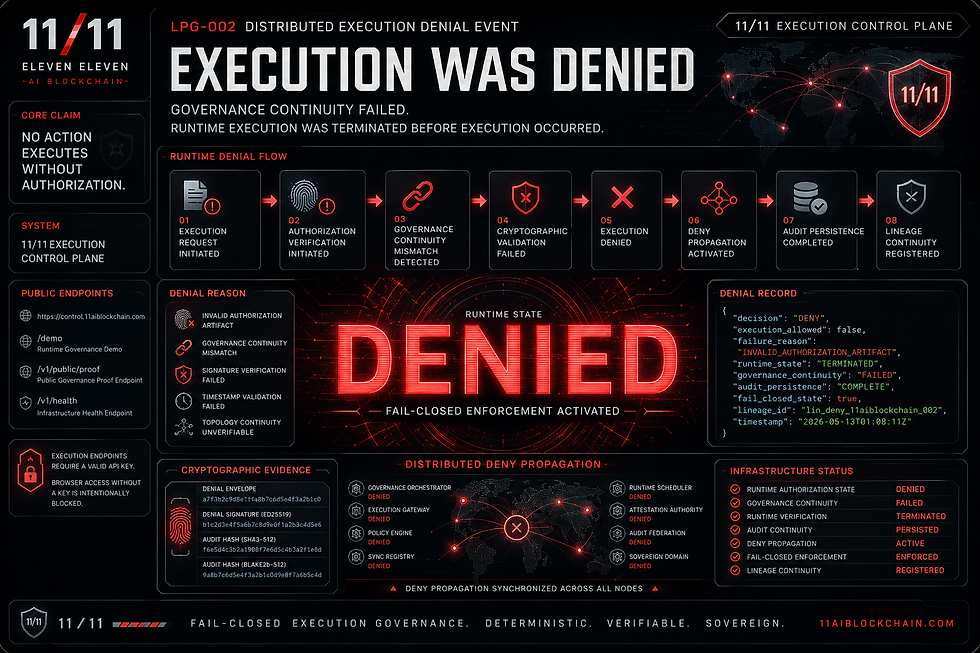
Execution governance systems implementing this RFC MUST deny execution whenever governance proof continuity cannot be validated.
1. Purpose
Execution governance cannot remain authoritative if governance evidence becomes isolated, fragmented, or operationally unverifiable.
Distributed governance requires:
synchronized proof exchange
immutable evidence continuity
deterministic governance reconciliation
cryptographic proof interoperability
verifiable runtime synchronization
fail-closed proof handling
Governance proof exchange therefore becomes foundational operational infrastructure.
2. Governance Proof Exchange Model
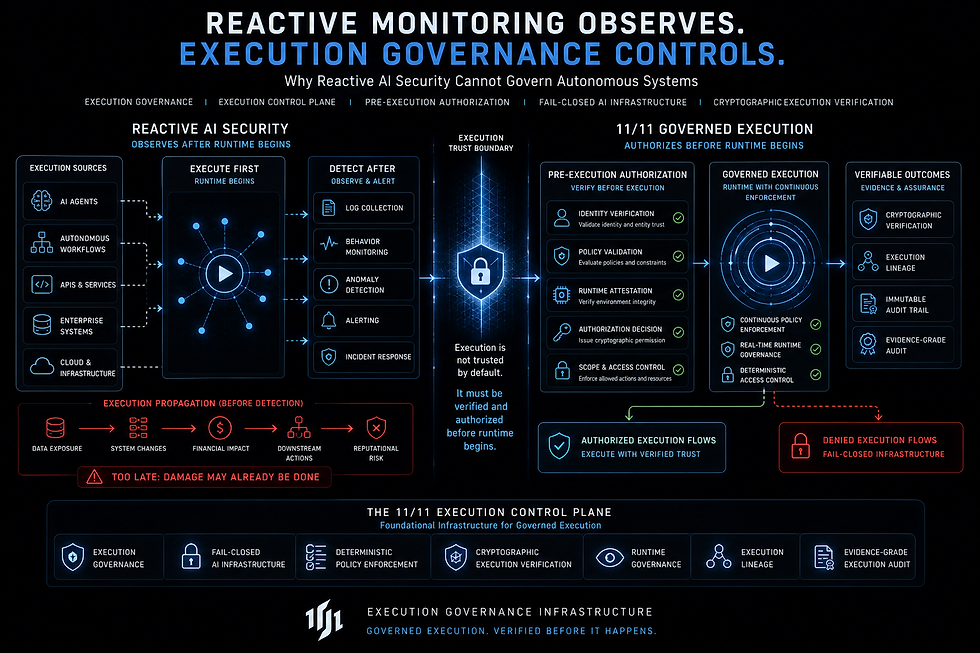
Execution governance proof exchange is the coordinated process through which governance infrastructure synchronizes execution evidence across distributed systems.
Governance proof exchange MAY include:
execution authorization artifacts
runtime attestation evidence
policy validation proofs
synchronization continuity proofs
audit lineage evidence
runtime integrity verification
distributed governance reconciliation
sovereign execution trust evidence
Proof exchange MUST remain cryptographically verifiable at all times.
3. Mandatory Proof Exchange Requirements
Execution governance systems implementing RFC-EG-033 MUST guarantee:
Requirement | Description |
Immutable Proof Persistence | Governance evidence MUST remain immutable |
Cryptographic Proof Validation | Proof exchange MUST remain verifiable |
Distributed Synchronization | Governance proofs MUST remain synchronized |
Deterministic Proof Resolution | Conflicting evidence MUST resolve deterministically |
Runtime Proof Continuity | Runtime verification evidence MUST persist |
Authority Proof Verification | Governance authority evidence MUST remain validated |
Fail-Closed Proof Enforcement | Proof uncertainty MUST deny execution |
Immutable Exchange Lineage | Proof exchange events MUST remain auditable |
Failure of proof exchange guarantees MUST terminate execution authorization.
4. Proof Exchange Failure Conditions
The following conditions constitute proof exchange failure:
unsigned governance evidence
fragmented proof lineage
unverifiable runtime proof continuity
synchronization ambiguity
detached audit evidence
inconsistent authority validation
topology reconciliation divergence
incomplete proof continuity
unauthorized evidence mutation
unverifiable exchange inheritance
Execution MUST deny whenever proof continuity becomes uncertain.
5. Distributed Proof Synchronization
Governance proof exchange MUST coordinate across:
sovereign execution domains
orchestration infrastructures
governance registries
runtime schedulers
execution gateways
attestation systems
audit synchronization fabrics
distributed verification infrastructures
Proof synchronization MUST remain topology-independent and cryptographically enforceable.
6. Cryptographic Proof Validation
Execution governance proof exchange MUST include:
signed proof envelopes
immutable evidence identifiers
deterministic exchange hashes
distributed proof lineage
timestamp-bound proof continuity
synchronized runtime evidence
cryptographic reconciliation validation
distributed audit persistence
Proof validation MUST remain independently reproducible.
7. Fail-Closed Proof Enforcement
Execution governance systems MUST deny execution whenever governance proof validity cannot be proven.
Permitted actions include:
deny
revoke
quarantine
isolate
invalidate
synchronize-before-authorize
Prohibited actions include:
optimistic proof handling
unsigned evidence inheritance
unverifiable proof reconciliation
topology bypass synchronization
partial proof acceptance
best-effort evidence continuity
Execution governance MUST never rely upon unverifiable governance evidence.
8. Proof Exchange Topology Requirements
Execution governance systems MUST maintain deterministic proof exchange boundaries between:
governance authorities
runtime infrastructures
orchestration systems
execution gateways
synchronization registries
attestation authorities
sovereign runtime zones
distributed audit fabrics
Proof continuity MUST survive distributed failover and topology migration events.
9. Sovereign Infrastructure Implications
Execution governance proof exchange becomes mandatory infrastructure for:
sovereign AI systems
defense-grade governance architectures
autonomous runtime infrastructures
regulated execution environments
distributed operational trust systems
financial governance coordination
high-assurance runtime verification
planetary-scale execution governance
Infrastructure lacking governance proof exchange cannot maintain authoritative execution governance.
10. Security Considerations
RFC-EG-033 mitigates:
governance evidence corruption
proof replay attacks
synchronization fragmentation
authority validation spoofing
distributed runtime drift
unsigned proof inheritance
topology reconciliation ambiguity
execution lineage corruption
runtime evidence escalation attacks
Cryptographic proof exchange reduces operational trust fragmentation across distributed execution systems.
11. Operational Implications
Execution governance systems implementing RFC-EG-033 increasingly resemble:
distributed proof synchronization fabrics
sovereign runtime evidence layers
cryptographic governance exchange systems
operational trust verification infrastructures
deterministic governance reconciliation architectures
planetary-scale execution evidence systems
Governance proof exchange therefore becomes foundational infrastructure for globally coordinated execution governance.
12. Conclusion
Execution governance cannot remain authoritative without synchronized governance proof continuity.
Distributed governance requires:
immutable evidence exchange
cryptographic proof validation
deterministic reconciliation
synchronized runtime continuity
fail-closed proof enforcement
RFC-EG-033 establishes execution governance proof exchange as a mandatory requirement for operational execution governance infrastructure.
Governance proof MUST remain synchronized, verifiable, immutable, and cryptographically authoritative at all times.
Public Governance Console
Runtime Governance Demo
Public Governance Proof Viewer
Infrastructure Health Dashboard
Execution Lineage Explorer

Comments