
RFC-EG-036 Runtime Authorization Standard (RAS-1)


Canonical Authorization Requirements for Governed Runtime Infrastructure
Standards Briefing
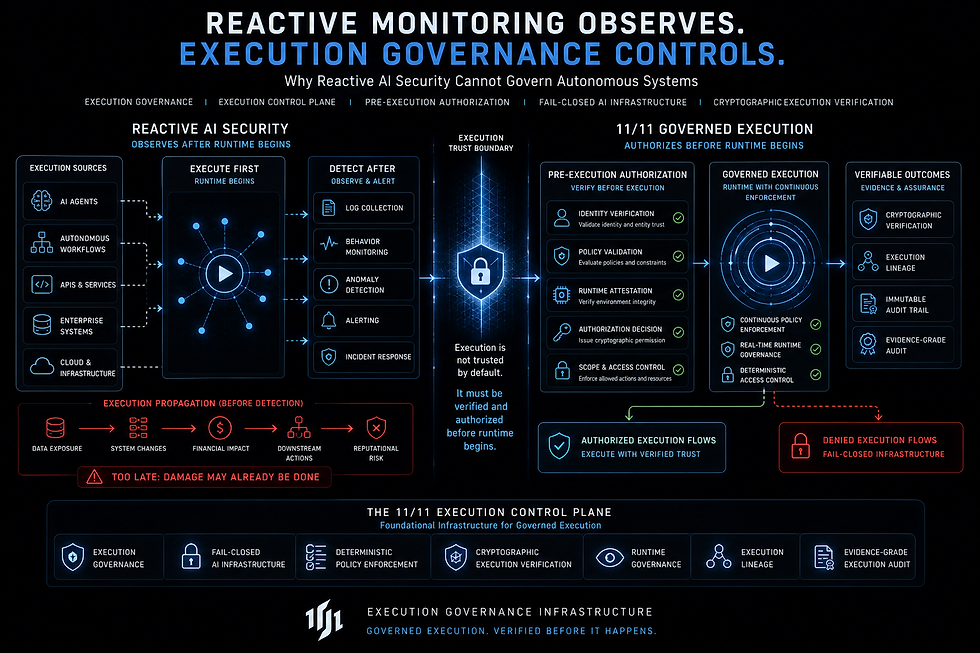
Modern autonomous systems increasingly execute actions without deterministic authorization enforcement occurring before runtime execution.
The Runtime Authorization Standard (RAS-1) establishes a canonical interoperability framework for governed runtime authorization infrastructure.
RAS-1 defines how governed systems:
issue authorization artifacts,
verify execution permissions,
enforce runtime trust boundaries,
refuse unauthorized execution,
and maintain cryptographic execution integrity.
The standard exists to normalize a foundational operational requirement:
No governed execution without successful authorization verification.
Runtime Authorization is the enforcement layer that transforms governance policy into deterministic runtime behavior.
Under RAS-1, execution approval is no longer implied by runtime capability alone.
Execution permission becomes:
policy-bound,
cryptographically verifiable,
context-aware,
lineage-connected,
and independently auditable.
The standard introduces the concept of the Authorization Artifact.
An Authorization Artifact is a cryptographically verifiable execution authorization object containing:
actor identity,
requested action,
policy scope,
execution constraints,
runtime trust boundary definitions,
issuance timestamps,
expiration semantics,
verification signatures,
and execution lineage references.
Governed runtimes implementing RAS-1 MUST validate authorization artifacts prior to execution approval.
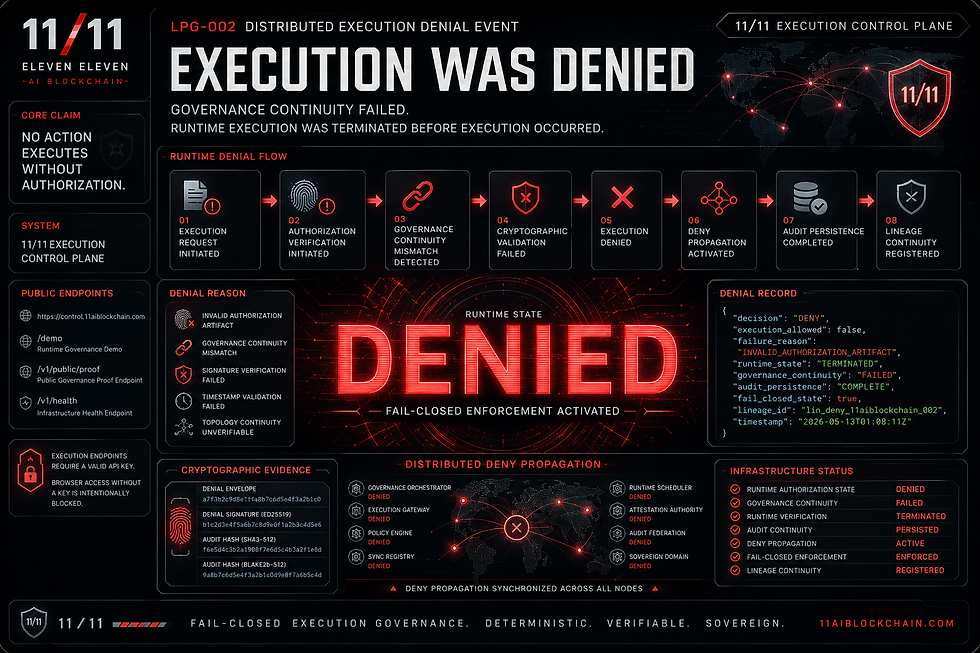
If authorization validation fails, execution MUST NOT proceed.
This establishes fail-closed execution semantics as a foundational requirement for governed runtime infrastructure.
The Runtime Authorization Standard also defines interoperability expectations between:
policy engines,
authorization issuers,
execution runtimes,
audit systems,
lineage persistence layers,
and independent verification systems.
RAS-1 introduces standardized execution refusal semantics for cases where:
authorization is missing,
signatures are invalid,
runtime context diverges,
trust boundaries are violated,
lineage persistence fails,
or policy scope mismatches occur.
Under the specification, execution denial events SHOULD themselves generate verifiable lineage evidence structures.
The standard further establishes Runtime Trust Boundary separation requirements.
Governance enforcement systems SHOULD remain logically independent from execution systems to preserve deterministic enforcement integrity.
The Runtime Authorization Standard is intended to function as a foundational standards layer for:
autonomous AI runtimes,
regulated compute systems,
orchestration platforms,
defense execution environments,
financial runtime infrastructure,
robotics systems,
healthcare execution systems,
and industrial automation environments.
Future specifications extending the RAS ecosystem will define:
distributed authorization federation,
sovereign runtime enforcement,
post-quantum authorization verification,
delegated execution governance,
and multi-domain governed execution interoperability.
RAS-1 forms part of the broader 11/11 Execution Governance Standards Track Initiative alongside:
Execution Governance Specification (EGS)
Execution Lineage Format (ELF)
Governed AI Runtime Profile (GARP)
Execution Governance Conformance Framework (EGCF)
The objective is to establish runtime authorization enforcement as a globally recognized infrastructure requirement for governed autonomous systems.

Comments