
Why Runtime Integrity Will Define Trusted Autonomous Infrastructure
- 11/11 AI

- May 8
- 4 min read
Updated: May 13
Modern AI systems increasingly operate as autonomous infrastructure rather than isolated software tools.
They coordinate workflows.
Trigger infrastructure actions.
Interact across distributed environments.
Execute machine-driven operational decisions.
And increasingly function without direct human intervention during runtime execution.
This creates a major infrastructure challenge:
How does infrastructure continuously verify that runtime execution remains trusted after authorization occurs?
Traditional systems largely assumed runtime integrity implicitly.
If execution began successfully, systems often assumed runtime conditions remained trustworthy afterward.
Autonomous systems invalidate that assumption.
Runtime conditions now evolve dynamically during execution itself.
Infrastructure trust can no longer depend solely on initial authorization.
It increasingly depends on continuously verifiable runtime integrity.
This transition fundamentally changes how trusted AI infrastructure must be designed.
The Problem With Static Trust Assumptions
Most traditional enterprise systems were designed around relatively static execution environments.
Infrastructure states changed predictably.
Runtime paths were constrained.
Operational conditions evolved slowly.
Autonomous systems do not operate this way.
AI infrastructure environments increasingly experience:
dynamic runtime orchestration
continuously changing execution paths
distributed infrastructure coordination
machine-generated workflow branching
external API propagation
adaptive runtime decision processes
evolving dependency chains
autonomous execution scaling
Under these conditions, initial authorization alone becomes insufficient.
Because execution environments may drift after runtime begins.
Policies may become invalid.
Infrastructure states may change.
Dependencies may become untrusted.
Execution chains may evolve beyond original authorization assumptions.
This creates a runtime trust problem rather than simply an authorization problem.
Why Runtime Integrity Matters
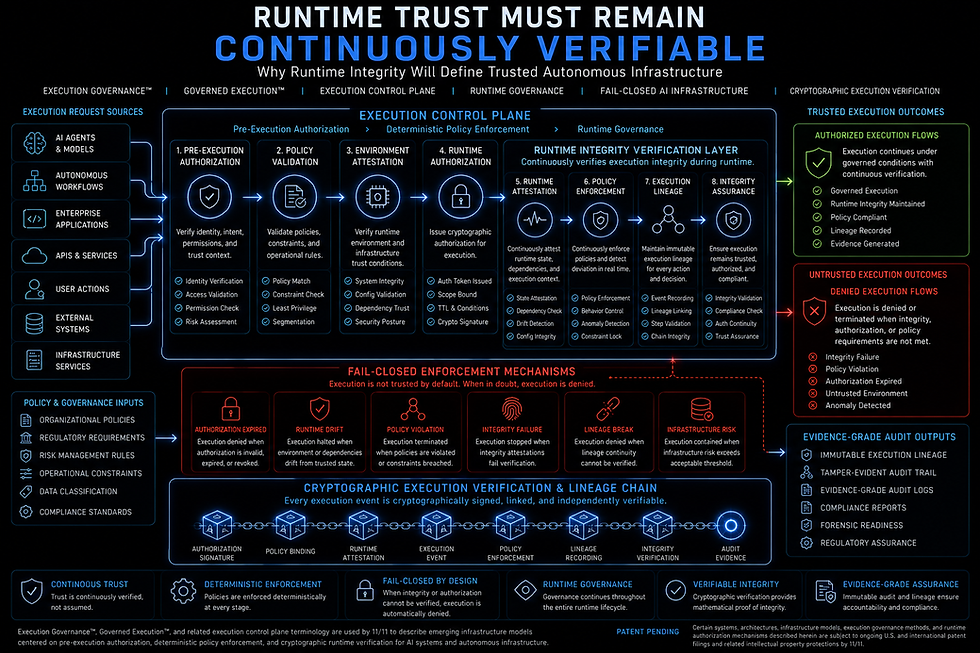
Runtime integrity means infrastructure continuously verifies that execution remains compliant, authorized, and trusted throughout runtime activity itself.
Not merely before execution begins.
This distinction is critical.
Because autonomous systems increasingly operate continuously across:
infrastructure orchestration
distributed runtime environments
operational workflows
financial systems
regulated environments
machine-driven decision systems
Organizations increasingly need assurance that:
runtime conditions remain trusted
execution paths remain authorized
policy constraints remain enforced
infrastructure integrity remains intact
execution lineage remains verifiable
downstream propagation remains governed
Without runtime integrity enforcement, authorization degrades into a one-time trust assumption.
That model increasingly fails in autonomous environments.
The Rise of Runtime Governance
Runtime governance introduces continuous enforcement throughout execution itself.
Under governed execution architectures:
authorization persists continuously during runtime
infrastructure integrity remains actively validated
execution conditions remain continuously attested
policy compliance remains enforceable
execution lineage remains preserved
runtime deviations trigger enforcement responses automatically
This transforms governance from static authorization into continuous runtime trust enforcement.
Execution no longer operates independently after approval occurs.
Execution remains governed throughout runtime activity.
That distinction increasingly defines trusted autonomous infrastructure.
Why Reactive Monitoring Is Insufficient
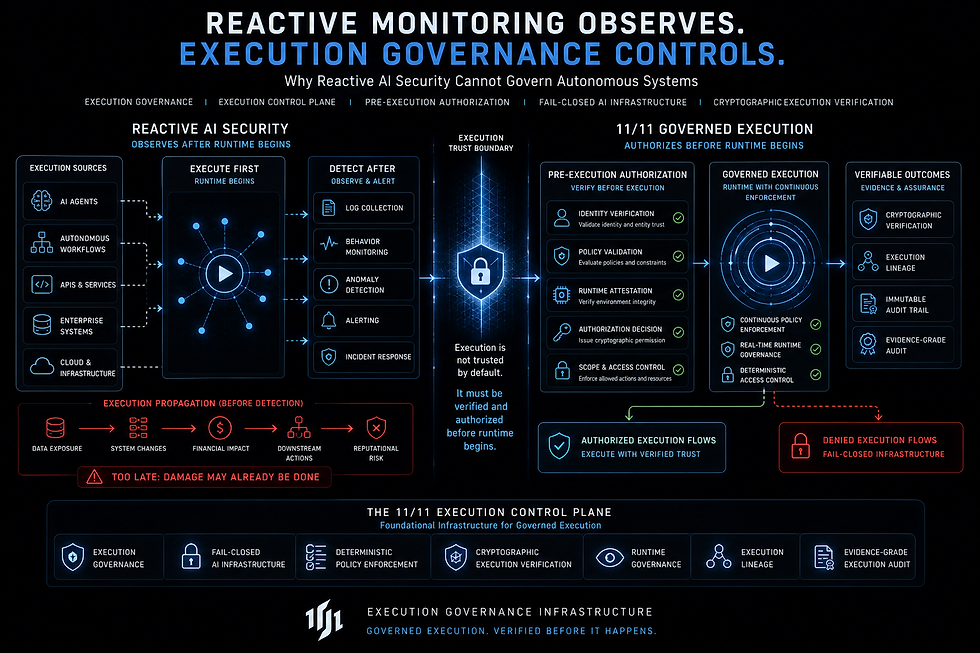
Most runtime security models still rely heavily on reactive monitoring.
Systems inspect telemetry after runtime propagation begins.
Monitoring tools attempt to identify anomalies after execution evolves.
Alerting systems notify operators after operational drift occurs.
This creates unavoidable governance delay.
In autonomous systems, runtime propagation frequently exceeds human response capacity.
By the time reactive systems detect integrity degradation:
execution chains may already expand
infrastructure states may already change
external systems may already propagate actions
operational impact may already occur
downstream dependencies may already drift
Reactive observability alone cannot guarantee runtime trust integrity continuously.
Governed execution solves this by embedding governance directly into runtime execution itself.
The Execution Control Plane and Runtime Integrity
The execution control plane becomes the infrastructure layer responsible for continuously governing runtime trust.
Its role extends beyond pre-execution authorization.
It continuously verifies:
runtime environment integrity
execution policy compliance
authorization continuity
infrastructure trust conditions
dependency validation
execution lineage preservation
operational constraint enforcement
cryptographic runtime attestation
This creates a continuously governed runtime environment.
A runtime trust architecture.
An operational integrity enforcement system.
Not merely an audit framework.
Why Fail-Closed Infrastructure Depends on Runtime Integrity
Fail-closed AI infrastructure fundamentally requires continuous runtime verification.
Because execution authorization alone is insufficient if runtime integrity degrades afterward.
Under fail-closed governed execution architectures:
runtime drift triggers containment
invalid attestations halt execution
untrusted environments terminate execution paths
broken execution lineage denies continuation
integrity violations trigger automatic enforcement responses
unverifiable runtime states default toward denial
Execution is not trusted statically.
It remains continuously governed throughout runtime activity.
This becomes increasingly necessary as autonomous systems gain operational authority within critical infrastructure environments.
Why Cryptographic Runtime Verification Matters
Runtime integrity ultimately requires independently verifiable trust.
Not merely inferred trust.
This is why cryptographic execution verification becomes foundational to governed execution architectures.
Under runtime governance systems:
runtime attestations become cryptographically verifiable
execution lineage becomes tamper-evident
authorization continuity becomes independently provable
policy enforcement integrity becomes auditable
runtime state validation becomes mathematically verifiable
This transforms runtime trust from observational confidence into cryptographic assurance.
The distinction becomes increasingly important in environments where infrastructure integrity must remain continuously provable.
Particularly across:
financial systems
healthcare infrastructure
industrial automation
autonomous operational systems
regulated enterprise environments
government infrastructure
Execution governance increasingly becomes the runtime trust layer beneath autonomous execution itself.
Why Runtime Integrity Defines the Next Infrastructure Standard
Infrastructure markets historically evolve toward continuous operational assurance.
Cloud systems evolved toward continuous orchestration governance.
Enterprise systems evolved toward continuous identity verification.
Distributed systems evolved toward continuous integrity enforcement.
AI infrastructure is now entering the runtime integrity phase.
This phase increasingly requires:
execution governance
governed execution
runtime governance
runtime integrity enforcement
execution control planes
deterministic policy enforcement
pre-execution authorization
fail-closed AI infrastructure
immutable execution audit
execution lineage
cryptographic execution verification
These systems increasingly become foundational infrastructure requirements for trusted autonomous environments.
Because infrastructure that cannot continuously verify runtime trust ultimately cannot guarantee execution integrity reliably.
11/11 and Runtime Governance Infrastructure
11/11 is not positioned as a generic AI company.
11/11 is building execution governance infrastructure for autonomous systems and governed runtime environments.
The objective is to establish continuously verifiable runtime trust beneath execution itself.
11/11 introduces infrastructure centered around:
execution governance
governed execution
runtime governance
runtime integrity enforcement
execution control planes
deterministic policy enforcement
pre-execution authorization
fail-closed AI infrastructure
execution lineage
immutable execution audit
cryptographic execution verification
As autonomous infrastructure continues expanding, runtime integrity increasingly becomes mandatory for trusted AI systems.
Because execution trust can no longer depend on static authorization assumptions alone.
Trusted infrastructure increasingly requires continuous runtime governance.
And that transition defines the rise of execution governance infrastructure.
Execution Governance™, Governed Execution™, and related execution control plane terminology are used by 11/11 to describe emerging infrastructure models centered on pre-execution authorization, deterministic policy enforcement, and cryptographic runtime verification for AI systems and autonomous infrastructure.
Patent Pending. Certain systems, architectures, infrastructure models, execution governance methods, and runtime authorization mechanisms described herein are subject to ongoing U.S. and international patent filings and related intellectual property protections by 11/11.
Public Governance Console
Runtime Governance Demo
Public Governance Proof Viewer
Infrastructure Health Dashboard
Execution Lineage Explorer


Comments