
Runtime Trust Will Become the Foundation of Autonomous AI Infrastructure
- 11/11 AI

- May 10
- 2 min read

AI infrastructure is entering a new operational era.
Systems are increasingly:
autonomous
adaptive
continuously executing
infrastructure-native
distributed across environments
capable of machine-speed orchestration
This changes the definition of infrastructure trust entirely.
Historically, trust was established:before execution.
Future AI systems require trust to persist:during execution itself.
This creates a new infrastructure requirement:
runtime trust.
SECTION 1 — THE END OF STATIC TRUST ASSUMPTIONS
Traditional infrastructure security largely depends on:static trust establishment.
Authentication occurs.Authorization occurs.Execution begins.
After execution starts, trust continuity is often assumed.
That assumption becomes dangerous in autonomous AI systems where:
runtime state changes dynamically
execution paths evolve continuously
infrastructure conditions shift
autonomous decisions compound over time
governance context changes during execution
Trust can no longer remain static.
Trust must become continuously validated.
SECTION 2 — WHAT RUNTIME TRUST MEANS
11/11 Runtime Trust Architecture establishes:continuous runtime trust validation.
Runtime trust means:execution remains continuously dependent on governance validity.
Infrastructure continuously evaluates:
authorization continuity
runtime policy alignment
environment integrity
execution scope validity
governance state continuity
cryptographic trust verification
Execution proceeds only while trust conditions remain valid.
This creates:deterministic runtime governance.
SECTION 3 — RUNTIME TRUST AS INFRASTRUCTURE
Runtime trust is not simply:security monitoring.
It becomes:operational infrastructure logic.
11/11 Runtime Governance Layer embeds trust directly into runtime execution systems themselves.
Trust becomes:
continuously enforced
cryptographically validated
runtime-native
governance-bound
deterministically enforced
Execution itself becomes dependent on active trust continuity.
SECTION 4 — FAIL-CLOSED RUNTIME TRUST ENFORCEMENT
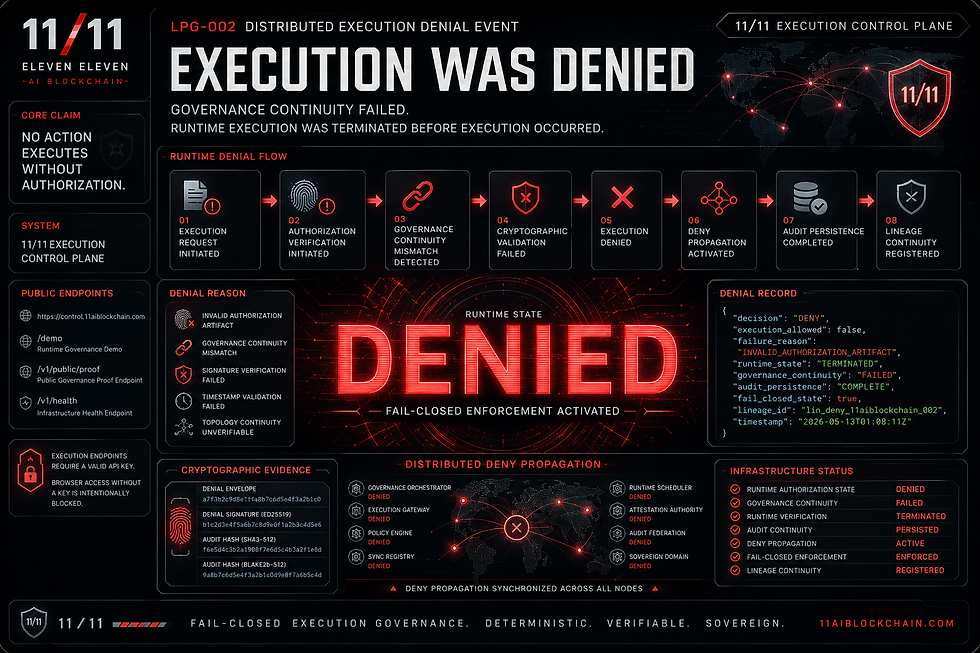
11/11 Execution Control Plane establishes:fail-closed runtime trust enforcement.
If authorization becomes invalid:execution stops.
If runtime integrity breaks:execution stops.
If governance continuity fails:execution stops.
If cryptographic verification becomes invalid:execution stops.
Trust continuity becomes mandatory for execution continuity.
SECTION 5 — AUTONOMOUS SYSTEMS REQUIRE CONTINUOUS TRUST
Autonomous AI systems increasingly:
coordinate workflows
invoke infrastructure
execute distributed actions
orchestrate machine-generated decisions
operate continuously without human intervention
This creates execution velocity beyond traditional trust models.
Infrastructure must continuously prove:
execution remains authorized
governance conditions remain valid
runtime boundaries remain enforced
trust continuity remains intact
Runtime trust becomes foundational for autonomous infrastructure.
SECTION 6 — FROM REACTIVE SECURITY TO CONTINUOUS TRUST
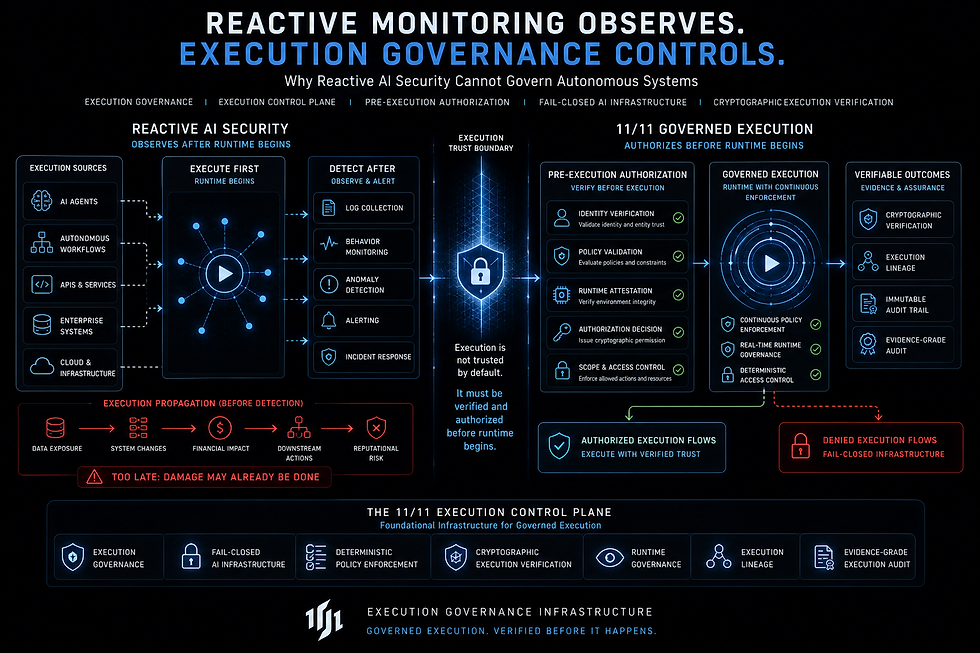
Traditional security systems often operate:reactively.
Runtime trust systems operate:continuously.
This creates a major architectural transition.
Instead of:execute → monitor → respond
The future becomes:verify → authorize → govern → validate continuously → prove
Execution itself becomes:continuously trusted infrastructure behavior.
SECTION 7 — WHY RUNTIME TRUST BECOMES MANDATORY
As AI systems increasingly operate across:
enterprise infrastructure
healthcare systems
financial environments
defense operations
logistics systems
autonomous agent ecosystems
organizations require:continuous trust enforcement.
Infrastructure must guarantee:
runtime integrity
governance continuity
execution accountability
authorization persistence
deterministic enforcement
cryptographic runtime proof
Static trust assumptions become operationally insufficient.
SECTION 8 — THE FUTURE OF TRUSTED AI INFRASTRUCTURE
11/11 Runtime Trust Architecture establishes:runtime trust as a foundational infrastructure primitive.
This introduces:
deterministic runtime governance
fail-closed execution continuity
cryptographic trust validation
governed execution enforcement
runtime lineage continuity
evidence-grade runtime audit
Execution itself becomes:continuously trusted infrastructure behavior.
CLOSING
Autonomous AI systems cannot safely scale on:static trust assumptions.
The future requires:continuous runtime trust.
Execution itself must become:
continuously validated
runtime governed
cryptographically verified
deterministically enforced
permanently auditable
before and during runtime execution.
Runtime trust will become the foundation of autonomous AI infrastructure.
11/11 is building the execution governance layer for AI infrastructure.

Comments