
Why Sovereign Infrastructure Cannot Depend On Reactive Oversight


Reactive oversight was designed for slower systems.
For decades, infrastructure governance depended heavily on post-event review.
Actions occurred.
Logs were generated.
Analysts investigated what happened afterward.
Oversight operated retrospectively.
That operational model functioned when infrastructure moved at human speed.
But autonomous systems fundamentally change the speed of execution.
AI systems now coordinate workflows automatically.
Cloud infrastructure scales dynamically.
Operational runtimes make machine-speed decisions.
Distributed systems synchronize across global infrastructure in milliseconds.
Autonomous orchestration layers continuously execute actions without waiting for manual approval cycles.
This changes the role of governance itself.
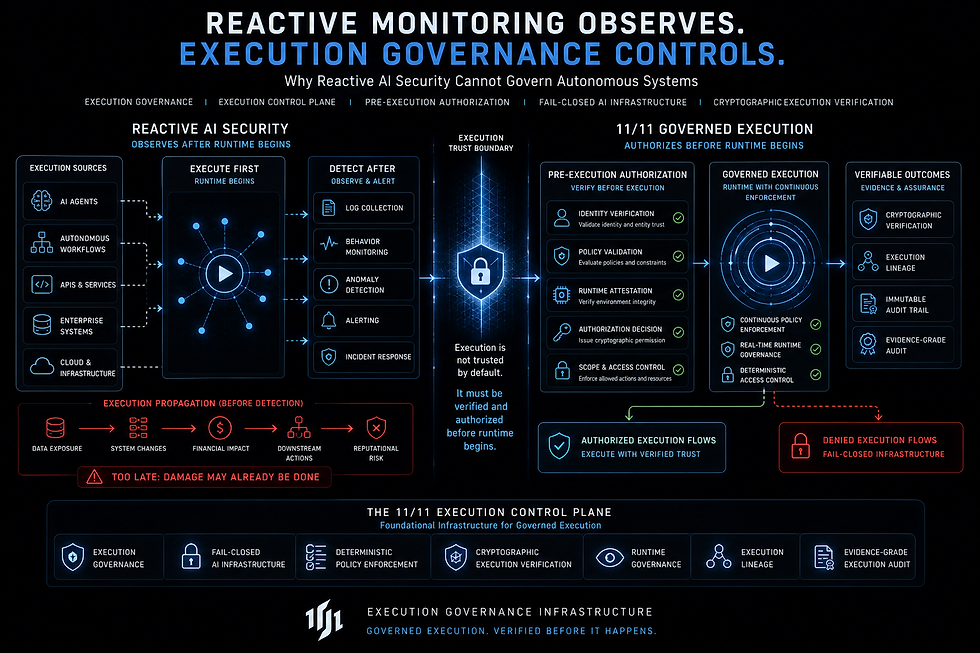
By the time reactive oversight begins, execution has already occurred.
The infrastructure has already acted.
That reality creates a dangerous operational gap.
Sovereign systems cannot afford governance that activates only after execution.
Critical infrastructure requires operational certainty before action occurs.
Public systems.
Defense systems.
Healthcare systems.
Financial infrastructure.
Energy infrastructure.
National operational platforms.
These environments cannot rely entirely on after-the-fact analysis once machine-speed execution becomes autonomous.
Because reactive governance cannot stop actions that already happened.
It can only document them afterward.
This is why governance must move directly into the execution boundary itself.
Execution Governance™ introduces governance before execution.
Instead of trusting infrastructure by assumption, governed systems require runtime verification before execution proceeds.
Identity is verified.
Authorization is confirmed.
Policy is synchronized.
Runtime conditions are validated.
Environmental context is checked.
Execution lineage is prepared.
Only then is execution admitted.
This transforms governance from retrospective visibility into active operational control.
Without this shift, sovereign infrastructure increasingly depends on probabilistic operational trust.
And probabilistic trust becomes unstable at machine speed.
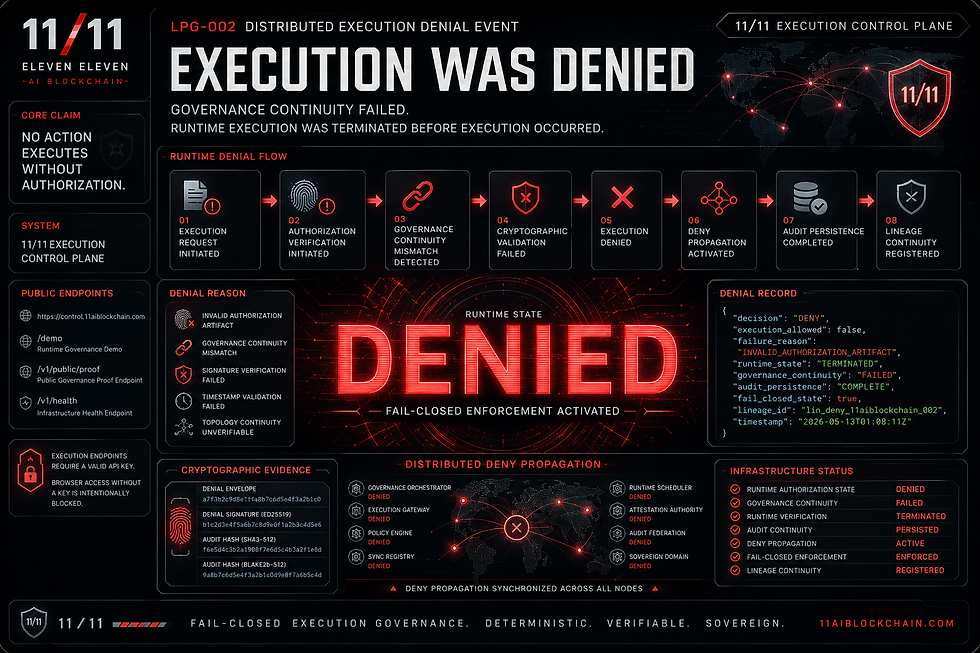
A disconnected policy engine.
An expired authorization state.
A stale runtime condition.
An unauthorized orchestration request.
A fragmented infrastructure dependency.
Any of these failures can propagate operational consequences before human oversight even detects the issue.
This is why reactive oversight alone becomes insufficient for autonomous infrastructure.
Machine-speed systems require machine-speed governance.
Governance must execute at the same operational velocity as the infrastructure it protects.
That means governance becomes continuous.
Synchronized.
Deterministic.
Fail-closed.
Provable.
Operational trust therefore stops being a reporting function and becomes infrastructure itself.
This is the infrastructure transition now underway across sovereign autonomous systems.
The future of operational resilience will not depend solely on automation capability.
It will depend on whether infrastructure can continuously govern execution before action occurs.
That is the role of governed execution.
That is the operational boundary 11/11 defines through Execution Governance™ infrastructure.
Public Infrastructure Endpoints
Public Runtime Infrastructure
Public Governance Console
Runtime Governance Demo
Public Governance Proof Viewer
Infrastructure Health Dashboard
Execution Lineage Explorer
Execution endpoints intentionally require valid API authorization.
Browser access without a valid authorization key is fail-closed by design.
11/11 introduces Execution Governance™ infrastructure for governed autonomous execution and deterministic operational trust.
Execution Governance™
Governed Execution™
Patent Pending

Comments