
The AI Execution Gap: Why Enterprises Are Flying Blind
- 11/11 AI

- May 4
- 5 min read
Executive Summary
Artificial intelligence has reached a point of mass adoption across enterprise environments. From finance to healthcare, logistics to defense, organizations are deploying AI at unprecedented speed to automate workflows, accelerate decision-making, and reduce operational cost.
On the surface, this appears to be a success story.
But underneath, a critical failure is emerging.
Enterprises are not struggling with AI capability.
They are struggling with AI control.
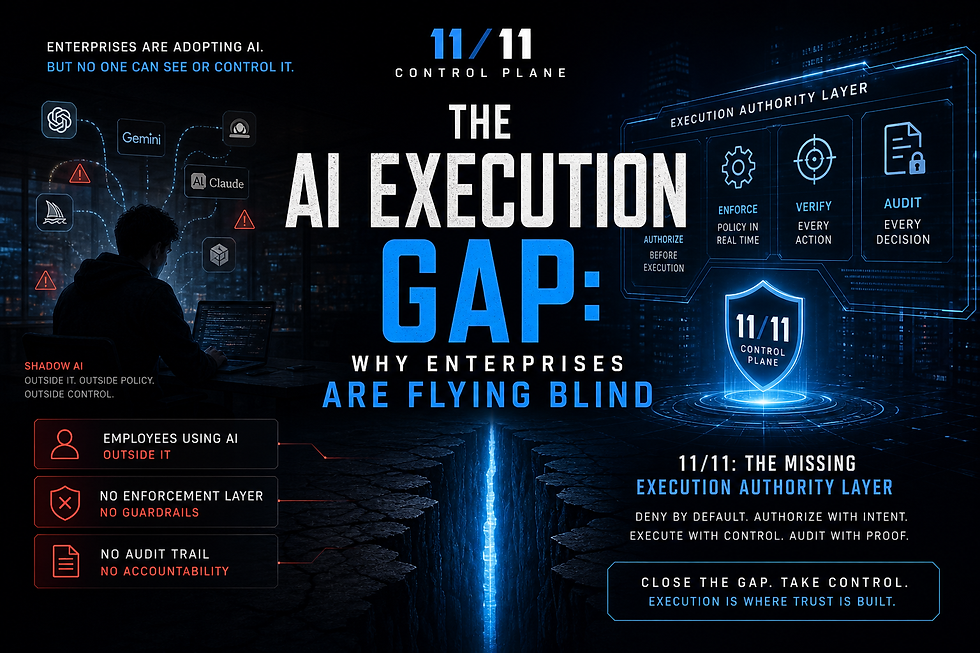
This failure has created what can now be defined as The AI Execution Gap a structural disconnect between AI usage and AI governance.
Organizations are deploying intelligence faster than they can control it.
And as a result, they are operating blind.
Defining the AI Execution Gap
The AI Execution Gap is the absence of a system that can:
Authorize AI-driven actions before execution
Enforce policy during execution
Verify outcomes after execution
In traditional software systems, governance mechanisms exist at multiple layers: identity, access control, logging, and compliance enforcement.
In AI systems, those controls are either incomplete or entirely absent.
This creates an environment where:
Actions are taken without deterministic authorization
Decisions are executed without enforceable constraints
Outcomes are generated without verifiable audit trails
The result is a system that is operationally powerful but structurally ungoverned.
The Illusion of Control
Many enterprises believe they have control over their AI systems because they have implemented:
API gateways
Identity and access management (IAM)
Logging systems
Security policies
However, these controls operate around AI not within it.
They manage access to systems.
They do not control execution of decisions.
For example:
An employee can access an approved AI tool, generate code, and deploy that code into a production environment.
From an infrastructure standpoint, everything appears compliant.
But the decision logic that produced that code was never:
Authorized
Evaluated against policy
Verified before execution
This is the illusion of control.
Trend Data: AI Usage Is Outpacing Governance
Recent enterprise studies reveal a consistent pattern:
1. Employees Are Using AI Outside of IT Oversight
A significant percentage of employees are now using AI tools without formal approval.
This includes:
Public large language models
Third-party automation platforms
AI-enabled SaaS products
These tools are often accessed through personal accounts, bypassing enterprise security layers.
This phenomenon, commonly referred to as Shadow AI, mirrors the rise of Shadow IT but with far greater risk implications.
Unlike traditional software, AI systems generate decisions that can directly impact business operations.
2. No Enforcement Layer Exists for AI Decisions
Even when AI tools are approved, enterprises lack a mechanism to enforce:
What the AI is allowed to do
What actions can be executed based on AI output
What constraints must be satisfied before execution
Policies exist on paper.
They are not enforced at runtime.
This creates a gap between intent and execution.
3. No Verifiable Audit Trail for AI Execution
Logging systems capture activity at the infrastructure level:
API calls
User access
System events
But they do not capture:
Why a decision was made
Whether it was authorized
Whether it complied with policy
Without this, enterprises cannot produce evidence-grade audit trails.
This is becoming a critical issue in regulated industries where compliance requires not just logging activity, but proving governance.
The Core Failure: Execution Without Authority
The root of the AI Execution Gap is simple:
AI systems are allowed to execute without a governing authority.
In traditional systems, execution is controlled through:
Role-based access control
Transaction validation
Approval workflows
In AI systems, execution is often triggered by:
Model output
Prompt responses
Automated workflows
There is no independent layer verifying whether execution should occur.
This creates a fundamental risk:
Execution is no longer tied to authorization.
Why This Matters Now
The AI Execution Gap is not a theoretical issue.
It is already impacting enterprises in measurable ways.
Operational Risk
AI-generated actions can:
Deploy incorrect configurations
Trigger unauthorized transactions
Modify critical systems without oversight
Compliance Risk
Regulatory frameworks are evolving to require:
Explainability
Traceability
Accountability
Without an execution control layer, enterprises cannot meet these requirements.
Security Risk
AI systems introduce new attack surfaces:
Prompt injection
Data leakage
Unauthorized automation
Without enforcement, these risks cannot be contained.
The Evolution of Enterprise Infrastructure
Every major shift in enterprise technology has introduced a new control layer:
The rise of the internet introduced firewalls
The rise of cloud introduced identity and access management
The rise of APIs introduced gateways and rate limiting
AI introduces a new requirement:
Execution control.
This is not optional.
It is foundational.
The Missing Layer: Execution Authority
To close the AI Execution Gap, enterprises need a new category of infrastructure:
An Execution Authority Layer.
This layer sits between AI systems and execution environments and enforces:
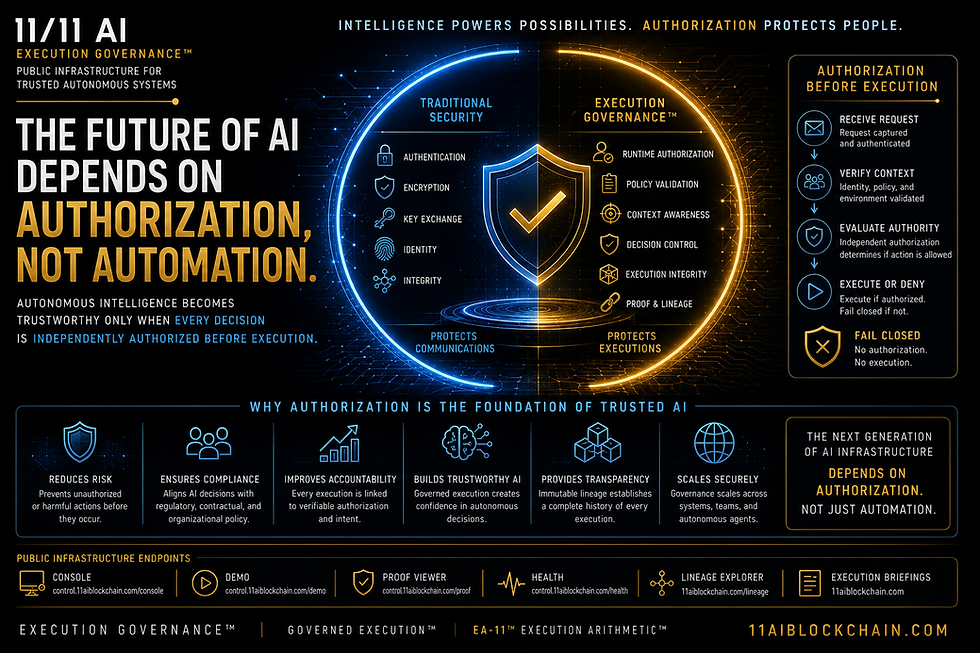
1. Pre-Execution Authorization
Every AI-driven action must be:
Evaluated against policy
Approved before execution
Denied by default if conditions are not met
This is a fail-closed model.
Execution does not occur unless explicitly authorized.
2. Deterministic Policy Enforcement
Policies must be:
Machine-enforceable
Deterministic
Applied consistently across all AI interactions
This eliminates ambiguity and ensures that decisions are governed by defined rules.
3. Cryptographic Audit and Evidence
Every execution must produce:
Immutable records
Verifiable signatures
Evidence-grade audit trails
This allows enterprises to prove not just what happened, but that it was authorized and compliant.
Positioning: 11/11 Control Plane
This is where the 11/11 Control Plane becomes critical.
11/11 is designed to function as the execution authority layer for AI systems.
It introduces a model where:
Execution is denied by default
Authorization is required before action
Policy is enforced at runtime
Audit is cryptographically verifiable
This transforms AI systems from:
Uncontrolled execution engines
into
Governed, verifiable infrastructure.
How 11/11 Closes the Gap
Step 1: Intercept Execution
All AI-driven actions pass through the control plane.
Nothing executes directly.
Step 2: Evaluate Against Policy
The system evaluates:
Who initiated the action
What the action is
Whether it complies with defined policy
Step 3: Authorize or Deny
If the action meets all conditions:
Execution is authorized
If not:
Execution is denied
Step 4: Record Evidence
Every decision produces:
A cryptographic record
A verifiable audit trail
A lineage of execution
The Strategic Advantage
Enterprises that adopt an execution authority layer gain:
Visibility
They can see what AI is doing across the organization.
Control
They can enforce what AI is allowed to do.
Compliance
They can prove governance to regulators.
Trust
They can safely scale AI deployment.
The Cost of Inaction
Organizations that ignore the AI Execution Gap face increasing risk:
Regulatory penalties
Security breaches
Operational failures
Loss of trust
As AI becomes more integrated into core operations, these risks compound.
The Future of AI Infrastructure
The next phase of AI adoption will not be driven by:
Better models
Larger datasets
Faster compute
It will be driven by:
Control.
The ability to govern execution at scale.
Closing
Enterprises are not lacking intelligence.
They are lacking control.
The AI Execution Gap is the defining challenge of this era.
And the organizations that solve it will define the future of AI deployment.
Final Positioning Statement
We are not building another AI system.
We are building the execution authority layer required to deploy AI safely, securely, and at scale.


Comments