
The Future of AI Leadership: Who Decides the Rules for Trust and Control
- 11/11 AI

- Dec 28, 2025
- 3 min read
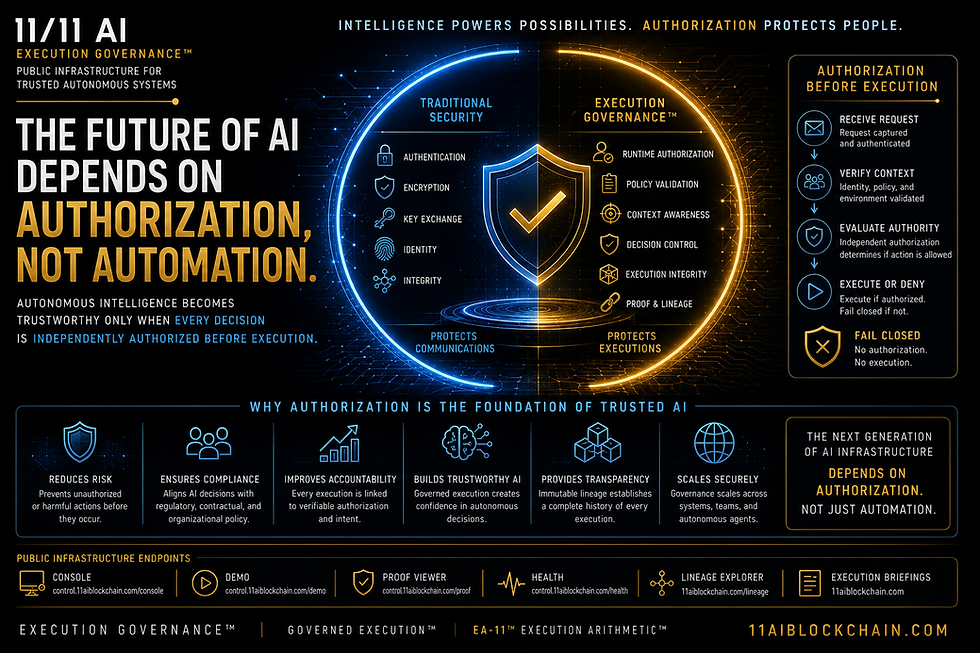
Artificial intelligence is no longer just a tool; it is becoming a force that shapes societies, economies, and global power structures. As AI systems grow more powerful and autonomous, the question arises: who controls the trust layer that governs whether AI is allowed to operate? The next era of AI will not be defined by the fastest algorithms or the largest datasets but by the systems and leaders who decide when and how AI runs This post explores the rise of AI leadership worldwide, the challenges of governing AI trust, and the implications for individuals, organizations, and nations.

The Shift from Technology to Governance
AI development has traditionally focused on improving models and expanding datasets. While these remain important, the emerging challenge is governance: creating frameworks that ensure AI systems operate safely, ethically and transparently. This governance includes deciding who sets the rules, how those rules are enforced and what happens when AI systems fail or cause harm.
The trust layer of AI refers to the mechanisms that verify AI’s reliability and ethical behavior. It involves transparency, accountability and control. Without a trusted system, AI risks becoming a black box that users and regulators cannot understand or influence. This lack of trust can slow adoption, invite misuse, or cause societal backlash.
Who Are the Emerging AI Leaders?
Leadership in AI is no longer limited to technology companies or research labs. Governments, international organizations and civil society groups are stepping into the arena to shape AI’s future. These leaders influence:
Policy and regulation: Governments create laws that define acceptable AI use, data privacy, and liability.
Standards and certification: International bodies develop standards for AI safety and ethics.
Public trust and education: NGOs and advocacy groups promote awareness and responsible AI use.
Corporate governance: Companies establish internal controls and ethics boards to oversee AI projects.
For example, the European Union’s AI Act proposes strict rules on high-risk AI applications, setting a precedent for global regulation. China has introduced guidelines emphasizing AI’s alignment with social values and national security. Meanwhile, organizations like the Partnership on AI bring together diverse stakeholders to discuss best practices.
The Power Struggle Over AI Control
The control over AI’s trust layer is a power struggle with high stakes. If a single entity or coalition controls these rules, they can influence which AI systems succeed or fail, shaping markets and societies. This raises concerns about:
Concentration of power: Dominant tech companies or governments might impose rules that favor their interests.
Lack of transparency: Closed decision-making processes can erode public trust.
Global inequality: Countries with less influence may be subject to rules set by others, limiting their AI development.
This struggle is visible in debates over data sovereignty, cross-border AI governance, and ethical standards. For instance, some countries advocate for AI that respects human rights and privacy, while others prioritize state control and surveillance.
Building Systems That Decide AI’s Operation
Creating systems that decide whether AI is allowed to run involves technical, legal and ethical components:
Technical safeguards: AI systems can include built-in controls that monitor behavior and halt operations if risks arise.
Legal frameworks: Laws define permissible AI uses and penalties for violations.
Ethical guidelines: Principles guide developers and users to align AI with societal values.
Auditing and certification: Independent reviews verify AI compliance with standards.
One practical example is the use of AI ethics boards within companies that review projects before deployment. Another is the development of AI “kill switches” that can deactivate systems in emergencies.

The Role of Individuals and Organizations
While global leaders set broad rules, individuals and organizations also play critical roles in AI trust:
Developers must build AI with transparency and fairness in mind.
Users should demand clear information about AI’s capabilities and limits.
Organizations need governance structures that oversee AI ethics and compliance.
Educators can raise awareness about AI risks and benefits.
For example, companies like Microsoft and Google have published AI principles and created ethics committees to guide development. Universities offer courses on AI ethics to prepare future leaders.
Preparing for a Future Where AI Trust Is Central
The rise of AI leadership globally means that trust and control will shape the technology’s impact more than raw performance. To prepare:
Stay informed about AI policies and standards in your region.
Advocate for transparent and inclusive AI governance.
Support initiatives that promote ethical AI development.
Encourage collaboration between governments, industry and civil society.
The future will belong to those who not only build AI but also build the systems that decide when and how AI operates.



Comments