
The Medical AI Infrastructure War

Updated: May 13
Why This Topic Matters
The healthcare industry is entering one of the largest infrastructure shifts in modern history.
For years, the conversation around artificial intelligence focused primarily on:
chatbots,
model performance,
automation,
productivity,
and diagnostic accuracy.
That phase is ending.
A much larger battle is beginning underneath the surface.
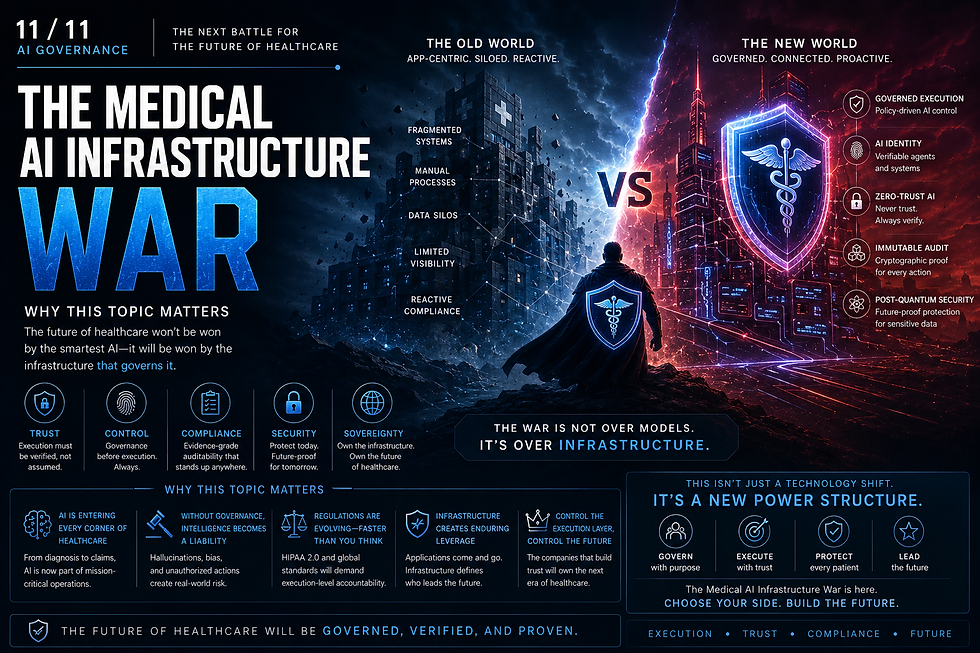
The next era of healthcare AI will not be defined only by who builds the smartest models.
It will increasingly be defined by who controls the infrastructure governing AI execution itself.
That is the beginning of the Medical AI Infrastructure War.
Healthcare Is Becoming an AI Operating Environment
Healthcare is no longer simply adopting software.
It is becoming a live AI execution environment.
Artificial intelligence is rapidly integrating into:
hospitals,
insurance systems,
diagnostics,
radiology,
pathology,
genomics,
pharmaceutical research,
claims infrastructure,
medical imaging,
robotic systems,
patient engagement platforms,
and public health operations.
This transformation changes healthcare from a records-based industry into an intelligence-driven operational ecosystem.
That shift creates an enormous infrastructure challenge.
Because intelligence without governance becomes dangerous.
The First Era of Healthcare AI Was About Capability
The early healthcare AI race focused heavily on capability.
Companies competed around:
larger models,
faster inference,
better diagnostics,
automation,
summarization,
and predictive analytics.
The assumption was simple:
the smartest AI would win.
But regulated healthcare environments do not operate purely on intelligence.
They operate on:
trust,
accountability,
authorization,
auditability,
and compliance.
That changes the competitive landscape entirely.
The Real Battle Is Moving Beneath the Application Layer
Most healthcare AI companies today compete at the application layer.
Applications are important.
But infrastructure ultimately becomes more valuable.
History repeatedly proves this.
The largest long-term winners in technology often control infrastructure layers beneath applications.
Examples include:
cloud infrastructure,
operating systems,
payment rails,
networking protocols,
identity systems,
and compute platforms.
Healthcare AI is entering the same transition.
The strategic battle is shifting toward:
execution governance,
trust architecture,
runtime authorization,
AI identity,
policy enforcement,
and evidence-grade compliance systems.
This is infrastructure.
And infrastructure creates leverage.
Why Infrastructure Matters More Than Models
AI models evolve rapidly.
What is state-of-the-art today may become obsolete tomorrow.
Infrastructure persists.
Infrastructure controls:
access,
interoperability,
execution,
trust,
policy,
and operational governance.
The organizations controlling healthcare AI infrastructure may eventually determine:
what systems are trusted,
what execution is allowed,
what models can operate,
and what compliance standards become mandatory.
This creates enormous strategic power.
Healthcare Cannot Operate on Blind AI Trust
One of the largest problems emerging in healthcare AI is the assumption that intelligence alone creates safety.
It does not.
AI systems are capable of:
hallucinations,
unpredictable inference,
false outputs,
hidden bias,
unauthorized execution,
and autonomous workflow escalation.
In consumer software, this may create inconvenience.
In healthcare, it can create catastrophic outcomes.
That changes the requirements for infrastructure.
Healthcare systems increasingly require:
deterministic governance,
execution authorization,
runtime verification,
immutable auditability,
and cryptographic accountability.
The infrastructure war is ultimately about who controls trusted execution.
The Rise of Execution Governance
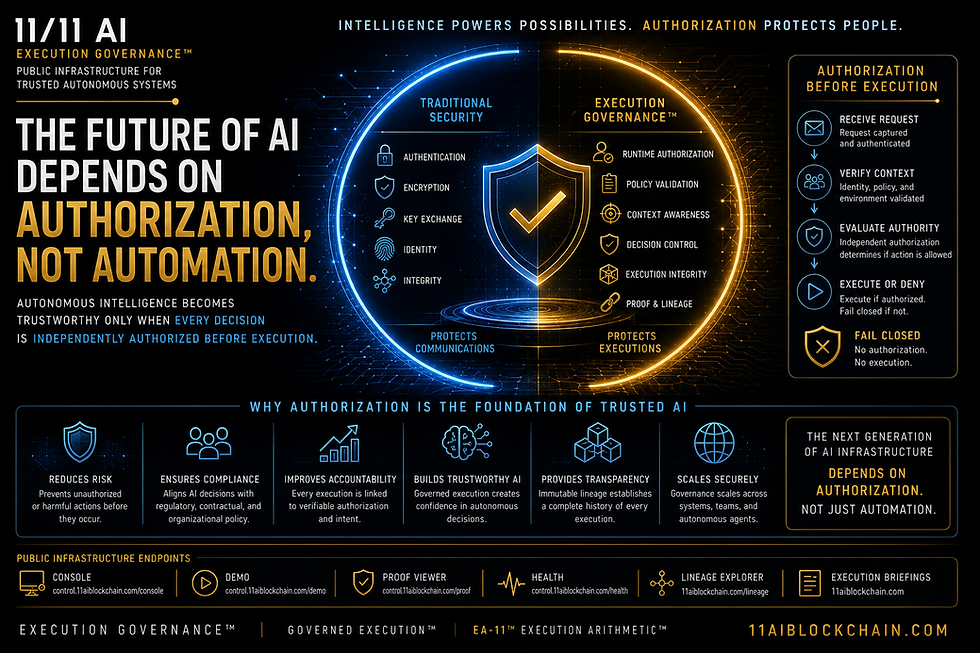
The next generation of healthcare infrastructure increasingly revolves around execution governance.
Execution governance means:
AI cannot simply run because it exists.
It must first be:
verified,
authorized,
policy-bound,
and continuously governed.
This creates a fundamentally different healthcare trust model.
Future systems may increasingly operate using workflows like:
Request → Verify → Allow or Deny → Execute → Generate Cryptographic Proof
This architecture changes the center of gravity of healthcare AI.
The trust anchor shifts from:
the AI itself
to
the governance layer controlling AI execution.
That distinction may define the next decade of medical infrastructure.
The Infrastructure Stack Is Expanding
Traditional healthcare technology stacks focused primarily on:
databases,
applications,
identity systems,
and network security.
Future healthcare AI stacks may increasingly include:
AI orchestration layers,
runtime governance engines,
policy enforcement systems,
cryptographic audit infrastructure,
execution attestation systems,
AI identity frameworks,
and post-quantum trust architecture.
This is not simply an upgrade.
It is the creation of an entirely new infrastructure category.
Why AI Identity Becomes Critical
Healthcare historically authenticated people.
Future healthcare systems increasingly need to authenticate machine actors.
AI systems may soon require:
verifiable identity,
execution credentials,
policy-scoped permissions,
runtime attestations,
and cryptographic trust anchors.
Organizations increasingly need to know:
what AI executed,
where execution occurred,
what policies governed it,
and whether execution remained trusted throughout runtime.
This creates the emergence of AI identity infrastructure.
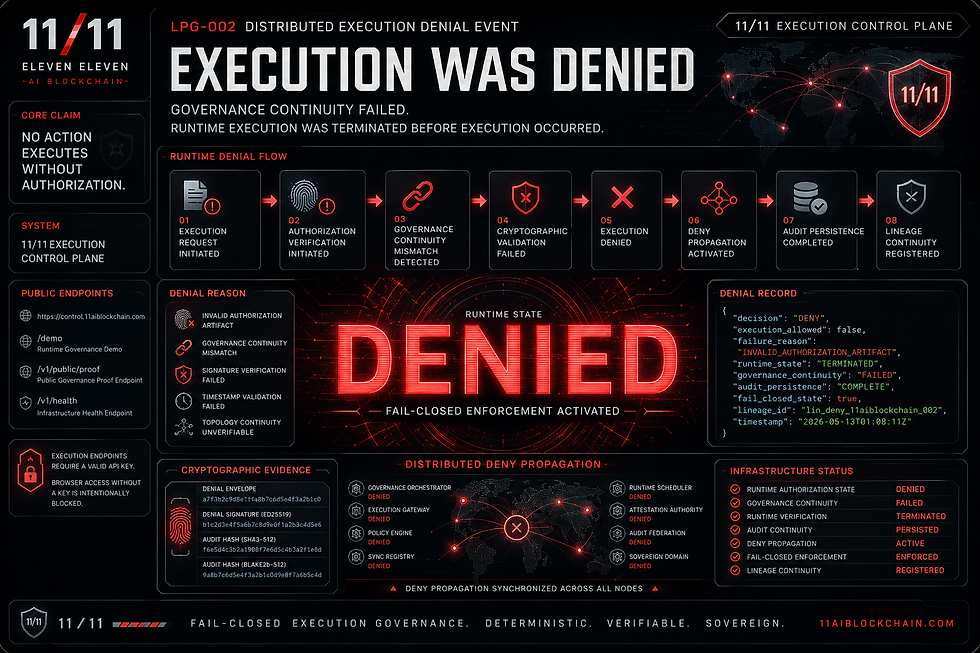
The Importance of Immutable Auditability
Healthcare is one of the most heavily regulated industries on Earth.
As AI systems become embedded into healthcare operations, organizations increasingly require:
replayable execution history,
immutable lineage,
deterministic audit trails,
and evidence-grade compliance systems.
Traditional logs are no longer sufficient.
Logs can be:
fragmented,
incomplete,
mutable,
or disconnected from actual execution pathways.
Future healthcare AI environments increasingly require:
signed execution records,
cryptographic attestations,
immutable lineage chains,
and runtime evidence systems.
This becomes critical for:
litigation,
insurance review,
regulatory audits,
FDA investigations,
and malpractice defense.
The Zero-Trust AI Transition
Cybersecurity already experienced the transition toward zero-trust architecture.
Healthcare AI is entering the same phase.
Future healthcare infrastructure may increasingly assume:
no AI is trusted automatically,
no model is authorized by default,
no workflow is inherently safe,
and every execution requires verification.
This creates zero-trust AI infrastructure.
In this model:
execution becomes continuously validated,
identity becomes cryptographic,
policy becomes dynamic,
and governance becomes persistent.
This is radically different from legacy healthcare software architecture.
Why Post-Quantum Security Changes Everything
Another major force shaping the infrastructure war is post-quantum security.
Healthcare data possesses unusually long life cycles.
Medical records may remain sensitive for:
decades,
lifetimes,
or across generations.
This creates concern around future cryptographic disruption.
Healthcare organizations increasingly face the reality that:
encrypted data stolen today may become vulnerable tomorrow.
This creates demand for:
crypto agility,
post-quantum trust models,
distributed governance,
and future-proof execution systems.
Organizations capable of building survivable infrastructure may possess enormous long-term advantages.
The Future of Healthcare Will Be Governed
Healthcare is moving toward an environment where AI systems increasingly influence:
diagnostics,
treatment recommendations,
operational workflows,
insurance coordination,
and patient prioritization.
That creates a simple but extremely important question:
Who governs the intelligence?
The future healthcare stack will likely require systems capable of:
authorizing execution before runtime,
enforcing policy during runtime,
and generating immutable proof after execution.
This is the emergence of governed medical intelligence.
Why This Creates a Massive Strategic Opportunity
The Medical AI Infrastructure War matters because infrastructure creates enduring strategic control.
Applications may change rapidly.
Infrastructure becomes foundational.
The organizations building:
execution governance,
trusted runtime systems,
AI identity frameworks,
evidence-grade audit infrastructure,
and deterministic compliance architecture
may ultimately control the operational foundation of future healthcare AI itself.
That position becomes extraordinarily valuable.
Because every AI system operating in regulated healthcare environments may eventually require trusted infrastructure beneath it.
The Industry Is Still Early
Most healthcare organizations remain focused on:
AI convenience,
workflow acceleration,
and application deployment.
Very few are architecting for:
governed execution,
cryptographic runtime proof,
deterministic AI control,
or post-quantum survivability.
That creates a temporary window.
The organizations building governance-first infrastructure today may become tomorrow’s trust anchors.
Why This Becomes a National Infrastructure Issue
Healthcare is not simply a commercial industry.
It intersects directly with:
national security,
public health,
emergency response,
pharmaceutical infrastructure,
military medicine,
and population analytics.
As AI becomes integrated into these systems, healthcare AI governance becomes strategically critical.
Nations may eventually compete around:
sovereign AI governance,
trusted medical execution infrastructure,
and regulated AI interoperability standards.
The infrastructure war is not only commercial.
It may eventually become geopolitical.
Final Thoughts
The healthcare industry is no longer entering the AI era.
It is entering the AI infrastructure era.
That distinction matters.
The long-term winners may not simply be companies building intelligent systems.
The winners may instead control:
trust,
execution,
authorization,
compliance,
and governance.
The Medical AI Infrastructure War is ultimately a battle over who governs intelligence inside regulated environments.
That battle is already beginning.
And the organizations building execution-control infrastructure today may ultimately define the future architecture of healthcare AI itself.
Public Governance Console
Runtime Governance Demo
Public Governance Proof Viewer
Infrastructure Health Dashboard
Execution Lineage Explorer

Comments