
The Missing Link in AI: Law, Execution, and the Rise of 11/11
- 11/11 AI

- Apr 10
- 3 min read

AI Has a Problem No One Is Solving
Artificial intelligence has advanced faster than any technology in modern history. Systems can reason, generate, predict, and act at scale. Enterprises are deploying AI across finance, healthcare, defense, and infrastructure.
But there is a critical flaw.
AI systems execute before they are verified.
Today’s architecture works like this:
A request is made
The system executes
Monitoring tools attempt to detect issues after the fact
This model is fundamentally broken.
By the time a system detects an issue:
The action has already occurred
Data may already be exposed
Financial transactions may already be completed
Decisions may already be irreversible
AI has reached a level where post-execution monitoring is no longer sufficient.
The Gap Between AI and Law
There is a widening gap between:
What AI systems are capable of doing
What regulatory frameworks require
Governments and enterprises are asking critical questions:
How do we prove an AI system made a compliant decision?
How do we enforce policy before execution?
How do we audit decisions in real time?
How do we trust autonomous systems operating at machine speed?
Existing solutions attempt to address this with:
Guardrails
Monitoring dashboards
Policy documentation
After-the-fact audits
These are not enforcement mechanisms.
They are observation layers.
Observation is not control.
Execution Is the Missing Layer
The real problem is not AI capability.
The problem is execution trust.
There is no universal system that:
Verifies whether an action is allowed before it runs
Enforces that decision during execution
Produces cryptographic proof afterward
Without this layer, AI systems operate in a state of implicit trust.
That model does not scale.
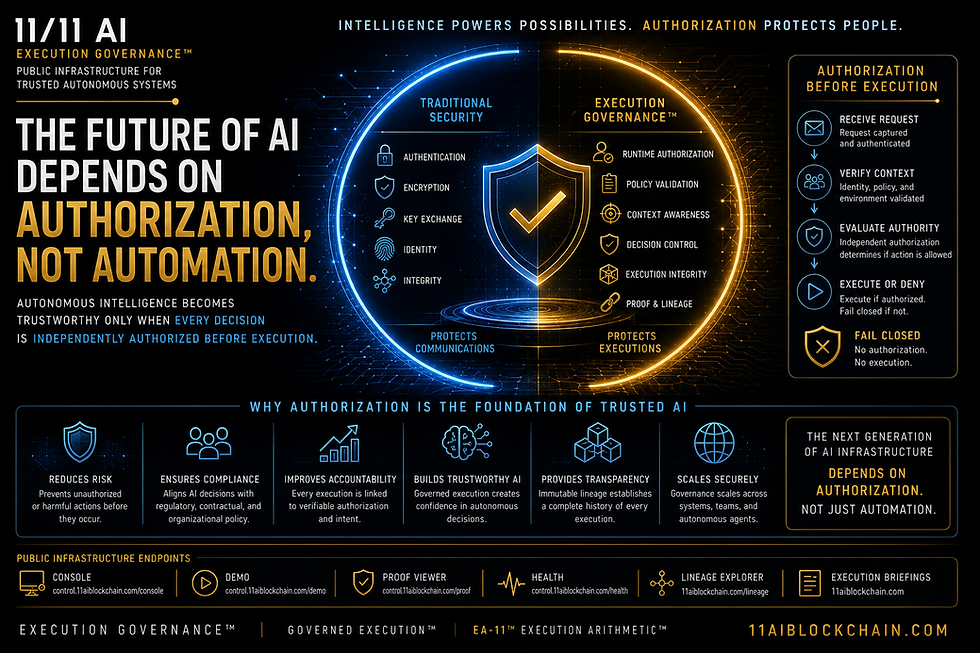
Introducing the Execution Governance Layer
11/11 introduces a new architectural category:
Execution Governance
This is not:
Another AI model
Another application
Another analytics tool
It is a control plane for execution itself.
How 11/11 Changes the Model
Instead of:Request → Execute → Monitor
11/11 enforces:Request → Verify → Allow or Deny → Execute → Cryptographic Proof
Every action becomes:
Authorized before execution
Verified during execution
Proven after execution
This creates a system where:
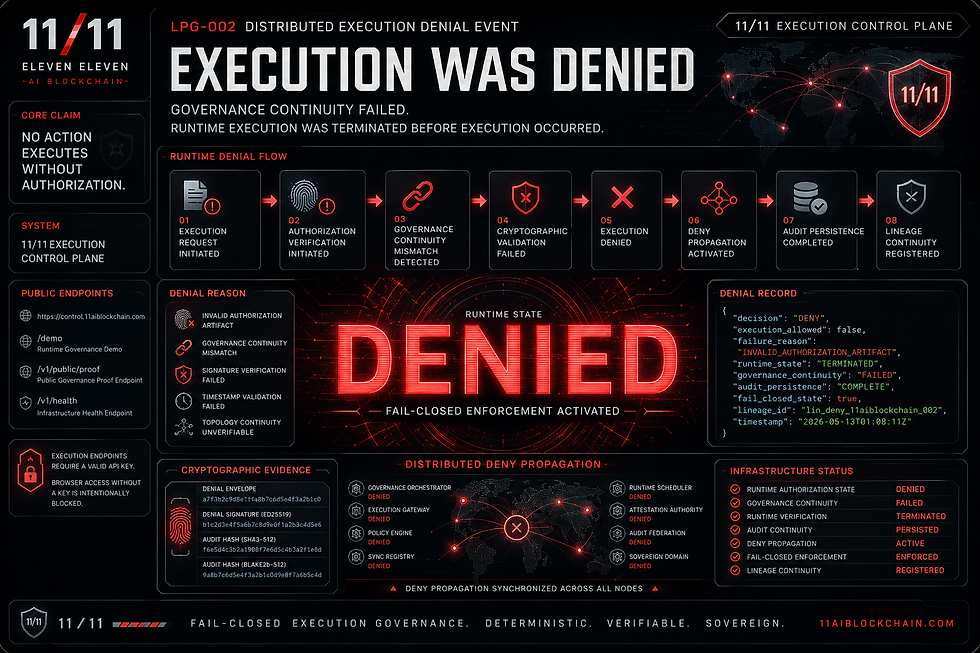
Unauthorized actions never run
All decisions are deterministic
Every outcome is auditable
Core Capabilities of 11/11
1. Policy Before Execution
Every request is evaluated against defined policies before it is allowed to run.
No execution occurs without validation.
2. Fail-Closed Architecture
If a system cannot verify trust, it does not execute.
This eliminates implicit trust assumptions.
3. Deterministic Enforcement
The same input always produces the same policy decision.
No ambiguity. No drift.
4. Cryptographic Runtime Verification
Execution is verified in real time using cryptographic methods.
Not logs. Not estimates. Proof.
5. Immutable Audit Layer
Every action is recorded as tamper-evident evidence.
This is not logging. It is provable history.
Why This Matters Now
AI is moving into high-stakes environments:
Financial systems
Healthcare decisioning
Government operations
Autonomous infrastructure
In these environments:
Errors are not acceptable
Audits must be provable
Compliance must be enforced, not assumed
The current stack cannot meet these requirements.
Comparison to Existing Approaches
Platforms like Amazon Web Services provide tools such as guardrails and automated reasoning within systems like Amazon Bedrock.
These are valuable.
But they operate inside the execution layer.
11/11 operates above it.
It governs:
Whether execution is allowed at all
Under what conditions
With what proof
This is a fundamentally different position in the stack.
A New Standard for Trust
The future of AI requires:
Verifiable execution
Enforced policy
Cryptographic accountability
Not optional.
Mandatory.
11/11 establishes:
A control plane for AI systems
A standard for execution trust
A framework for provable compliance
The Strategic Implication
This is not a feature.
It is infrastructure.
Just as:
NVIDIA defined accelerated computing
Apple defined secure hardware enclaves
Amazon defined cloud infrastructure
11/11 defines:
Execution governance for the next generation of systems
The Rise of 11/11
As AI adoption accelerates, the need for:
Trust
Control
Proof
becomes unavoidable.
Enterprises, governments, and infrastructure providers will require systems that can:
Prevent unauthorized execution
Enforce compliance in real time
Prove outcomes with certainty
This is where 11/11 sits.
Not as an application.
Not as a model.
But as the layer that determines:
What is allowed to run at all
Final Thought
AI does not fail because it is unintelligent.
It fails because it is ungoverned at the point of execution.
The missing link is not better models.
It is control over execution itself.
11/11 is that control.
“11/11 Execution OS and related technologies are part of a patent-pending architecture and reference implementation.”

Comments