
The Rise of AI Execution Control: Why the Next Military Advantage Is Not AI It Is Control of AI Execution
- 11/11 AI

- Apr 23
- 3 min read

Executive Summary
Artificial intelligence has already entered the operational layer of modern defense systems. From ISR pipelines to autonomous targeting systems and cyber operations, AI is no longer experimental it is actively shaping decision-making timelines, escalation risks, and battlefield outcomes.
However, a structural flaw exists across all current deployments:
AI systems execute first, and are evaluated after execution.
This creates a critical vulnerability in military systems:
Unauthorized execution pathways
Adversarial manipulation before detection
Lack of deterministic enforcement of mission constraints
Absence of cryptographic auditability at runtime
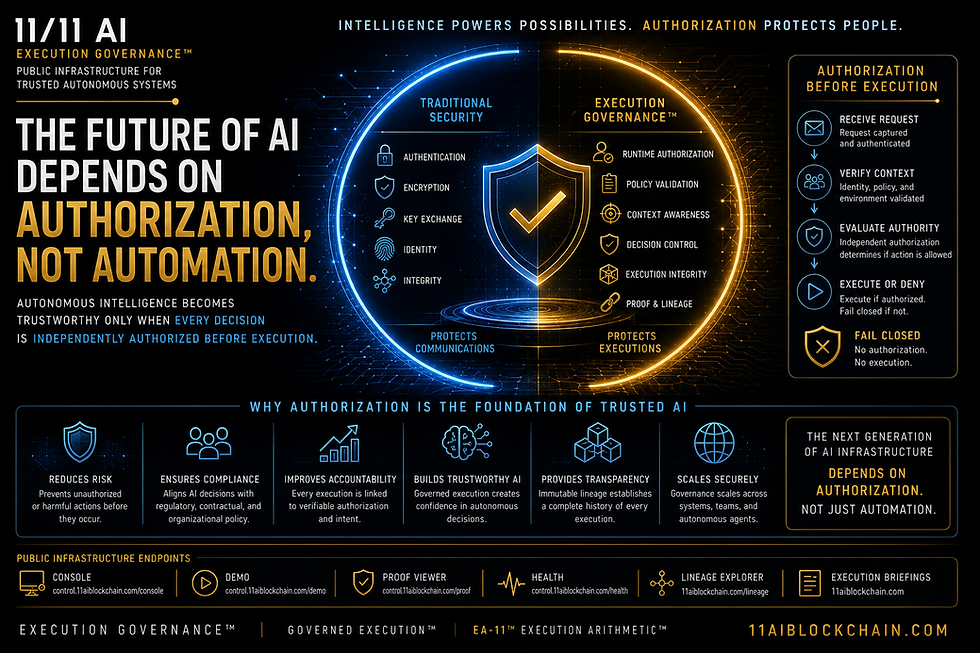
The next phase of military AI evolution is not model improvement.It is execution control infrastructure.
The 11/11 AI Control Plane represents a new class of infrastructure designed to:
Enforce policy before execution
Prevent unauthorized or unsafe actions in real time
Provide cryptographic proof of every execution path
Enable deterministic governance across AI, data, and compute
This is not a feature.This is a new layer of military computing architecture.
1. The Strategic Problem: AI Without Execution Control
Modern military AI deployments include:
Autonomous ISR processing
Target recognition systems
Cyber defense automation
Decision-support systems
Drone swarms and autonomous systems
The problem is not capability.The problem is lack of control at the moment of execution.
Current Model (Broken)
AI receives input
AI executes
System logs output
Humans review after
This creates a pre-execution gap:
No guarantee the AI is operating within authorized boundaries
No enforcement of mission constraints before action
No ability to stop unsafe execution in real time
This gap is unacceptable in:
Classified environments
Autonomous weapons systems
Financial or infrastructure attack scenarios
Intelligence decision chains
2. The Shift: From AI Systems to AI Execution Infrastructure
The defense market is transitioning from:
Model-centric architecture → Control-plane architecture
This mirrors historical shifts:
CPU → Operating System
Internet → TCP/IP control layer
Cloud → Hypervisor isolation
Now:
AI → Execution Governance Layer
3. The 11/11 Architecture Model
The 11/11 system introduces a three-layer execution model:
1. Policy Layer
Defines:
What is allowed
What is denied
Trust conditions
Identity constraints
2. Verification Layer (Pre-Execution)
Before any AI action:
Input is validated
Context is checked
Policy is enforced
Execution is approved or denied
3. Execution + Proof Layer
Execution occurs only if verified
Cryptographic proof is generated
Immutable audit trail is created
Core Principle:
Nothing executes unless it is verified.
4. Military Applications of Execution Control
4.1 Autonomous Weapons Systems
Risk today:
AI misclassification
Unintended escalation
Lack of override before action
11/11 impact:
Enforces engagement rules before execution
Blocks unauthorized target selection
Logs cryptographic proof of decision
4.2 Intelligence Analysis Chains
Risk today:
AI hallucination influences decisions
No validation of reasoning chain
11/11 impact:
Enforces structured decision validation
Requires policy compliance before output
Creates verifiable intelligence lineage
4.3 Cyber Defense Systems
Risk today:
Automated responses can trigger escalation
AI can be manipulated by adversarial inputs
11/11 impact:
Validates every automated action
Blocks unauthorized system changes
Provides forensic-grade audit trails
4.4 Multi-Domain Operations (MDO)
Future warfare requires coordination across:
Air
Land
Sea
Cyber
Space
11/11 enables:
Cross-domain execution control
Unified policy enforcement
Trusted interoperability between systems
5. Why This Is a National Security Priority
The question is no longer:
“Is AI powerful enough?”
The real question is:
“Who controls what AI is allowed to do before it executes?”
This defines:
Decision superiority
Escalation control
System integrity
Trust in autonomous operations
6. Market Reality: The Infrastructure Explosion
AI Infrastructure Growth
$35B → $223B by 2030
Alternative projections: up to ~$394B by 2030
AI Chips and Compute
AI chip market projected to exceed $450B by 2030
Military AI
$9.3B → $19.3B by 2030
Up to ~$35B by 2035
Critical Insight:
None of these markets solve:
Execution control
Pre-runtime governance
Cryptographic enforcement
This is the missing layer.
7. The Control Plane Opportunity
Every AI system requires:
Compute
Data
Model
Deployment
But the next mandatory layer is:
Execution Control
This creates a new category:
→ AI Governance Infrastructure
Comparable to:
AWS for cloud
NVIDIA for compute
TCP/IP for networking
8. Why 11/11 Is Positioned as a Strategic Asset
11/11 is not:
A model
A SaaS tool
A feature layer
It is:
A control plane for AI execution
This means:
It sits above all AI systems
It governs execution across environments
It becomes a dependency for regulated AI
9. Strategic Outcome
If adopted at scale:
AI becomes deterministic
Military systems gain execution assurance
Autonomous operations become controllable
Trust becomes enforceable
Final Statement
The future of military AI will not be defined by who has the best model.
It will be defined by:
Who controls execution before it happens.


Comments