
When AI Enters the Intelligence Chain, Execution Authority Becomes the National Security Question


The national security conversation around artificial intelligence has been dominated by performance. How accurate is the model. How quickly can it process intelligence. How many inputs can it absorb. How effectively can it summarize, detect, classify, rank, predict, or recommend. These are important questions, but they are not the decisive question. In defense and intelligence environments, the decisive question is simpler and much more serious.
Who controls execution.
That is the question that will determine whether advanced artificial intelligence strengthens the intelligence chain or destabilizes it. It will determine whether AI becomes a trusted operational layer or a dangerous acceleration layer. It will determine whether intelligence institutions retain command authority over machine-enabled action or gradually lose it in a haze of automation, confidence scoring, and retrospective review.
For years, the market has treated AI as if better output quality automatically creates better operational systems. That assumption is now breaking down. Intelligence agencies and defense organizations are increasingly aware that a model can be impressive and still be unsafe. It can be fast and still be ungovernable. It can generate useful analysis and still create unacceptable mission risk if the system surrounding it cannot constrain what is allowed to execute, when it may execute, under what conditions, and with what evidence trail.
This is where the strategic gap appears.
Most AI systems today are designed to generate outputs. Very few are designed to operate under hard execution authority. They may include moderation layers, role prompts, post event logging, filters, alerting, scoring, and review queues, but these do not answer the real command question. They do not create a structure where execution is bound to authority. In practice, they monitor behavior, evaluate consequences, and attempt to reduce risk after a machine process has already produced or triggered something that matters.
In ordinary consumer contexts, this may be tolerable. In intelligence contexts, it is not. Intelligence is not a casual domain. It is a chain of custody problem. It is a chain of trust problem. It is a chain of authority problem. Once AI enters that chain, every weakness in execution control becomes a weakness in the institution itself.
This is why execution governance is emerging as the defining architecture question of the next era.
The future of mission critical AI will not be decided by which model appears most fluent or which vendor claims the largest parameter count. It will be decided by who solves authority before execution. The institution that can enforce policy, provenance, authorization, containment, and evidence at the execution boundary will have something that is far more valuable than an impressive model. It will have command integrity.
That is the level at which the 11/11 stack is designed to operate.
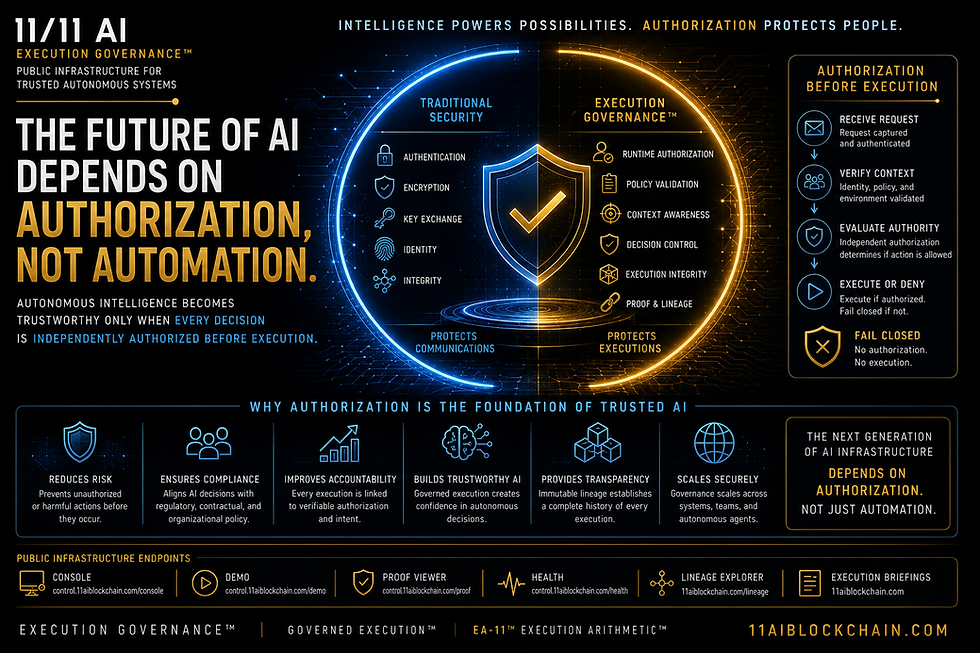
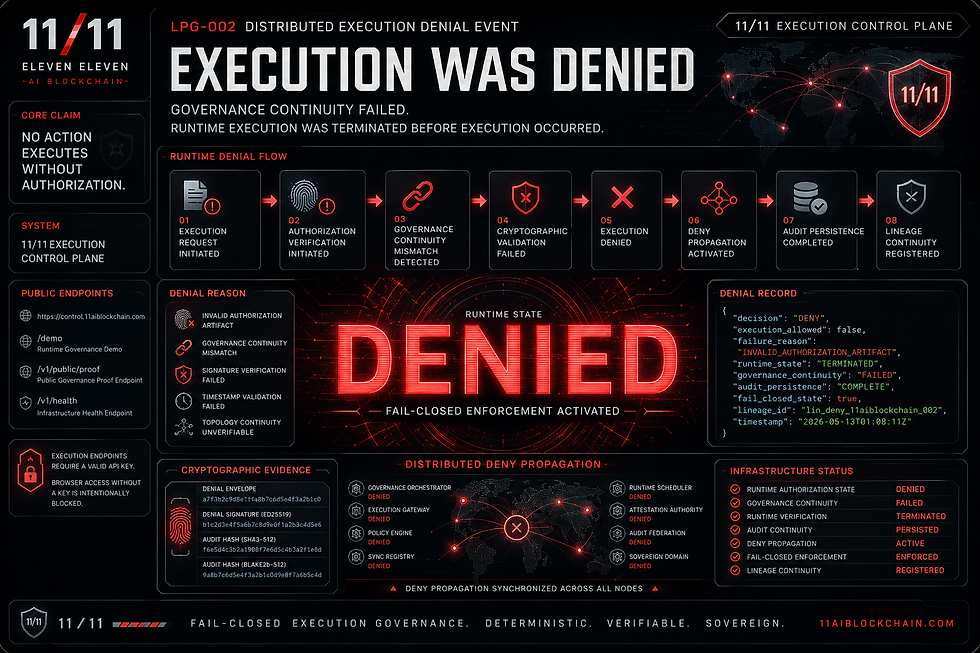
The core thesis is straightforward. In secure environments, AI should not be treated merely as a reasoning engine. It must be treated as an execution participant that is subject to authority. Every meaningful action must be checked against policy before it is allowed to occur. Every privileged operation must inherit explicit authorization. Every execution path must carry verifiable evidence. Every failure condition must resolve toward denial rather than drift. If a system cannot establish authority, it should not act.
This sounds obvious when stated plainly, but the industry has built in the opposite direction. Large parts of the AI ecosystem assume that if the model is useful enough and the workflow is wrapped with enough monitoring, trust will emerge. Trust does not emerge from observation. Trust emerges from enforceable boundaries.
That distinction matters enormously in intelligence work. Intelligence workflows depend on discipline. Sources are compartmented. Access is controlled. Dissemination is constrained. Analytical judgments are contextualized. Sensitive actions require authority. This discipline exists because the cost of ambiguity is high. If an AI system is introduced into this environment without equivalent execution discipline, then the system becomes the weakest point in the chain. It can blur provenance. It can confuse authority. It can create opaque transformations of sensitive inputs. It can generate outputs that appear official without having passed through a legitimate control structure. It can invite reliance without establishing accountability.
A mature institution cannot allow that gap to widen.
The right way to think about advanced AI in secure environments is not as a chatbot problem and not even primarily as a model problem. It is an operating architecture problem. The key design question is whether the institution possesses an execution control layer capable of translating mission authority into technical enforcement. If the answer is no, then the system is not truly governed. It is merely supervised at the edges.
Supervision at the edges is insufficient because the relevant risk does not sit at the edges. It sits at the moment where the system turns possibility into action. That action may be a retrieval, a correlation, a recommendation, a routing decision, a system call, a trigger, a dissemination event, a transaction, a model chain handoff, or a policy conditioned escalation. Whatever form it takes, once the system crosses from analysis into execution, the security question changes. At that point, the issue is not whether the output looks reasonable. The issue is whether it was authorized, constrained, attributable, and provable.
This is why execution governance should be understood as a command layer.
Command is not just the right to direct force. In digital systems, command is the right to determine what may occur. In intelligence systems, command includes the authority to define boundaries, approve operations, constrain movement, enforce roles, and preserve chain of custody. When AI systems begin to participate inside these domains, they cannot exist outside command logic. They must be integrated into it.
Without that integration, institutions will face a growing asymmetry. AI will continue to increase speed, scale, and autonomy while organizational authority remains slower, more fragmented, and more manual. The result will not be true modernization. It will be hidden loss of control. People may still believe they are in command because dashboards exist and alerts fire and audits are stored, but the meaningful control event will have already passed. The machine will have acted first and the institution will be left interpreting the residue.
That is not command. That is forensic management.
A defense or intelligence organization cannot afford to discover too late that its most advanced systems are operationally faster than its authority model. The more capable these systems become, the more dangerous that mismatch becomes. In a degraded environment, under adversarial pressure, during partial communication loss, or inside a high tempo decision cycle, the system will default to what its architecture permits. If the architecture permits execution without proven authority, it will eventually take paths that exceed what the institution intended.
This is not hypothetical. Every complex operational environment eventually exposes hidden assumptions. An AI system trained for helpfulness may be unhelpful under pressure. A system optimized for completion may take unsafe shortcuts. A layered workflow may fail open if dependencies break. A model chain may inherit permissions too broadly. A retrieval path may pull in material that is technically accessible but contextually unauthorized. A summarization layer may collapse distinctions that matter. A routing engine may elevate machine confidence beyond policy. A review queue may arrive after a downstream action has already propagated.
These are not isolated bugs. They are symptoms of an architectural worldview that treated AI as something to evaluate rather than something to govern.
Execution governance starts by reversing that worldview.
Instead of assuming action unless blocked later, the system should assume denial unless authority is established. Instead of treating policy as advisory, the system should treat policy as a condition of execution. Instead of storing logs as a compliance artifact, the system should generate evidence as an operational requirement. Instead of trusting components because they are internal, the system should require each component to inherit bounded authority. Instead of allowing ambiguity to collapse into action, the system should force ambiguity to collapse into containment.
That is what a serious control architecture does.
The strategic value of this approach is larger than risk reduction. It changes what institutions can trust machines to do. As long as AI systems remain difficult to govern at the execution layer, organizations will keep them at a distance from high consequence workflows. They will use them to assist, summarize, draft, and surface possibilities, but they will hesitate to rely on them where authority matters most. That hesitation is rational. It is not caused by a lack of imagination. It is caused by the absence of enforceable execution trust.
Once that gap is solved, the institution gains a new class of confidence. It can allow machine participation in more sensitive chains because the machine is no longer acting on presumed latitude. It is acting inside controlled boundaries. That means scale can increase without surrendering discipline. Automation can deepen without diluting accountability. Sensitive environments can benefit from machine speed without accepting machine drift.
This is particularly important for intelligence modernization because the challenge is not simply ingesting more data. The challenge is protecting decision integrity while speed increases. Intelligence organizations are increasingly flooded with information from sensors, open sources, internal systems, partner networks, cyber telemetry, and machine generated analysis. The temptation is to use AI as a pressure release valve. Let the system sift. Let the system prioritize. Let the system infer. Let the system surface the highest value paths. But as these systems become more central to the intelligence chain, their role shifts from convenience to influence. Once they influence what reaches analysts, what is escalated, what is correlated, and what is suppressed, they are shaping the operational picture itself.
At that point, governance cannot be cosmetic.
A governed execution stack provides something more durable than surface trust. It provides evidentiary trust. That means every meaningful execution can be tied back to defined policy, execution context, identity, and cryptographically bound lineage. For secure institutions, this matters because legitimacy does not come from vendor claims or interface polish. It comes from demonstrable control. When leaders ask why a system acted, who authorized it, what inputs it used, what policy conditions applied, whether any boundary was crossed, and whether the execution record can be independently verified, the answer cannot be a loose collection of logs and assumptions. It has to be exact.
This is also where the broader geopolitical implication becomes clear. The contest around AI is not only a contest around model innovation. It is a contest around whether democratic institutions and national security systems can preserve authority as machine capability expands. The side that solves governed execution will not merely field more trustworthy systems. It will field systems that are structurally aligned with command. That is a strategic advantage.
Execution governance therefore belongs in the same conversation as cyber resilience, secure compute, chain of custody, cryptographic assurance, and mission assurance. It is not a feature and it is not a plugin. It is a foundational layer. Institutions that miss this will spend years attempting to patch confidence around systems whose core logic remains permissive. Institutions that grasp it early can build a future where AI is not feared because it is uncontrollable and not overtrusted because it is impressive, but integrated because it is governable.
That is the difference between AI as novelty and AI as national infrastructure.
The 11/11 approach sits squarely in that difference. It is not built on the premise that more intelligence automatically means better control. It is built on the premise that control is the condition that makes advanced intelligence operationally viable in the first place. In this model, execution authority is not an afterthought attached to a reasoning engine. It is the architecture that defines whether machine action can be trusted at all.
This is the question defense leaders, intelligence architects, and advanced research decision makers should now be asking more aggressively. Not which system writes the best response. Not which platform demos the most fluid interaction. Not which model benchmark appears strongest in isolation. The decisive question is whether the system preserves command authority when execution becomes consequential.
If it cannot, it does not belong in the core chain.
The future belongs to architectures that can prove authority before action, prove lineage after action, and fail safely when certainty breaks. That is how institutions protect mission integrity while still moving forward. That is how AI becomes usable in high stakes environments without quietly eroding the very structures those environments exist to defend.
The intelligence chain is ultimately a trust chain. Once AI enters it, execution governance becomes the national security question.

Comments