
EG-WHITEPAPER-001 Execution Governance Reference Architecture Overview
- 11/11 AI

- May 15
- 3 min read
11/11 Execution Governance Architecture Initiative
Version: Draft v0.1
Classification: Reference Architecture Whitepaper
Specification Family: Execution Governance Infrastructure

Executive Summary
Execution governance establishes deterministic operational enforcement for regulated AI and runtime infrastructure systems.
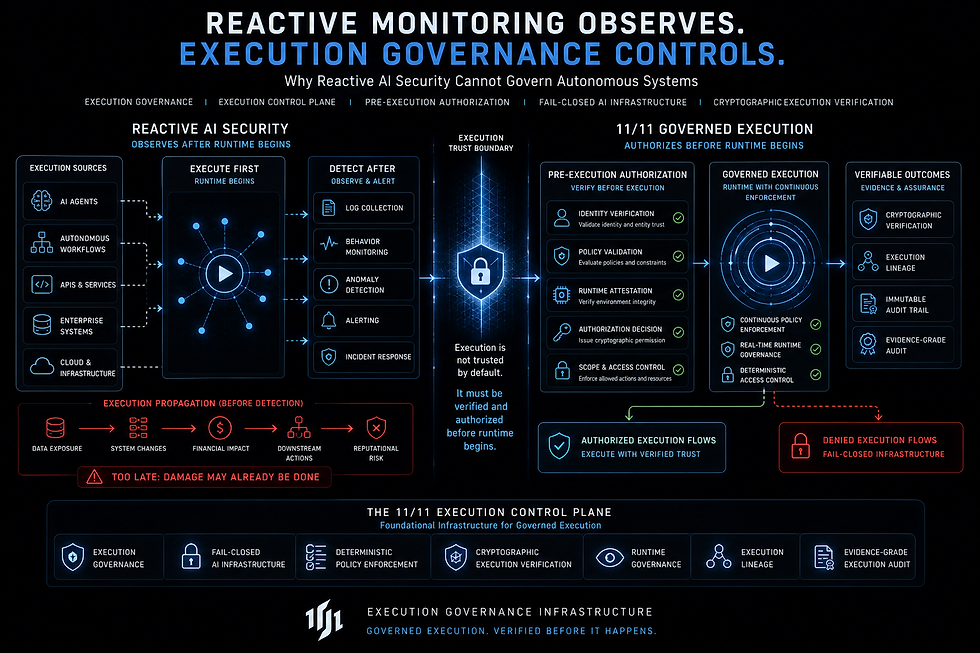
Traditional runtime architectures execute first and evaluate consequences later.
Execution governance introduces:
• deterministic authorization before execution• fail-closed runtime enforcement• cryptographic verification continuity• immutable operational synchronization• distributed telemetry governance• execution lineage traceability
The result is governed operational infrastructure where execution cannot proceed without deterministic governance validation.
1. Execution Governance Architecture Principle
Governed runtime systems MUST maintain deterministic governance continuity across all operational environments.
Execution governance architectures SHALL enforce:
• runtime synchronization continuity• deterministic authorization enforcement• cryptographic operational verification• immutable runtime continuity• distributed telemetry synchronization• fail-closed runtime protections
Any unverifiable runtime condition SHALL trigger deterministic containment protections.
2. Core Execution Governance Layers
Execution governance infrastructure consists of the following operational layers:
Governance Control Plane
Coordinates runtime authorization, synchronization, and operational enforcement.
Policy Enforcement Layer
Applies deterministic governance validation before runtime execution.
Cryptographic Verification Layer
Maintains continuous cryptographic proof validation and trust synchronization.
Runtime Coordination Layer
Synchronizes distributed runtime execution across sovereign operational environments.
Immutable Audit Layer
Maintains tamper-evident operational continuity and audit persistence.
Execution Lineage Layer
Tracks operational execution continuity across all runtime transitions.
3. Deterministic Governance Lifecycle
Execution governance systems SHALL validate:
Runtime Initialization
Policy Authorization
Governance Coordination
Runtime Integrity Verification
Cryptographic Validation
Telemetry Synchronization
Fail-Closed Enforcement Evaluation
Runtime Approval
Immutable Synchronization Persistence
Audit Continuity Verification
Validation failures SHALL trigger deterministic containment protections.
4. Fail-Closed Runtime Enforcement
Governed runtime environments MUST operate under deterministic fail-closed protections.
Failure conditions SHALL trigger containment including:
• authorization synchronization interruption• runtime governance mismatch• cryptographic verification failure• immutable audit discontinuity• distributed coordination inconsistency• unauthorized operational modification• runtime state divergence• unverifiable runtime transitions
Execution MUST default to containment during runtime uncertainty.
5. Cryptographic Governance Verification
Governed execution systems SHALL implement cryptographic verification supporting:
• signed governance records• runtime integrity verification• immutable proof continuity• distributed trust synchronization• governance evidence propagation• audit authenticity validation
Cryptographic verification SHALL remain continuous during runtime propagation.
6. Distributed Runtime Synchronization
Distributed runtime governance systems SHALL synchronize:
• runtime continuity propagation• telemetry synchronization continuity• distributed operational consistency• cryptographic synchronization continuity• immutable audit persistence• runtime governance integrity
Desynchronization SHALL trigger deterministic containment protections.
7. Sovereign Runtime Infrastructure
Execution governance infrastructure supports:
• sovereign AI environments• regulated financial infrastructure• autonomous operational systems• industrial coordination systems• telecommunications infrastructure• defense runtime systems• healthcare operational governance• cross-domain runtime federation
The architecture enables deterministic operational governance across critical runtime environments.
8. Execution Governance Operational Domains
Execution governance operational domains include:
Runtime Governance
Federation Coordination
Service Mesh Governance
Model Governance
Agent Governance
Financial Infrastructure Governance
Industrial Infrastructure Governance
Cross-Domain Authorization
Autonomous Runtime Coordination
Distributed Runtime Synchronization
9. Reference Architecture Components
Reference architecture components include:
• governance control planes• runtime policy systems• cryptographic verification systems• execution lineage systems• immutable audit infrastructure• distributed telemetry synchronization• federation coordination systems• runtime orchestration layers
Each component participates in deterministic governance enforcement continuity.
10. Strategic Infrastructure Positioning
Execution governance infrastructure represents:
• deterministic runtime enforcement• operational governance continuity• fail-closed runtime orchestration• sovereign infrastructure coordination• cryptographic operational verification• immutable operational traceability
Execution governance transforms runtime systems from permissive execution environments into governed operational infrastructure.
Public Governance Infrastructure
Public Governance Console
Runtime Governance Demo
Public Governance Proof Viewer
Infrastructure Health Dashboard
Execution Lineage Explorer
Whitepaper Positioning
EG-WHITEPAPER-001 establishes the foundational execution governance reference architecture for deterministic runtime infrastructure systems requiring fail-closed operational protections, cryptographic verification continuity, immutable synchronization, and distributed runtime coordination.
Part of the 11/11 Execution Governance Architecture Initiative.Establishing deterministic governance architecture standards for sovereign runtime infrastructure systems.


Comments