
Why AI Governance Without Proof Is Worthless

The Illusion of Control Is About to Collapse

Every enterprise claims to have AI governance.
They have:
Policies
Frameworks
Guidelines
Committees
And on paper, it looks complete.
But here is the reality:
Most AI governance today cannot prove anything actually happened the way it claims.
And in the next phase of AI adoption, that is not just a weakness.
It is a failure.
The Shift From Policy to Proof
For years, governance has been built on:
Written rules
Internal controls
Best practices
This worked when systems were:
Human-operated
Slow-moving
Auditable after the fact
But AI changes the equation.
Now:
Decisions happen instantly
Actions execute automatically
Systems operate at machine speed
And regulators are no longer asking:
“Do you have policies ?”
They are asking:
“Can you prove enforcement ?”
Policies Are Not Enforcement
Let’s be direct:
Policies do not control systems.
They describe intent.
That is all.
A policy can say:
“All actions must be authorized”
“Sensitive operations require approval”
“AI must operate within defined boundaries”
But unless the system enforces those rules:
the policy is irrelevant
The Core Gap: Declared vs Actual Behavior
There is a growing gap between:
What organizations say their AI systems do
and
What their systems actually execute
Without proof, there is no way to verify:
Whether policy was applied
Whether authorization occurred
Whether execution was valid
This is the governance gap.
Why Logging Is Not Enough
Most enterprises believe logging solves this.
It does not.
Logs are:
Editable
Incomplete
Post-execution
Often disconnected from decision logic
Logs answer:
“What happened?”
They do not answer:
“Was this action authorized and valid?”
The New Requirement: Evidence
Governance in the age of AI requires:
evidence, not statements
Evidence means:
Verifiable
Tamper-resistant
Cryptographically provable
Tied directly to execution
Without evidence:
Governance cannot be validated
Compliance cannot be demonstrated
Risk cannot be contained
What Regulators Actually Care About
Regulators are shifting toward three core requirements:
1. Proof of Authorization
Was the action allowed?
Under what policy?
At what time?
2. Proof of Execution Integrity
Did the system execute what was authorized?
Was anything altered?
3. Proof of Lineage
What led to this action?
Which systems, data, and decisions were involved?
The End of “Trust Us” Governance
Historically, enterprises operated on:
“Trust us we have controls.”
That model is ending.
The new standard is:
“Show us the proof.”
AI Makes This Non-Negotiable
AI systems:
Generate actions dynamically
Operate across systems
Make non-deterministic decisions
This creates:
Unpredictable execution paths
Complex system interactions
High-impact outcomes
Without proof:
You cannot audit decisions
You cannot validate outcomes
You cannot defend actions
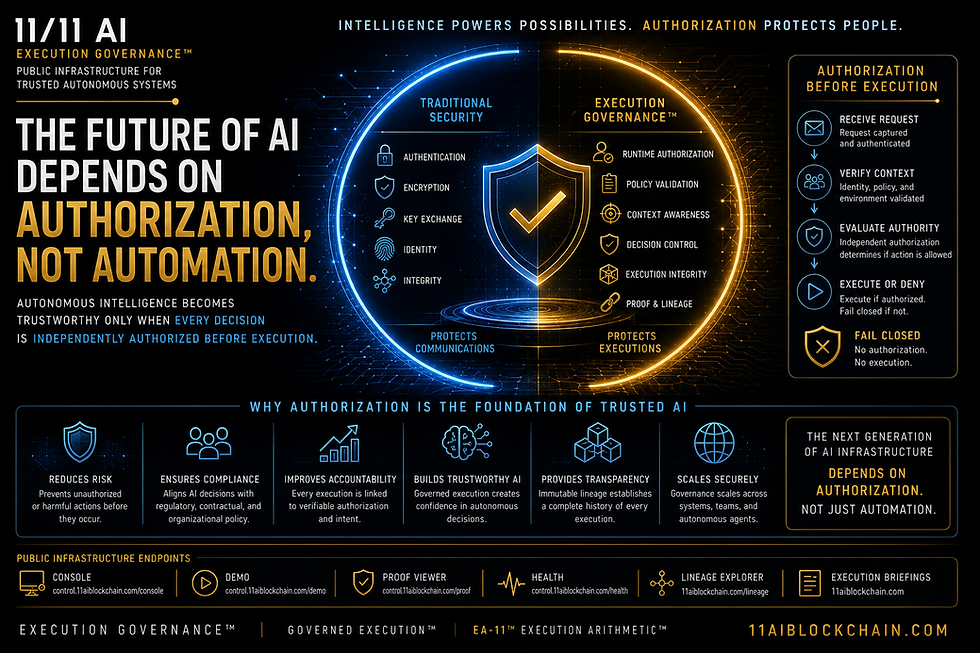
The Three Pillars of Evidence-Grade Governance
To move from policy to proof, systems must implement:
1. Cryptographic Execution Records
Every action must produce:
A signed record
Bound to identity
Bound to policy
Bound to time
This creates:
non-repudiable evidence
2. Verifiable Lineage
Every execution must be traceable across:
Inputs
Decisions
Systems
Outputs
This creates:
end-to-end visibility
3. Immutable Audit Trails
Audit logs must be:
Tamper-resistant
Append-only
Cryptographically verifiable
This creates:
trusted auditability
From Logs to Proof Artifacts
Traditional systems produce logs.
Evidence-grade systems produce:
proof artifacts
These artifacts include:
Authorization signatures
Policy validation results
Execution hashes
Lineage identifiers
They are not just records.
They are verifiable evidence objects.
Why This Matters for Compliance
Regulatory frameworks are evolving toward:
Real-time verification
Continuous compliance
Evidence-based audits
This means:
Audits will not rely on documentation
They will rely on system-generated proof
If you cannot produce it:
you are non-compliant
The Cost of No Proof
Without evidence-grade governance:
1. Legal Risk
Inability to defend decisions
Exposure to liability
2. Regulatory Failure
Failed audits
Fines and restrictions
3. Operational Blindness
No visibility into execution paths
No confidence in system behavior
4. Loss of Trust
Customers lose confidence
Partners reduce integration
Markets penalize risk
The Enterprise Reality Today
Most enterprises today:
Have governance policies
Have logging systems
Have monitoring tools
But they do not have:
Cryptographic authorization proof
Verifiable execution lineage
Immutable evidence trails
This means:
their governance is not provable
The Required Shift
Enterprises must move from:
Policy-based governance→ Evidence-based governance
This requires:
Re-architecting execution layers
Embedding proof into every action
Making verification native to the system
The Role of an Execution Control Layer
To generate evidence, governance must be enforced at:
the point of execution
This layer must:
Intercept actions
Validate policy
Issue authorization
Generate proof artifacts
Record lineage
This is not optional.
It is foundational.
Evidence as Infrastructure
Proof is not a feature.
It is infrastructure.
It must be:
Built into the system
Generated automatically
Verified independently
The Strategic Advantage
Organizations that implement evidence-grade governance gain:
1. Defensible Systems
Every action can be proven
2. Regulatory Readiness
Compliance becomes continuous
3. Operational Clarity
Full visibility into execution
4. Market Trust
Confidence from customers and partners
The Inevitable Outcome
Just as:
Financial systems require audit trails
Security systems require authentication
Networks require encryption
AI systems will require:
proof of execution
The Bottom Line
Governance without proof is not governance.
It is documentation.
Policies do not protect systems.Proof does.
Logs do not prove enforcement.Cryptographic evidence does.
If you cannot prove how your AI executed, you are not governing it.
11/11 Position
11/11 is evidence-grade AI governance.
Every action authorized
Every execution proven
Every decision traceable


Comments