
Why AI Infrastructure Must Fail Closed


Reactive Security Is No Longer Sufficient
Modern infrastructure still largely operates under an outdated assumption:
execution is trusted by default.
Systems execute first.
Verification occurs later.
Monitoring occurs after runtime activity already happened.
Audit occurs after operational exposure already exists.
This model was tolerated when systems were smaller, slower and operationally isolated.
That environment no longer exists.
AI systems now operate across:
autonomous orchestration
distributed runtime environments
enterprise decision systems
financial infrastructure
healthcare operations
multi-agent coordination
critical infrastructure automation
In these environments, execution itself becomes the trust boundary.
Reactive security models cannot sufficiently govern systems that already executed untrusted operations.
Infrastructure must therefore evolve toward:fail-closed execution governance.
What Fail-Closed Infrastructure Means
Fail-closed infrastructure denies execution whenever trust requirements cannot be verified.
Execution does not proceed because execution was requested.
Execution proceeds only when authorization requirements are satisfied.
Under fail-closed governance:
missing authorization results in denial
invalid verification results in denial
expired authorization results in denial
policy mismatch results in denial
replay detection results in denial
environment mismatch results in denial
runtime integrity failure results in denial
Infrastructure therefore defaults toward:non-execution unless trust is established.
This fundamentally changes runtime trust assumptions.
The Failure of Reactive AI Security
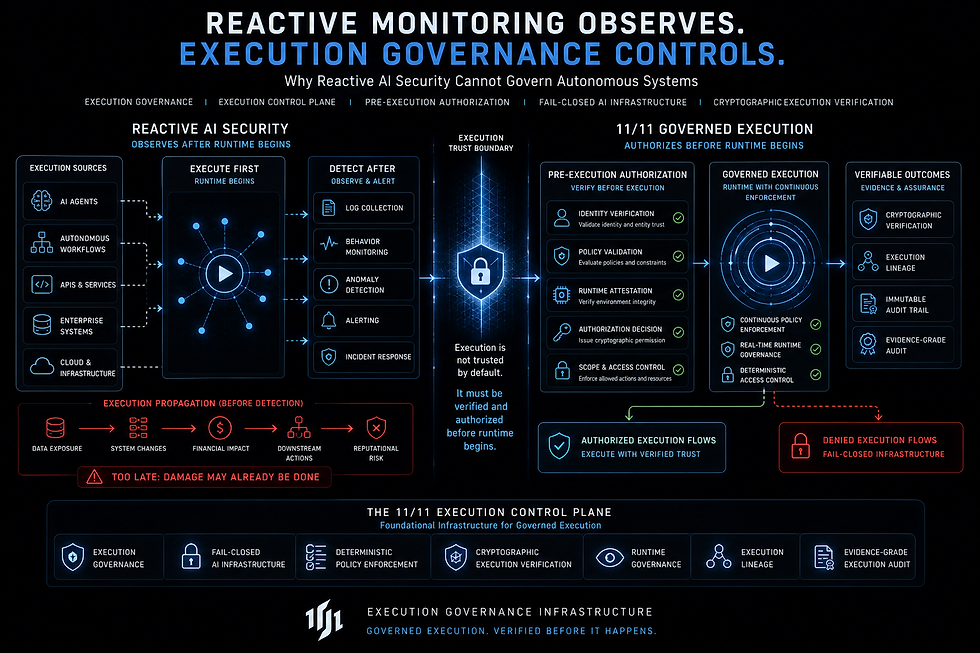
Most current AI security approaches remain reactive.
They focus on:
monitoring
anomaly detection
post-execution audit
runtime observation
behavioral scoring
after-the-fact remediation
These systems attempt to identify compromise after execution already occurred.
But autonomous infrastructure introduces a different operational reality.
By the time reactive systems detect malicious or unauthorized execution:
execution already happened.
This becomes increasingly dangerous in:
autonomous agents
financial execution systems
critical infrastructure automation
AI-driven orchestration
regulated healthcare environments
distributed machine operations
Reactive governance therefore becomes structurally insufficient.
Governed Execution Changes the Trust Model
Execution governance introduces a fundamentally different infrastructure model.
Execution is no longer implicitly trusted.
Execution must first be:
verified
authorized
policy compliant
cryptographically attributable
runtime-bound
operationally governed
before runtime activity begins.
This establishes:governed execution.
Under governed execution:
trust is established before execution.
Not after.
Pre-Execution Authorization
Fail-closed infrastructure requires mandatory pre-execution authorization.
Every execution request must first pass through:
policy authority
verification systems
authorization services
runtime integrity validation
environmental trust evaluation
cryptographic verification
Execution therefore becomes conditional upon governance validation.
This creates deterministic operational trust.
Authorization Artifacts
Fail-closed governance depends upon authorization artifacts.
Authorization artifacts function as runtime trust objects.
These artifacts may contain:
execution scope
initiator identity
environmental binding
policy validation state
cryptographic signature
validity windows
runtime attribution data
Execution should not proceed without valid authorization artifacts.
Authorization becomes infrastructure-native.
Fail-Closed Infrastructure and Autonomous Systems
Autonomous systems increase the necessity of fail-closed execution.
As AI agents begin coordinating:
transactions
infrastructure operations
orchestration workflows
enterprise automation
machine-to-machine interactions
runtime trust becomes existentially important.
Autonomous systems cannot safely operate under open execution assumptions.
They require governed execution environments.
This makes fail-closed governance foundational infrastructure for the autonomous era.
Runtime Governance
Fail-closed infrastructure requires active runtime governance systems.
These may include:
execution gateways
policy authorities
authorization engines
verification services
governance meshes
lineage systems
immutable audit systems
Together these components form:the execution control plane.
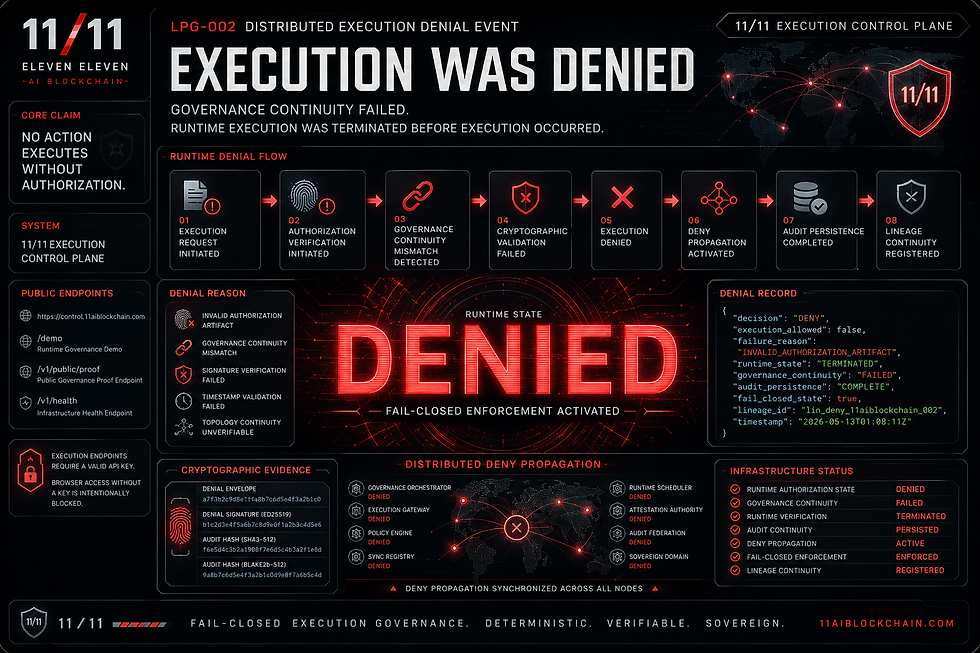
Denial as Infrastructure
Historically, denial was treated as operational failure.
Execution governance changes that assumption.
Under governed infrastructure:
denial becomes a security capability.
Execution denial proves that governance is functioning correctly.
A denied execution event demonstrates:
policy enforcement
authorization validation
runtime governance
operational integrity
trust boundary enforcement
Denial therefore becomes:evidence of infrastructure maturity.
Cryptographic Verification
Fail-closed infrastructure increasingly requires cryptographic verification.
Execution authorization must become:
attributable
verifiable
tamper-evident
runtime-bound
evidence-capable
This enables:
immutable execution audit
execution lineage
forensic validation
regulatory verification
operational accountability
Execution governance therefore evolves into:cryptographically governed infrastructure.
Infrastructure Is Changing
Historically:
network encryption became mandatory.
Identity verification became mandatory.
Zero Trust became normalized.
Runtime governance now emerges as the next infrastructure requirement.
As AI infrastructure scales, execution itself can no longer remain implicitly trusted.
Infrastructure must increasingly require:
governed execution
pre-execution authorization
fail-closed enforcement
runtime verification
cryptographic execution proof
immutable lineage systems
This transition is already beginning.
Conclusion
Fail-closed infrastructure establishes a new operational trust model for AI systems and autonomous environments.
Under this model:
execution is denied unless verified
authorization becomes mandatory
runtime governance becomes foundational
reactive security becomes insufficient
cryptographic verification becomes infrastructure-native
governed execution becomes operationally necessary
Infrastructure therefore shifts from:trusted-by-default
to:
verified-before-execution.
Fail-closed execution governance is no longer theoretical.
It is becoming inevitable infrastructure.
“In governed infrastructure, failure to verify must result in denial.”

Comments