
Why Civilizations Create Layers Of Participation

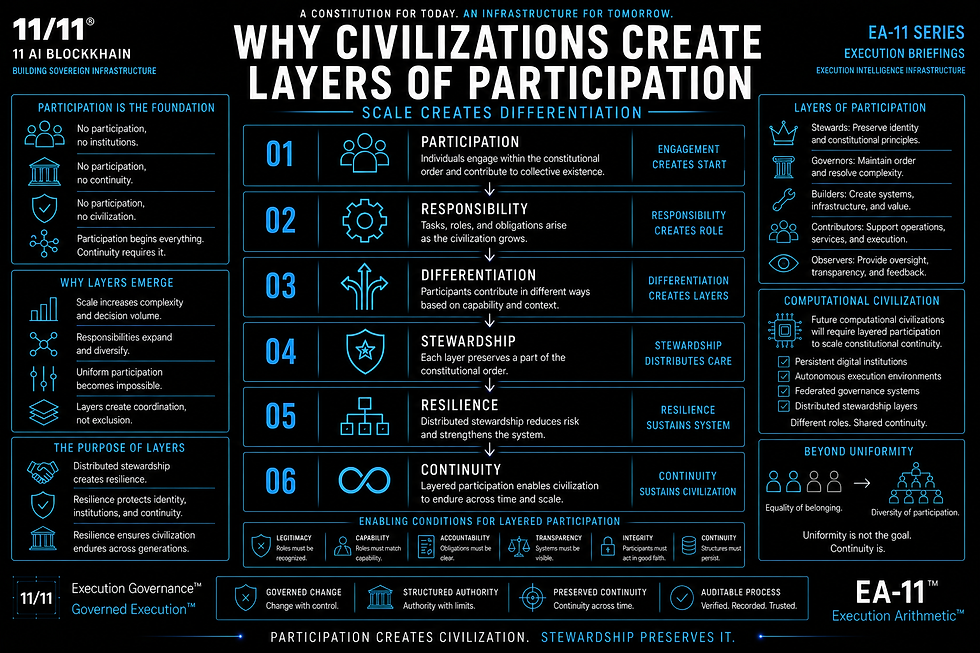
Every civilization begins with participation.
Without participation there are no institutions.
Without participation there is no continuity.
Without participation there is no civilization.
Yet participation rarely remains uniform.
As civilizations grow, different participants assume different roles.
Some preserve.
Some govern.
Some build.
Some contribute.
Some maintain.
Some observe.
This differentiation appears repeatedly throughout history.
The pattern is so common that it raises an important question.
Why do civilizations create layers of participation?
The answer may be that continuity itself requires differentiation.
The larger a civilization becomes, the more difficult it becomes for every participant to engage in identical ways.
Scale creates variation.
Variation creates layers.
Layers create structure.
Structure creates continuity.
Participation Is Never Static
Many constitutional systems begin with relatively simple participation structures.
As the system grows, complexity increases.
New responsibilities emerge.
New obligations emerge.
New forms of stewardship emerge.
Participation evolves.
The result is not less participation.
The result is differentiated participation.
Participants continue contributing.
They simply contribute differently.
Scale Changes Participation
A small constitutional order may allow every participant to engage directly with nearly every decision.
Large civilizations cannot operate this way indefinitely.
The volume of decisions becomes too large.
The complexity becomes too great.
The continuity requirements become too demanding.
As scale increases, civilizations create participation layers.
The purpose is not exclusion.
The purpose is coordination.
Differentiation Creates Continuity
One of the most misunderstood aspects of constitutional participation is differentiation.
Differentiation is often viewed as inequality.
Its deeper function is continuity.
When responsibilities become specialized, continuity becomes more resilient.
Participants focus on different aspects of constitutional order.
The result is distributed stewardship.
Civilization becomes less dependent upon any single participant.
Layers Of Stewardship
Civilizations ultimately survive because stewardship becomes distributed.
Some participants preserve identity.
Some preserve institutions.
Some preserve continuity.
Some preserve constitutional order.
Participation therefore becomes layered stewardship.
The civilization survives because responsibility is shared across multiple levels.
Participation And Constitutional Identity
Not every participant occupies the same role.
Yet every participant contributes to constitutional identity.
This distinction is important.
Differentiated participation does not eliminate belonging.
It organizes belonging.
A civilization becomes stronger when participation remains diverse while constitutional identity remains shared.
Computational Participation
Future computational civilizations will likely encounter similar dynamics.
Persistent digital institutions.
Autonomous constitutional systems.
Federated governance environments.
Execution civilizations operating continuously across time.
These systems will require participation structures capable of scaling.
Layered participation may emerge as naturally within computational civilization as within institutional civilization.
The Myth Of Uniform Participation
Uniform participation is often treated as an ideal.
History suggests otherwise.
Most enduring civilizations survive because participation becomes organized rather than uniform.
Different participants contribute differently.
Different responsibilities emerge.
Different forms of stewardship appear.
The constitutional challenge becomes maintaining legitimacy across these layers.
Participation And Continuity
The deeper purpose of participation is continuity.
The deeper purpose of layered participation is scalable continuity.
The constitutional system survives because responsibility becomes distributed.
Distributed responsibility creates resilience.
Resilience creates endurance.
Endurance creates civilization.
Beyond Sovereignty
Sovereignty explains preservation.
Participation explains continuity.
The constitutional question is no longer:
Who preserves the system?
The constitutional question becomes:
How does an entire civilization participate in preservation?
Layered participation emerges as one answer.
Conclusion
Civilizations create layers of participation because continuity becomes increasingly difficult to sustain at scale.
Participation differentiates.
Responsibilities diversify.
Stewardship distributes.
The result is constitutional resilience.
As computational civilization evolves, layered participation may become one of the primary mechanisms through which constitutional continuity survives growth, complexity, and time.
Participation creates civilization.
Layered participation allows civilization to endure.
11/11 introduces Execution Governance™ infrastructure for governed autonomous execution and deterministic operational control.
Execution Governance™ Governed Execution™ EA-11™ Execution Arithmetic™
Patent Pending
Public Infrastructure Endpoints

Comments