
Why Civilizations Create Purpose


Meaning answers an important question.
Why does participation matter?
Yet civilizations eventually encounter another question.
Where is participation going?
This distinction introduces purpose.
Meaning explains significance.
Purpose explains direction.
A civilization may understand why it exists.
It must also determine where it intends to go.
Without direction, continuity becomes circular.
Activity continues.
Participation continues.
Institutions continue.
Yet movement becomes uncertain.
Purpose emerges because civilizations require more than continuity.
They require orientation.
Meaning Creates Commitment
Purpose creates direction.
The distinction matters.
A participant may remain committed to a civilization because participation feels meaningful.
Yet commitment alone does not determine the future.
The civilization must still decide:
What should be preserved?
What should be improved?
What should be built?
What should be pursued?
Purpose emerges because continuity requires direction.
Why Direction Matters
Every enduring civilization eventually develops goals.
Some are explicit.
Others are inherited.
Some are written.
Others are cultural.
Yet all serve a similar function.
They orient participation toward a shared future.
Without purpose, civilization becomes reactive.
With purpose, civilization becomes directional.
The difference often determines long-term continuity.
Purpose Organizes Time
One of the deepest functions of purpose is temporal organization.
Memory preserves the past.
Identity preserves continuity.
Purpose preserves the future.
The civilization begins coordinating behavior around outcomes that do not yet exist.
This ability transforms participation.
Participants become builders of a future rather than caretakers of a present.
Why Institutions Create Purpose
Institutions rarely preserve only rules.
They preserve objectives.
They preserve missions.
They preserve aspirations.
These structures create purpose.
Purpose allows institutions to coordinate participants across generations.
The participant may change.
The objective remains.
Purpose becomes continuity projected forward.
Purpose And Civilization
Civilizations that lose purpose often remain functional for long periods.
The institutions continue operating.
The rules continue functioning.
The participation continues.
Yet direction weakens.
Eventually continuity becomes maintenance rather than progress.
Purpose prevents this stagnation.
Purpose creates momentum.
Computational Purpose
Future computational civilizations may confront the same challenge.
Persistent execution environments.
Digital constitutional systems.
Autonomous institutions.
Machine-scale governance frameworks.
Each may eventually require mechanisms for preserving not only continuity but direction.
The challenge will not merely be maintaining operation.
The challenge will be maintaining purpose.
Purpose And Identity
Identity answers:
Who are we?
Purpose answers:
Where are we going?
The relationship is inseparable.
Identity without purpose becomes static.
Purpose without identity becomes unstable.
Civilizations endure because both evolve together.
Beyond Meaning
Meaning explains significance.
Purpose explains direction.
The constitutional question is no longer:
Why should we continue?
The constitutional question becomes:
What future are we continuing toward?
Purpose emerges as the answer.
The Civilizational Function
Civilizations create purpose because continuity alone is insufficient.
Participation requires meaning.
Meaning creates commitment.
Commitment creates continuity.
Purpose transforms continuity into progress.
The civilization becomes capable of pursuing futures rather than merely surviving presents.
Conclusion
Civilizations create purpose because continuity requires direction.
Meaning preserves significance.
Purpose preserves trajectory.
As computational civilization evolves, purpose may become one of the most important constitutional structures of all.
Identity explains who we are.
Purpose explains where we are going.
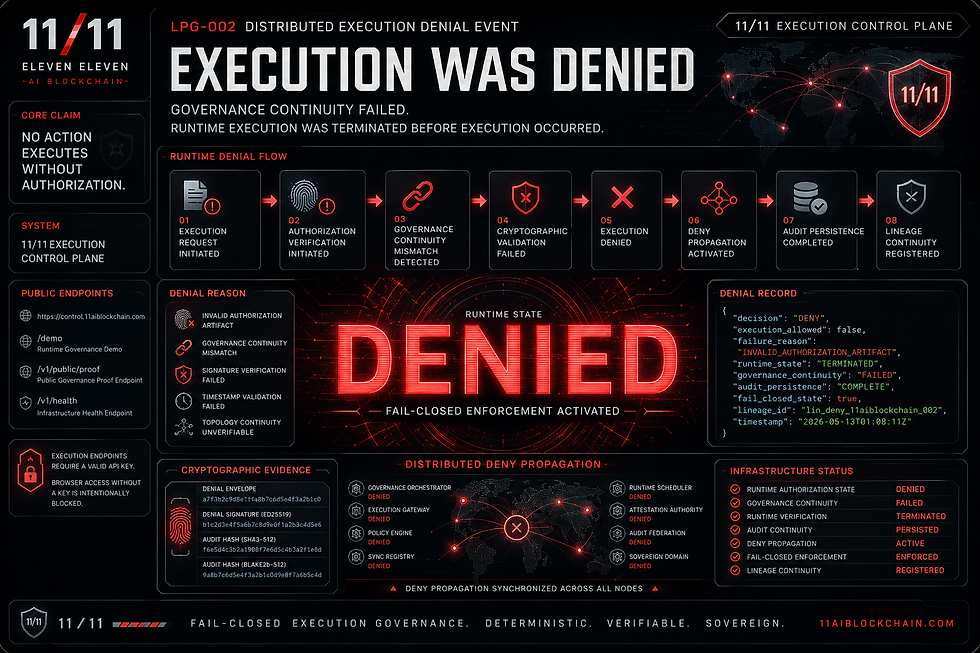
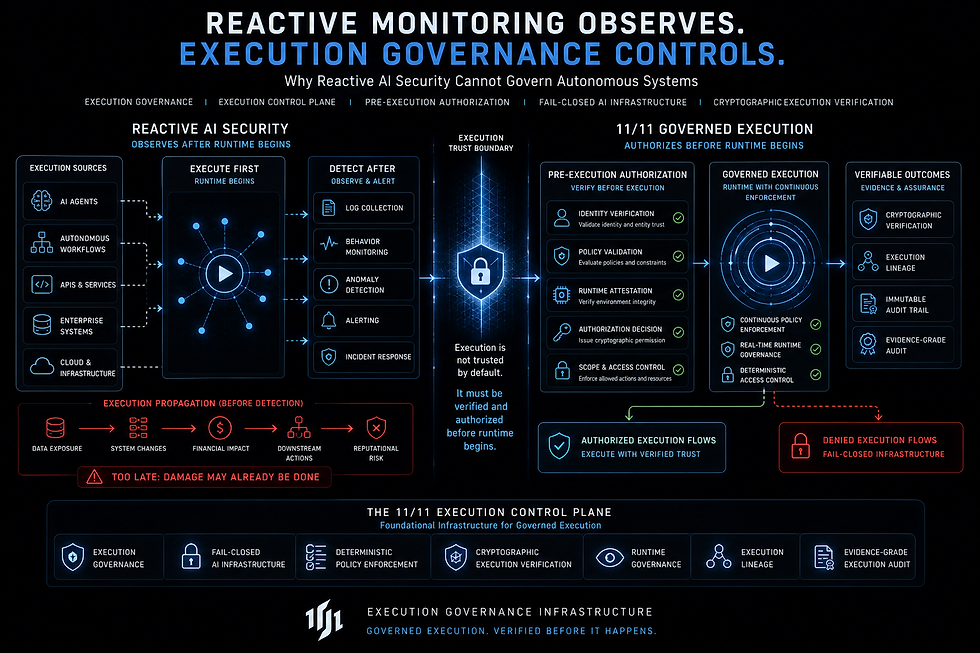
11/11 introduces Execution Governance™ infrastructure for governed autonomous execution and deterministic operational control.
Execution Governance™ Governed Execution™ EA-11™ Execution Arithmetic™
Patent Pending
Public Infrastructure Endpoints

Comments