
Why Civilizations Create Shared Reality


Every enduring civilization depends upon a remarkable achievement.
Millions of participants.
Millions of experiences.
Millions of perspectives.
Yet enough agreement exists to maintain a common reality.
Without this agreement, constitutional order becomes impossible.
Membership becomes uncertain.
Authority becomes disputed.
Participation becomes fragmented.
Continuity becomes fragile.
Civilizations therefore create shared reality.
Not because everyone thinks identically.
Because constitutional systems require enough common understanding to preserve continuity across time.
This shared reality becomes one of the least visible yet most important foundations of civilization itself.
Reality Is A Constitutional Requirement
Many people view reality as external to civilization.
Constitutional systems reveal something deeper.
Civilizations must continuously define:
What happened.
What matters.
What is recognized.
What is legitimate.
What is remembered.
What is preserved.
These decisions gradually construct a shared understanding of reality.
Without such structures, constitutional continuity becomes impossible.
Why Agreement Matters
Civilizations do not require total agreement.
They require sufficient agreement.
The difference is important.
A constitutional order survives because participants possess enough common understanding to cooperate despite disagreement.
The objective is not uniformity.
The objective is continuity.
Shared reality provides the minimum foundation required for participation.
Memory Creates Reality
Memory preserves events.
Precedent preserves judgment.
Together they create shared reality.
The civilization remembers.
The civilization interprets.
The civilization applies.
Over time, these processes establish a common understanding of constitutional order.
Reality becomes inherited rather than rediscovered.
Recognition Depends Upon Shared Reality
Recognition requires common understanding.
A civilization must collectively recognize:
Membership.
Identity.
Authority.
Participation.
Legitimacy.
Without shared reality, recognition fragments.
Without recognition, constitutional order weakens.
Shared reality therefore becomes one of the foundations beneath constitutional identity.
Why Institutions Preserve Reality
Institutions serve many functions.
One of the most important is preserving shared reality.
Records.
Archives.
Precedent.
Governance.
Constitutions.
Each contributes to a common understanding of what the civilization believes to be true.
This role becomes increasingly important as systems scale.
Computational Shared Reality
Future computational civilizations will likely confront the same challenge.
Persistent execution environments.
Digital constitutional systems.
Federated governance frameworks.
Autonomous institutional structures.
These environments will require mechanisms capable of preserving shared reality across vast scales.
The challenge is not merely storing information.
The challenge is preserving common understanding.
Reality And Continuity
The deeper purpose of shared reality is continuity.
Participants cooperate because they recognize a common framework.
Institutions persist because they operate within a common framework.
Civilizations endure because they preserve a common framework.
Shared reality becomes the invisible architecture beneath constitutional continuity.
Beyond Precedent
Precedent preserves judgment.
Shared reality preserves meaning.
The constitutional question is no longer:
What should we continue applying?
The constitutional question becomes:
What do we continue recognizing together?
The answer creates civilization.
The Civilization Function
A civilization survives when enough participants share enough reality to preserve enough continuity.
This condition is fragile.
It requires maintenance.
It requires memory.
It requires precedent.
It requires constitutional order.
Yet without it, civilization gradually fragments into disconnected experiences.
Shared reality becomes the mechanism through which continuity remains possible.
Conclusion
Civilizations create shared reality because continuity requires common understanding.
Memory preserves experience.
Precedent preserves judgment.
Shared reality preserves meaning.
As computational civilization evolves, shared reality may become one of the most important constitutional structures ever created.
Constitutions preserve order.
Shared reality preserves civilization.
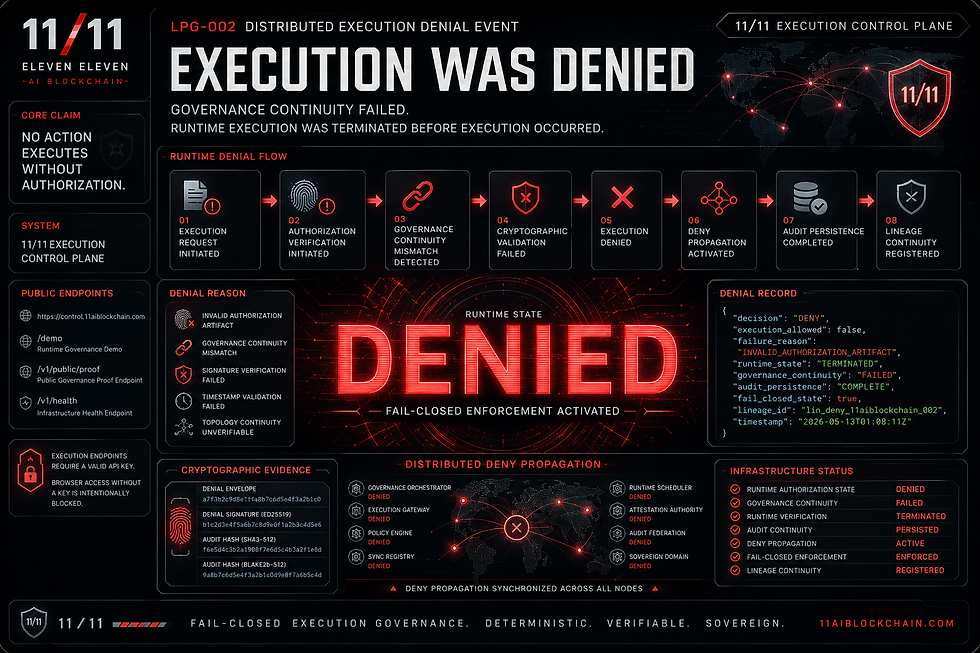
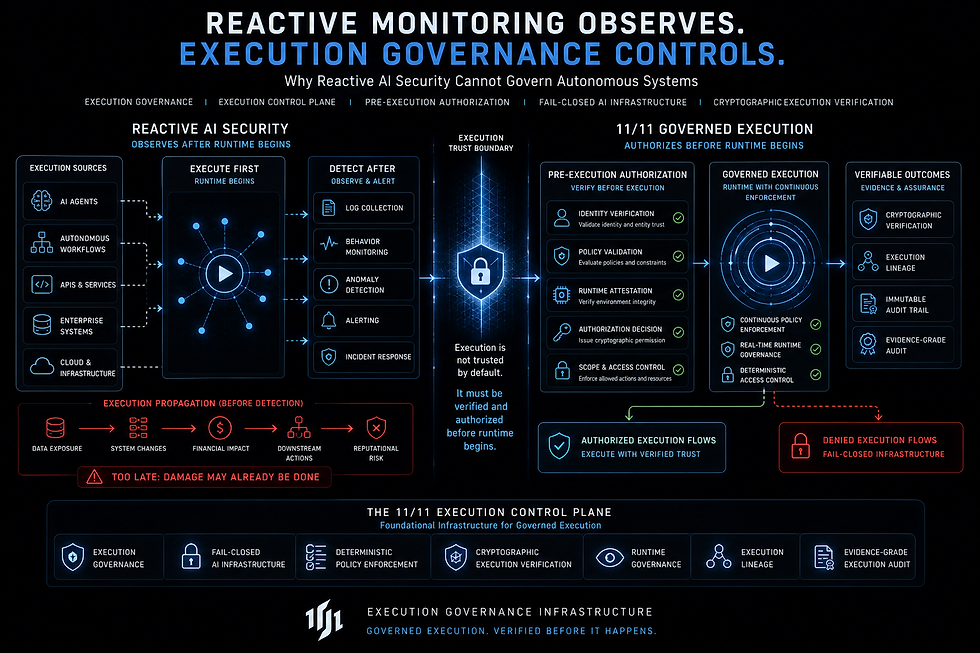
11/11 introduces Execution Governance™ infrastructure for governed autonomous execution and deterministic operational control.
Execution Governance™ Governed Execution™ EA-11™ Execution Arithmetic™
Patent Pending
Public Infrastructure Endpoints

Comments