
Why Civilizations Create Trust


Every civilization depends upon something it cannot fully enforce.
Trust.
Laws may exist.
Institutions may exist.
Governance may exist.
Yet no civilization can function if every interaction requires complete verification.
The cost becomes too great.
The complexity becomes too great.
The civilization becomes unable to scale.
Trust emerges because continuity requires efficiency.
Civilizations eventually discover that survival depends upon creating relationships that do not require constant proof.
The result is trust.
Not as sentiment.
Not as optimism.
But as constitutional infrastructure.
Trust Reduces Complexity
A civilization without trust must verify everything.
Every transaction.
Every commitment.
Every relationship.
Every institution.
Every decision.
Such a system becomes overwhelmed by its own complexity.
Trust emerges because verification alone cannot sustain civilization.
Trust reduces the cost of participation.
The lower the cost of participation, the greater the capacity for continuity.
Trust Is Inherited
One of the most important characteristics of trust is that it accumulates.
A civilization remembers.
Participants remember.
Institutions remember.
The result is inherited trust.
New participants benefit from relationships established before they arrived.
This inheritance allows civilizations to scale beyond individual relationships.
Trust becomes civilizational memory expressed as confidence.
Why Institutions Create Trust
Institutions are often viewed as mechanisms of control.
Their deeper purpose may be trust creation.
Institutions establish expectations.
Expectations create predictability.
Predictability creates trust.
Trust creates participation.
Participation creates continuity.
The institution therefore becomes a machine for converting uncertainty into stability.
Trust And Legitimacy
Legitimacy and trust reinforce one another.
Legitimate institutions generate trust.
Trust strengthens legitimacy.
The cycle becomes self-reinforcing.
Civilizations endure because enough participants trust enough institutions enough of the time to preserve continuity.
This condition is fragile.
Yet without it, constitutional order becomes difficult to sustain.
Why Computational Systems Need Trust
Future computational civilizations will confront the same challenge.
Persistent execution systems.
Autonomous institutions.
Machine-scale governance.
Federated constitutional frameworks.
The scale of these environments will make constant verification impossible.
Trust structures will emerge because participation requires them.
The challenge will be creating trust without sacrificing accountability.
Trust Is Not Blind
Trust is often confused with certainty.
Civilizations reveal otherwise.
Trust exists precisely because certainty is unavailable.
The participant cannot know everything.
The institution cannot verify everything.
Trust becomes a mechanism for operating despite uncertainty.
This function explains why trust repeatedly appears wherever civilizations endure.
Trust And Continuity
The deeper purpose of trust is continuity.
Civilizations survive because participants continue participating.
Participation depends upon trust.
Trust depends upon predictability.
Predictability depends upon constitutional order.
The chain is difficult to see.
Yet it operates continuously beneath civilization itself.
The Cost Of Distrust
History repeatedly demonstrates the consequences of collapsing trust.
Participation declines.
Institutions weaken.
Legitimacy erodes.
Continuity fragments.
The problem is rarely immediate collapse.
The problem is accelerating complexity.
Every interaction becomes more expensive.
Civilization becomes harder to sustain.
Beyond Shared Reality
Shared reality explains common understanding.
Trust explains cooperation.
The constitutional question is no longer:
What do we recognize together?
The constitutional question becomes:
What do we rely upon together?
Trust emerges as the answer.
Conclusion
Civilizations create trust because continuity becomes impossible without it.
Trust reduces complexity.
Trust enables participation.
Trust strengthens legitimacy.
Trust sustains civilization.
As computational civilizations emerge, trust may become one of the most important constitutional infrastructures ever created.
Shared reality preserves understanding.
Trust preserves cooperation.
Cooperation preserves civilization.
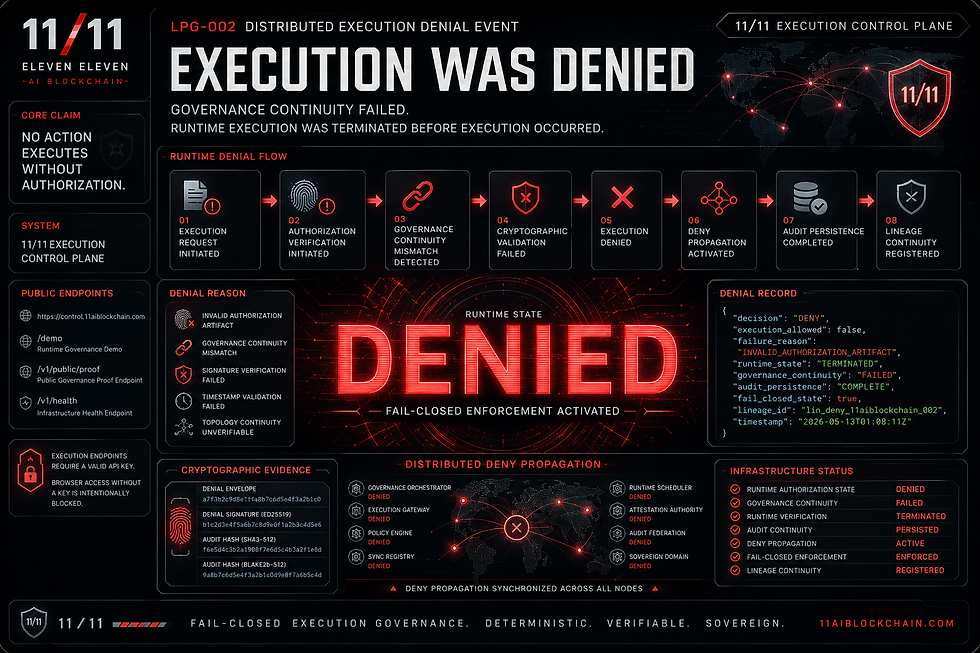
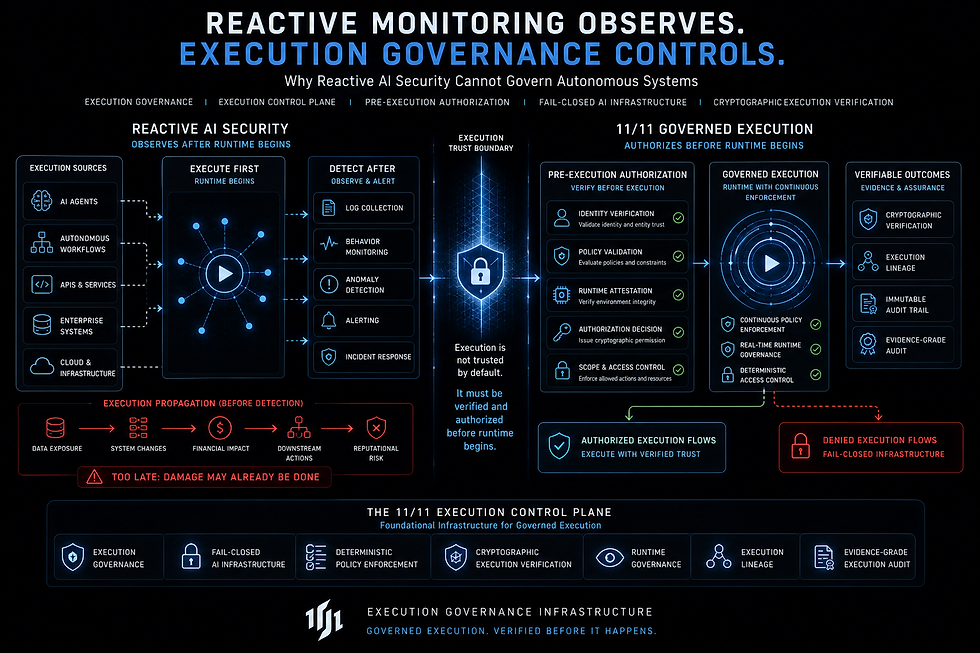
11/11 introduces Execution Governance™ infrastructure for governed autonomous execution and deterministic operational control.
Execution Governance™ Governed Execution™ EA-11™ Execution Arithmetic™
Patent Pending
Public Infrastructure Endpoints

Comments