
Why Computation Has States Beyond True And False

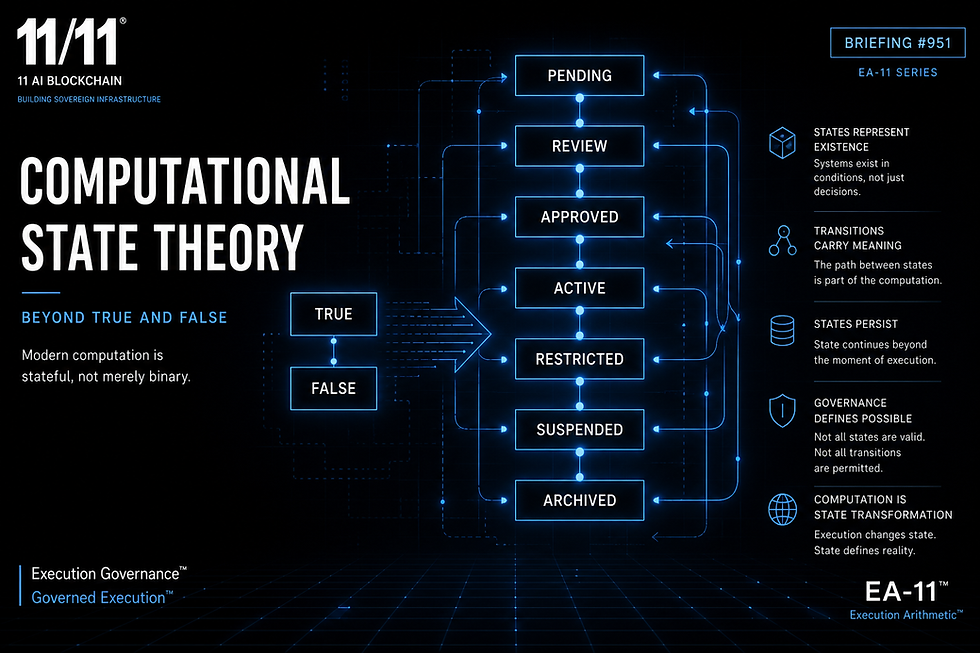
For most of the history of computing, computation has been described through the lens of binary logic.
A proposition is either true or false.
A condition is either satisfied or unsatisfied.
A branch is either taken or not taken.
This model proved extraordinarily successful because it allowed engineers to build deterministic systems from simple foundations. Binary logic remains one of the most powerful abstractions ever developed.
Yet modern computational infrastructure increasingly demonstrates that binary logic alone is insufficient for describing how real systems behave.
The challenge is not that Boolean logic is incorrect.
The challenge is that Boolean logic describes decisions, while modern infrastructure must govern states.
These are not the same thing.
A decision may occur instantaneously.
A state may persist indefinitely.
A decision can be represented as a single evaluation.
A state represents an ongoing condition of existence.
This distinction becomes increasingly important as computational systems move beyond isolated calculations and begin operating as persistent autonomous environments.
A cloud platform does not merely evaluate conditions.
It maintains states.
An identity system does not merely answer questions.
It maintains states.
An autonomous execution environment does not merely process instructions.
It maintains states.
The future of computational theory therefore requires a framework capable of explaining states that exist beyond simple binary outcomes.
This requirement serves as the foundation of Computational State Theory.
The Limitations Of Binary Thinking
Boolean logic provides answers.
Computational systems require context.
Consider a user account.
Traditional logic may ask:
Is the user authorized?
The answer may be true or false.
Yet real systems rarely operate this way.
A user may be:
Pending approval
Temporarily suspended
Under review
Restricted
Probationary
Expired
Revoked
Delegated
Federated
Archived
None of these conditions can be fully represented through a single binary value.
Each represents a distinct computational state.
The system behaves differently depending upon which state exists.
The computational reality is therefore not binary.
It is stateful.
As systems become larger and more autonomous, the number of possible states grows dramatically.
Theoretical models that rely solely on true-or-false distinctions fail to capture this complexity.
Computation As State Management
A deeper view of computation reveals that most modern systems are fundamentally state management systems.
Databases manage states.
Identity systems manage states.
Networks manage states.
Economic systems manage states.
Governance systems manage states.
Even artificial intelligence systems increasingly manage states.
The execution itself is often secondary.
What matters is how execution changes the state of the environment.
This observation creates a profound shift in perspective.
Instead of asking:
"What decision was made?"
We begin asking:
"What state exists now?"
This question is often far more important.
A single decision may occur in milliseconds.
The resulting state may persist for years.
The persistence of state frequently matters more than the event that created it.
The Emergence Of Intermediate States
Classical computational models often assume a direct transition from one condition to another.
Modern systems rarely behave this way.
Instead they operate through intermediate states.
Examples include:
Requested
Pending
Validated
Approved
Active
Suspended
Expired
Archived
These states create a progression.
The progression itself contains meaning.
The computational environment becomes a dynamic system rather than a static evaluation engine.
This progression cannot be understood through Boolean logic alone.
It requires a richer theory of state.
State As Computational Reality
The most important insight of Computational State Theory may be that states are not secondary artifacts.
They are the primary reality of computation.
Applications exist as states.
Users exist as states.
Permissions exist as states.
Resources exist as states.
Policies exist as states.
Identities exist as states.
Even computation itself can be understood as movement between states.
Under this model, execution becomes a mechanism for state transformation.
The execution matters because it changes state.
Without state transformation, execution has little significance.
This perspective places states at the center of computational theory.
Beyond Binary Infrastructure
The rise of autonomous systems makes state-centric thinking increasingly necessary.
Autonomous systems continuously evaluate their environments.
They adapt.
They respond.
They evolve.
They persist.
Such systems may occupy hundreds or thousands of possible operational conditions.
Attempting to reduce these conditions to true-or-false distinctions destroys important information.
State theory preserves that information.
It provides a richer vocabulary for describing computational reality.
This richer vocabulary becomes essential for governing increasingly complex execution environments.
Computational State Spaces
Every system possesses a state space.
A state space represents all possible conditions that a system may occupy.
Some systems possess only a few states.
Others possess millions.
Large-scale infrastructure increasingly operates across enormous state spaces.
Understanding these spaces becomes one of the central challenges of modern computational architecture.
The larger the state space becomes, the more important state governance becomes.
Not every state should be reachable.
Not every transition should be permitted.
Not every state should persist indefinitely.
These observations form the bridge between Computational State Theory and Execution Governance™.
The Future Of Computational Theory
As computational systems continue to evolve, theoretical models based exclusively on binary logic become increasingly incomplete.
Binary logic remains foundational.
But foundations alone do not describe entire structures.
Modern infrastructure requires theories capable of describing persistence, transition, inheritance, restriction, continuity, and transformation.
These concepts emerge naturally from state-centric models.
The next generation of computational theory will likely focus less on isolated decisions and more on persistent state environments.
Such systems are no longer simply computing answers.
They are maintaining realities.
Conclusion
The history of computing has largely been written through the language of true and false.
The future of computing may be written through the language of state.
Computation is not merely the evaluation of conditions.
It is the creation, modification, preservation, and transformation of states.
Understanding this distinction reveals why modern computational systems cannot be fully described through binary logic alone.
The future belongs to systems that recognize computation as a state-driven phenomenon.
Computational State Theory begins with this observation.
True and false may describe decisions.
States describe reality.
11/11 introduces Execution Governance™ infrastructure for governed autonomous execution and deterministic operational control.
Execution Governance™ Governed Execution™ EA-11™ Execution Arithmetic™
Patent Pending

Comments