
Why Computational Citizenship Emerges


Every enduring civilization eventually creates a distinction between those who belong and those who do not.
This distinction appears in different forms throughout history.
Membership.
Citizenship.
Affiliation.
Recognition.
Participation.
Yet beneath these different expressions lies the same underlying reality.
A civilization cannot operate indefinitely without determining who exists within its constitutional order.
The same principle increasingly applies to computational environments.
As computational systems evolve beyond applications and become persistent institutional realities, they encounter a familiar question:
Who belongs?
This question marks the emergence of Computational Citizenship.
Not as a political construct.
Not as a legal construct.
But as an inevitable consequence of persistent constitutional order.
Membership Precedes Citizenship
Before citizenship comes membership.
A system must first distinguish participants from non-participants.
Without distinction there can be no identity.
Without identity there can be no accountability.
Without accountability there can be no continuity.
Membership therefore emerges as one of the earliest organizational requirements of any enduring system.
The constitution defines order.
Citizenship defines participation within that order.
Why Systems Create Membership
A temporary system may not require citizenship.
A calculator requires none.
A simple application requires little.
A civilization requires it.
The difference is persistence.
As systems endure across time, they must answer questions concerning:
Participation
Recognition
Responsibility
Rights
Obligations
Continuity
Citizenship emerges as a mechanism for organizing these relationships.
The larger the system becomes, the more important membership becomes.
Recognition As A Constitutional Act
Citizenship ultimately begins with recognition.
A system acknowledges that an entity belongs within its constitutional framework.
This recognition creates a relationship.
The relationship creates standing.
The standing creates participation.
Citizenship therefore represents more than identification.
It represents constitutional recognition.
The system is not merely observing an entity.
The system is acknowledging membership.
Citizenship Creates Continuity
One of the most important functions of citizenship is continuity.
Constitutions preserve order.
Citizens preserve civilizations.
A constitutional framework without recognized participants possesses structure but lacks continuity.
Citizenship provides the mechanism through which constitutional order survives across generations.
This principle may become increasingly important within computational civilizations.
Rights And Obligations
Membership inevitably creates asymmetry.
Participants receive benefits.
Participants accept responsibilities.
This duality appears throughout constitutional systems.
Rights emerge.
Obligations emerge.
Participation creates both.
Computational citizenship therefore cannot be understood solely through privileges.
It must also be understood through responsibility.
The relationship operates in both directions.
Identity Is Not Citizenship
Identity and citizenship are often confused.
Identity answers:
Who are you?
Citizenship answers:
To what do you belong?
A system may recognize identity without granting citizenship.
A visitor possesses identity.
A citizen possesses membership.
This distinction becomes increasingly important as computational systems become federated and interconnected.
Constitutional Membership
The deeper purpose of citizenship is constitutional.
Citizenship establishes the relationship between individuals and constitutional order.
It defines participation within the framework.
It creates continuity between constitutional principles and constitutional reality.
Without citizens, constitutions become abstractions.
Without constitutions, citizenship loses meaning.
The two concepts evolve together.
Computational Civilization
Future computational systems may increasingly resemble constitutional societies.
Persistent digital institutions.
Governed execution environments.
Federated identity systems.
Autonomous infrastructures.
Such environments will inevitably confront questions of membership.
Who participates?
Who belongs?
Who possesses standing?
These questions are not technical.
They are constitutional.
Citizenship As An Emergent Property
The most important insight may be this:
Citizenship is rarely designed first.
Citizenship emerges.
As systems grow.
As continuity develops.
As constitutional order matures.
Membership becomes necessary.
Recognition becomes necessary.
Participation becomes necessary.
Citizenship emerges because constitutional civilization eventually requires it.
Conclusion
Computational Citizenship is not merely a feature of advanced systems.
It is an emergent property of constitutional order itself.
Whenever a persistent constitutional framework must distinguish members from non-members, citizenship begins to appear.
The future of computational civilization may therefore depend not only upon constitutions.
It may depend upon the citizens who participate within them.
Constitutions preserve order.
Citizenship preserves civilization.
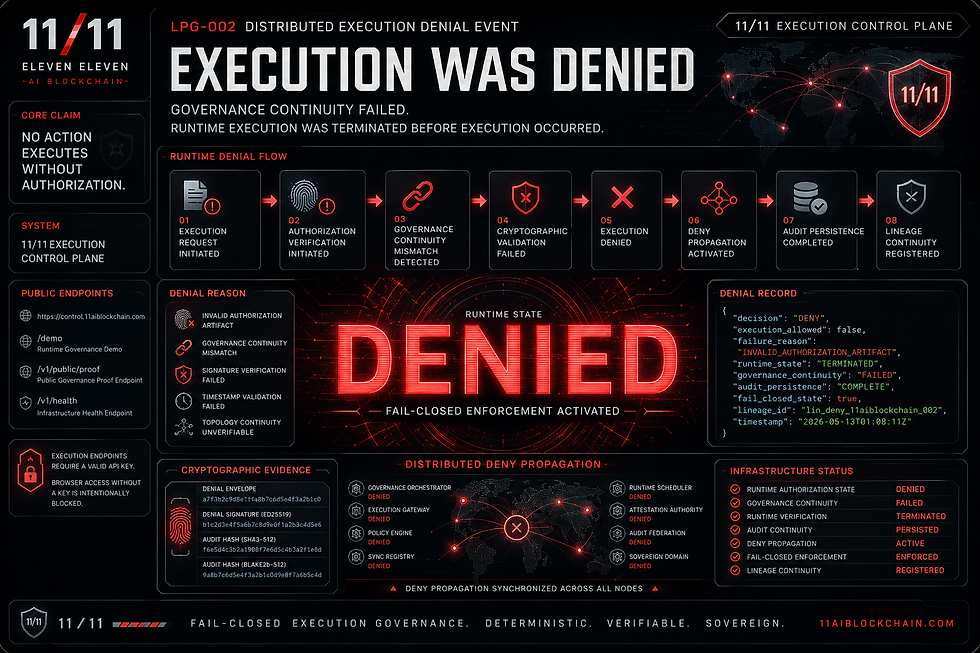
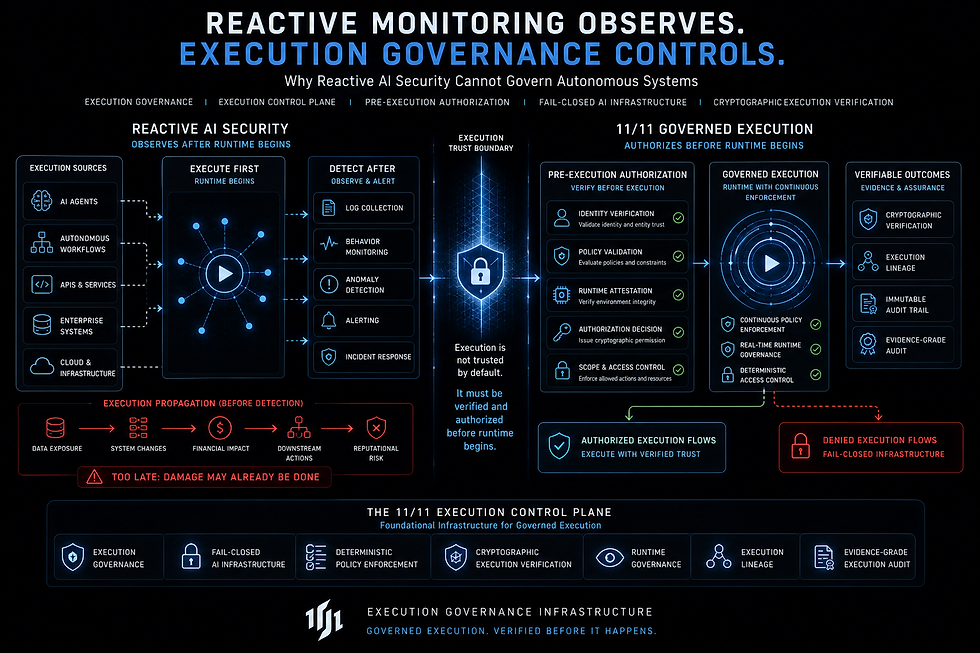
11/11 introduces Execution Governance™ infrastructure for governed autonomous execution and deterministic operational control.
Execution Governance™ Governed Execution™ EA-11™ Execution Arithmetic™
Patent Pending
Public Infrastructure Endpoints

Comments