
Why Constitutions Endure


Every civilization eventually confronts the same problem.
People are temporary.
Institutions seek permanence.
The individuals who establish an order eventually disappear.
The order must remain.
This challenge may be one of the oldest problems in human organization.
How can a system preserve continuity longer than the people who created it?
How can principles survive their authors?
How can order survive its founders?
How can legitimacy survive generations?
The answer repeatedly emerges in the same form.
The Constitution.
Not because constitutions are perfect.
Not because constitutions eliminate conflict.
Not because constitutions prevent change.
Constitutions endure because they solve a problem that no civilization can avoid.
The problem of continuity.
The Mortality Problem
Every authority is temporary.
Every leader is temporary.
Every institution is temporary.
Every generation is temporary.
Civilizations therefore face a permanent dilemma.
If order depends entirely upon individuals, order disappears when those individuals disappear.
A durable civilization requires something that exists above individuals.
Something capable of preserving continuity despite turnover.
The constitution emerges as a solution to this problem.
It creates a framework capable of surviving those who created it.
Memory Beyond Individuals
Civilizations possess memory.
Institutions possess memory.
Constitutions are among the most powerful forms of institutional memory ever created.
They preserve principles.
They preserve boundaries.
They preserve legitimacy.
They preserve assumptions about order itself.
This preservation allows civilizations to accumulate continuity across generations.
The constitution becomes a vessel through which memory survives time.
Why Power Does Not Endure
Power often appears permanent.
History demonstrates otherwise.
Power changes hands.
Power shifts.
Power fragments.
Power concentrates.
Power disappears.
Power alone rarely creates permanence.
The reason is simple.
Power governs the present.
Constitutions govern continuity.
One manages circumstances.
The other preserves foundations.
Civilizations endure because foundations outlive circumstances.
The Architecture Of Continuity
A constitution is fundamentally an architecture of continuity.
Its purpose is not to prevent change.
Its purpose is to allow change without destroying identity.
This distinction explains why enduring constitutions balance permanence and adaptation.
Too much permanence creates irrelevance.
Too much adaptation creates instability.
The constitution survives because it protects both continuity and evolution simultaneously.
Why Civilizations Build Constitutions
Civilizations eventually discover that stability cannot depend entirely upon force.
Force requires constant application.
Force requires constant presence.
Force requires constant maintenance.
Constitutions create a different mechanism.
They transform continuity into a shared structure.
The result is order that survives even when direct enforcement becomes impossible.
Constitutions therefore become instruments of civilization rather than instruments of control.
Constitutional Endurance
Not every constitution survives.
Many fail.
Many decay.
Many become irrelevant.
Yet the constitutions that endure tend to share common characteristics.
They preserve foundational principles.
They maintain legitimacy.
They balance continuity and adaptation.
They resist concentration of authority.
Most importantly, they remain recognizable despite changing conditions.
Recognition becomes the hallmark of endurance.
Computational Civilization
The same challenge now approaches computational systems.
Autonomous infrastructures.
Persistent digital institutions.
Governed execution environments.
Machine-scale organizational systems.
These systems increasingly require continuity across decades rather than software releases.
The question therefore becomes familiar.
How can computational order survive the systems that created it?
How can computational principles survive technological change?
The answer may once again be constitutional.
Beyond Governance
Governance explains operation.
Constitutions explain continuity.
This distinction is critical.
Many systems function.
Few endure.
Endurance requires a framework capable of preserving identity across time.
Constitutions provide that framework.
The future of computational civilization may depend less upon governance itself and more upon the constitutional structures beneath governance.
The Civilization Test
Every civilization eventually faces a test.
Can it preserve its principles longer than the people who created them?
This is ultimately the constitutional question.
Constitutions endure because they provide a mechanism for answering it.
They allow continuity to outlive individuals.
They allow legitimacy to outlive institutions.
They allow order to outlive circumstances.
This capability may be among the most important achievements of organized civilization.
Conclusion
Constitutions endure because they solve a problem that no civilization escapes.
The problem of continuity.
People disappear.
Technologies change.
Institutions evolve.
Civilizations transform.
Yet constitutional systems preserve identity despite these realities.
The future of computational civilization may ultimately depend upon learning the same lesson.
Order survives when principles survive.
Principles survive when constitutions endure.
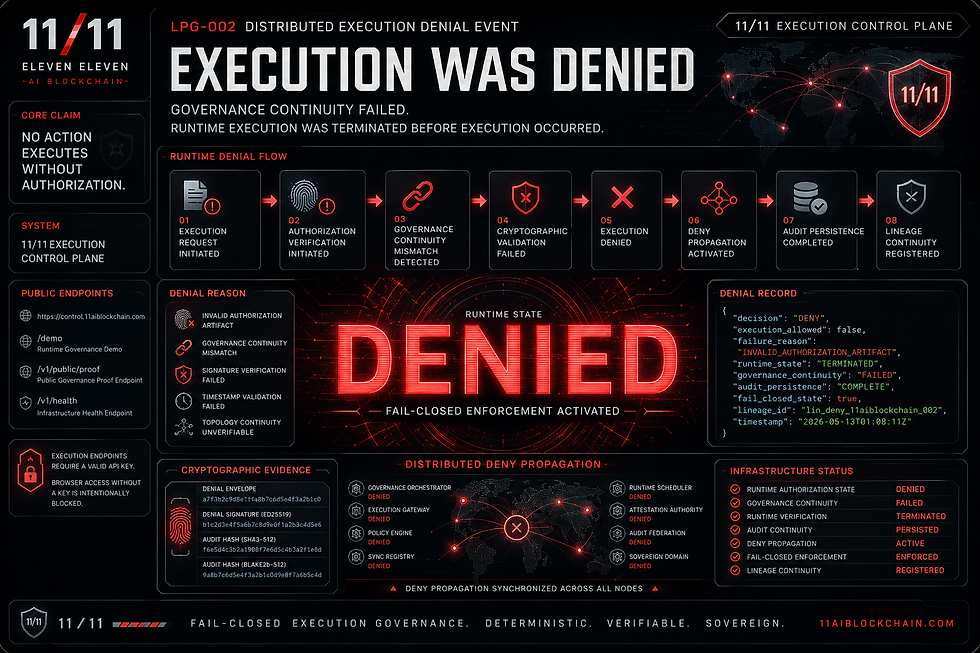
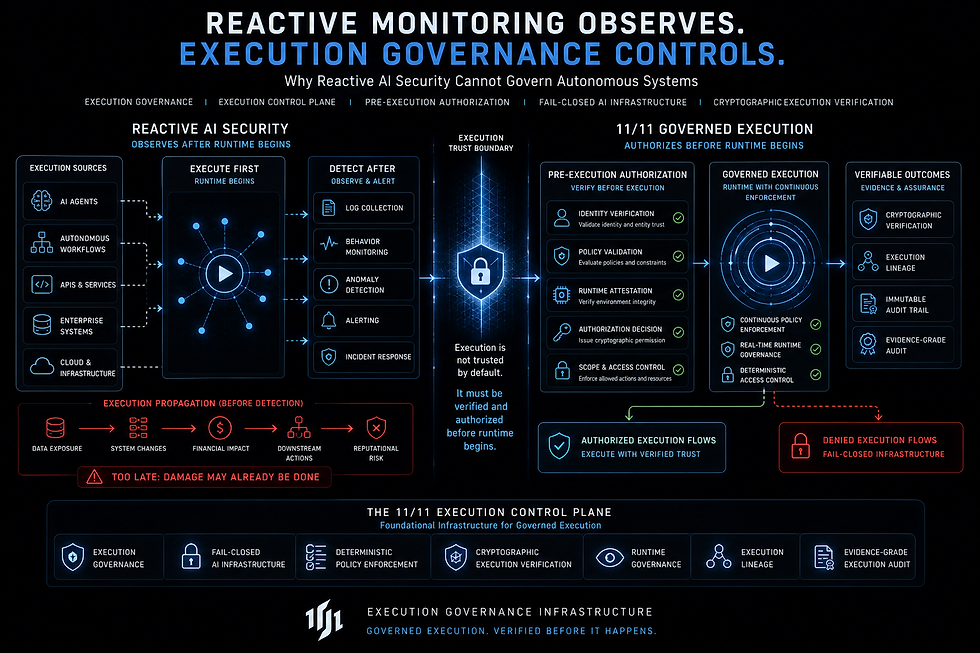
11/11 introduces Execution Governance™ infrastructure for governed autonomous execution and deterministic operational control.
Execution Governance™ Governed Execution™ EA-11™ Execution Arithmetic™
Patent Pending
Public Infrastructure Endpoints

Comments