
Why Execution Governance Becomes Inevitable


Throughout this series, a pattern has appeared repeatedly.
Execution expands.
Consequences expand.
Complexity expands.
Governance requirements expand.
The relationship is not ideological.
It is structural.
Every sufficiently consequential execution environment eventually creates governance requirements.
The only question is when those requirements become visible.
Execution Governance™ emerges because the visibility threshold has been crossed.
Execution is no longer small.
Execution is no longer isolated.
Execution is no longer exclusively human.
Execution is becoming autonomous, distributed, continuous, and foundational.
The governance requirement therefore becomes unavoidable.
This is why Execution Governance™ becomes inevitable.
Infrastructure Categories Emerge From Persistent Problems
Infrastructure categories do not emerge because someone invents terminology.
They emerge because recurring problems refuse to disappear.
Storage became infrastructure because information required preservation.
Networking became infrastructure because systems required connectivity.
Identity became infrastructure because participation required recognition.
Cybersecurity became infrastructure because systems required protection.
Execution Governance™ follows the same pattern.
Execution creates governance requirements.
The requirements persist.
The category emerges.
Execution Changes First
Governance is not the cause.
Execution is the cause.
The most important realization is that governance expansion is a response rather than a driver.
Execution becomes faster.
Execution becomes autonomous.
Execution becomes interconnected.
Execution becomes consequential.
Governance follows.
Execution Governance™ exists because execution changed first.
Consequences Become Systemic
Historically many execution failures remained localized.
Today execution increasingly operates inside critical systems.
Financial systems.
Healthcare systems.
Infrastructure systems.
Identity systems.
Autonomous systems.
The consequence of execution increasingly extends beyond the execution itself.
Governance becomes necessary because the consequence becomes systemic.
Governance Stops Being Optional
Every infrastructure category eventually crosses a threshold.
Before the threshold:
Optional.
After the threshold:
Required.
Execution Governance™ is approaching the same transition.
Organizations increasingly discover that governance can no longer remain external, occasional, or reactive.
Governance becomes operational.
Governance becomes embedded.
Governance becomes infrastructural.
Autonomous Systems Accelerate Inevitability
Autonomous systems do not create the governance requirement.
They accelerate it.
Execution frequency increases.
Execution volume increases.
Execution complexity increases.
Governance demand increases accordingly.
The governance challenge becomes visible sooner because execution expands faster.
The underlying relationship remains unchanged.
Execution creates governance demand.
Why Governed Execution™ Emerges
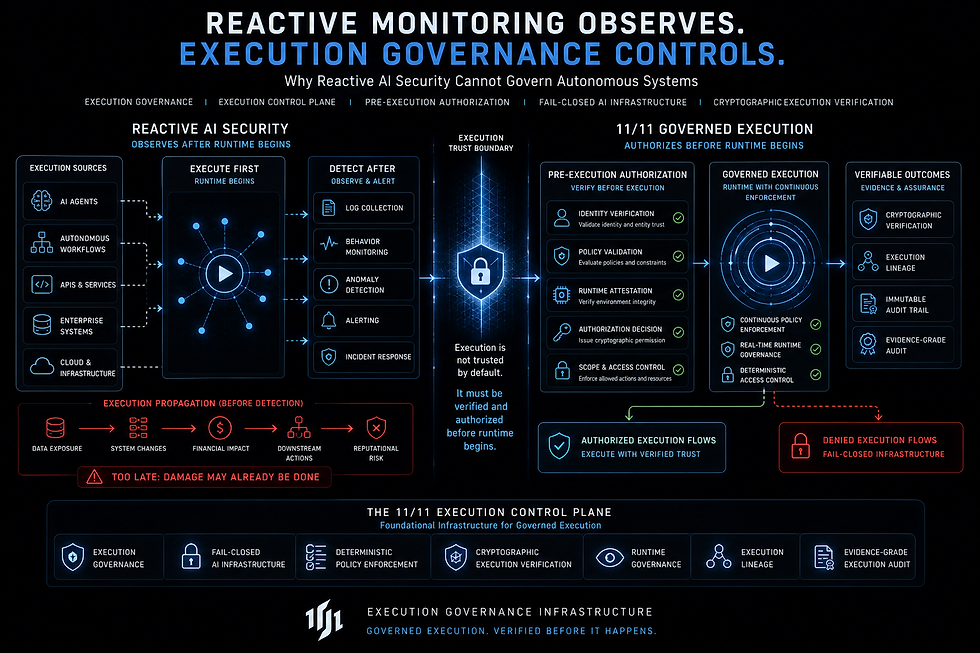
Governed Execution™ is the operational expression of this inevitability.
Execution can no longer remain independent from governance.
Authority becomes embedded.
Policies become embedded.
Verification becomes embedded.
Accountability becomes embedded.
Execution becomes governed.
The operational model changes because the execution environment changes.
Why Verifiable Trust Emerges
Trust follows the same pattern.
Traditional trust depended upon assumption.
Modern execution increasingly requires evidence.
Governance creates evidence.
Evidence creates confidence.
Confidence creates trust.
Verifiable trust emerges because execution environments require observable trustworthiness rather than assumed trustworthiness.
The Category Is Structural
Execution Governance™ should not be viewed as:
a product
a feature
a compliance process
an audit mechanism
It is a structural category.
The category emerges because execution environments repeatedly encounter the same governance problem.
The persistence of the problem creates the category.
The Execution Threshold
The defining question becomes simple:
When does execution become consequential enough to require governance?
Every environment eventually answers differently.
Yet the threshold always exists.
Beyond that threshold:
Execution alone becomes insufficient.
Governed execution becomes necessary.
The threshold is what makes the category inevitable.
Conclusion
Execution Governance™ becomes inevitable because execution itself becomes inevitable.
As execution expands, governance requirements expand.
As governance requirements expand, governance becomes infrastructure.
As governance becomes infrastructure, governed execution becomes the operational model.
The category exists because the problem exists.
The problem persists because execution persists.
Execution Governance™ is therefore not a prediction.
It is a consequence.
Execution creates outcomes.
Execution Governance™ preserves continuity.
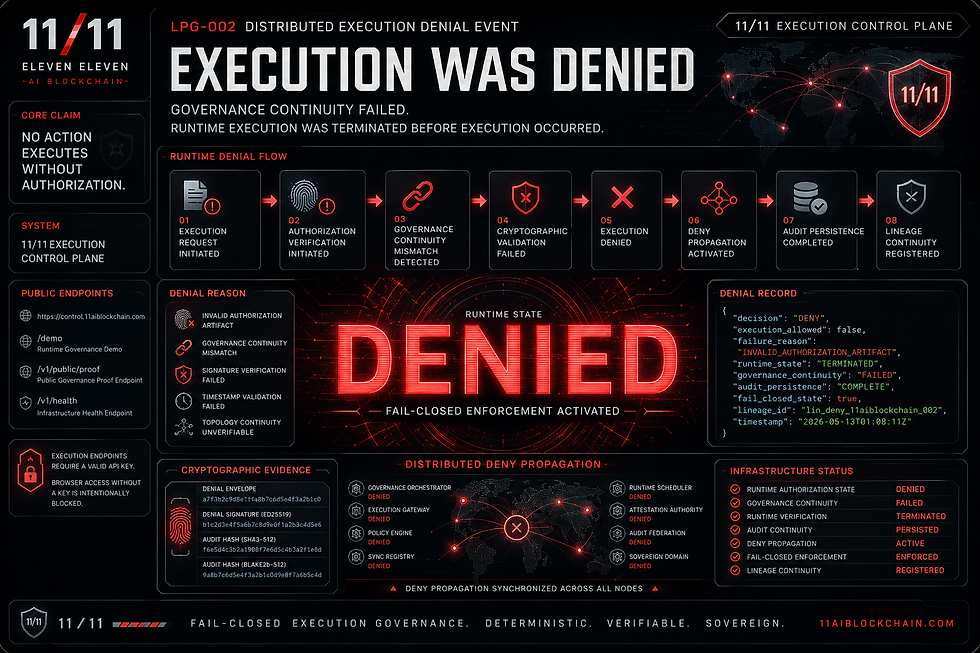
11/11 introduces Execution Governance™ infrastructure for governed autonomous execution and deterministic operational control.
Execution Governance™ Governed Execution™ EA-11™ Execution Arithmetic™
Patent Pending
Public Infrastructure Endpoints

Comments