
Why Execution Governance Becomes Infrastructure

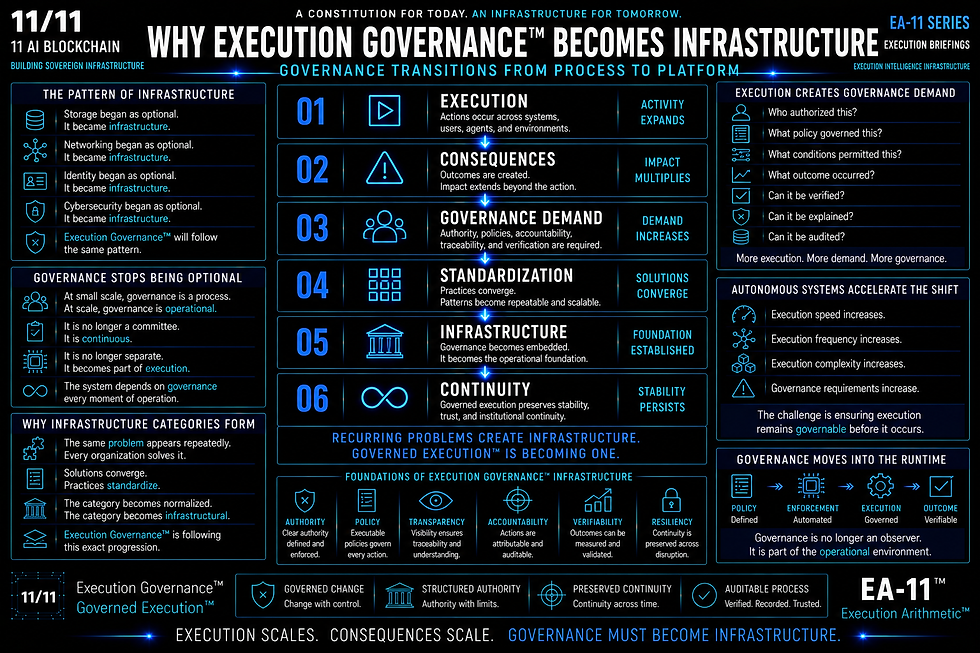
Every major technology category eventually experiences the same transition.
At first it appears optional.
Later it becomes required.
Eventually it becomes infrastructure.
The pattern repeats throughout technological history.
Storage became infrastructure.
Networking became infrastructure.
Identity became infrastructure.
Cybersecurity became infrastructure.
The reason is simple.
Certain problems become impossible to avoid.
When avoidance becomes impossible, infrastructure emerges.
Execution Governance™ follows the same pattern.
The category does not emerge because governance expands.
The category emerges because execution expands.
As execution becomes autonomous, distributed, persistent, and consequential, governance transitions from oversight to infrastructure.
Infrastructure Solves Persistent Problems
Infrastructure exists to solve recurring problems.
Not occasional problems.
Not theoretical problems.
Persistent problems.
The problems that appear repeatedly across systems, organizations, and environments.
Execution increasingly creates such problems.
Authority.
Accountability.
Oversight.
Traceability.
Continuity.
The more execution scales, the more these challenges appear.
Infrastructure emerges because the problems become unavoidable.
Governance Stops Being Optional
Many organizations initially treat governance as secondary.
A policy.
A process.
A committee.
An audit.
This approach works while execution remains limited.
As execution expands, governance changes.
The organization discovers that governance is no longer separate from operations.
Governance becomes operational infrastructure.
The system depends upon it continuously.
Execution Creates Governance Demand
Every execution event creates governance demand.
Who authorized it?
What policy governed it?
What conditions permitted it?
What outcome occurred?
Can it be verified?
Can it be explained?
Can it be audited?
As execution volumes increase, governance demand increases proportionally.
The result is structural.
Governance becomes embedded within execution itself.
Why Infrastructure Categories Form
Infrastructure categories emerge when every participant repeatedly solves the same problem.
Eventually the problem becomes standardized.
Then normalized.
Then infrastructural.
Execution Governance™ follows this exact progression.
Organizations repeatedly confront the same challenge:
How do we govern execution before execution occurs?
The repeated appearance of the problem creates the category.
Autonomous Systems Accelerate The Shift
Autonomous systems accelerate infrastructure formation.
Execution speed increases.
Execution frequency increases.
Execution complexity increases.
Governance requirements increase.
The relationship is unavoidable.
The more autonomous execution becomes, the more governance must become infrastructural.
The challenge is no longer managing users.
The challenge is governing execution itself.
Governance Moves Into The Runtime
Historically governance often existed outside operational systems.
Reviews.
Audits.
Committees.
Reports.
Modern environments increasingly move governance into runtime itself.
Authority becomes enforced.
Policies become executable.
Constraints become operational.
Governance becomes part of the environment rather than an observer of the environment.
This transition is a defining characteristic of infrastructure.
Why Execution Governance™ Persists
Infrastructure persists because the underlying problem persists.
Execution will not disappear.
Autonomous systems will not disappear.
Consequences will not disappear.
The governance challenge therefore remains.
Execution Governance™ persists because the execution problem persists.
The category becomes durable because the need becomes durable.
The Infrastructure Threshold
Every category crosses a threshold.
Before the threshold:
Optional.
After the threshold:
Required.
Execution Governance™ is approaching that threshold.
Organizations increasingly recognize that governed execution is not a compliance enhancement.
It is an operational requirement.
The shift is already underway.
Beyond Governed Execution™
Governed Execution™ explains the operational model.
Execution Governance™ explains the infrastructure category.
Infrastructure explains permanence.
The progression is becoming increasingly visible across autonomous systems and execution environments worldwide.
Conclusion
Execution Governance™ becomes infrastructure because execution becomes infrastructure.
As execution expands, governance requirements expand with it.
The recurring nature of the problem transforms governance from process to platform, from oversight to infrastructure.
Infrastructure emerges wherever recurring problems become unavoidable.
Governed execution has become unavoidable.
Execution Governance™ follows naturally.
11/11 introduces Execution Governance™ infrastructure for governed autonomous execution and deterministic operational control.
Execution Governance™ Governed Execution™ EA-11™ Execution Arithmetic™
Patent Pending
Public Infrastructure Endpoints

Comments