
Why Execution Governance Creates Determinism


Every execution environment faces a fundamental challenge.
Uncertainty.
An action may succeed.
An action may fail.
An action may produce unexpected consequences.
An action may create outcomes nobody anticipated.
Traditional systems often accept this uncertainty.
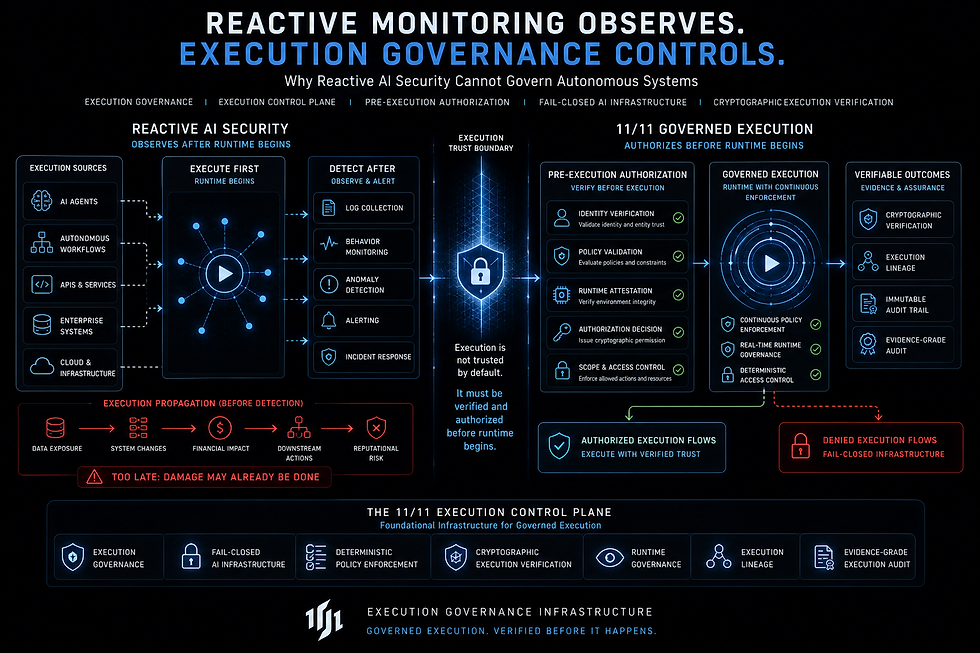
They execute first.
They evaluate later.
The model assumes uncertainty is manageable.
Modern infrastructure increasingly challenges this assumption.
Execution occurs at scale.
Execution occurs continuously.
Execution occurs autonomously.
The cost of uncertainty increases dramatically.
Execution Governance™ emerges because uncertainty becomes operationally expensive.
The objective becomes creating predictable execution before execution occurs.
The result is determinism.
Uncertainty Creates Friction
Every uncertain execution introduces questions.
Will the action be permitted?
Will the action succeed?
Will the action remain compliant?
Will the outcome remain acceptable?
The more uncertainty exists, the more resources become dedicated to managing uncertainty itself.
Execution slows.
Complexity grows.
Continuity weakens.
Governance reduces uncertainty by establishing known conditions before execution begins.
Determinism Begins Before Execution
Many systems attempt to create certainty after outcomes appear.
Execution Governance™ reverses the sequence.
Authority is established.
Policies are established.
Conditions are established.
Constraints are established.
Only then does execution occur.
Determinism therefore begins before execution.
The environment becomes predictable because the conditions become predictable.
Governance Creates Boundaries
Execution environments become deterministic when boundaries become explicit.
What may execute.
What may not execute.
Under what authority.
Under what conditions.
Through what process.
Governance transforms ambiguity into boundaries.
Boundaries transform uncertainty into predictability.
Why Autonomous Systems Require Determinism
Autonomous systems amplify uncertainty.
They execute faster.
They execute more frequently.
They execute at larger scales.
Small uncertainties become large consequences.
Execution Governance™ therefore becomes a mechanism for constraining uncertainty before execution begins.
The system becomes more governable because the execution becomes more predictable.
Determinism Creates Continuity
Continuity depends upon predictability.
Predictability depends upon determinism.
Participants must understand how the system behaves.
Institutions must understand how the system behaves.
Infrastructure must understand how the system behaves.
Deterministic execution creates stable expectations.
Stable expectations create continuity.
Governance And Repeatability
One of the most important functions of governance is repeatability.
The same conditions should produce the same outcomes.
Without repeatability, execution becomes difficult to trust.
With repeatability, execution becomes dependable.
Governance therefore acts as a repeatability engine.
The system becomes consistent across time.
Execution Governance™ And Infrastructure
Infrastructure depends upon deterministic behavior.
Networks.
Identity systems.
Databases.
Security systems.
Execution environments increasingly require the same characteristic.
The more foundational execution becomes, the more deterministic execution becomes necessary.
Governance supplies that requirement.
Why Determinism Scales
Uncertainty scales poorly.
Determinism scales efficiently.
As execution volume increases, deterministic environments become increasingly valuable.
The organization spends less effort resolving ambiguity and more effort producing outcomes.
Governance becomes an operational multiplier.
Beyond Trust
Trust emerges from governed execution.
Determinism strengthens trust.
The constitutional question is no longer:
Can execution be governed?
The constitutional question becomes:
Can execution remain predictable at scale?
Execution Governance™ provides the answer.
Conclusion
Execution Governance™ creates determinism because modern execution environments cannot scale indefinitely on uncertainty.
Governance establishes authority.
Authority establishes boundaries.
Boundaries establish predictability.
Predictability establishes continuity.
As autonomous systems continue expanding, deterministic execution may become one of the defining characteristics of governed infrastructure.
Execution Governance™ reduces uncertainty.
Determinism preserves continuity.
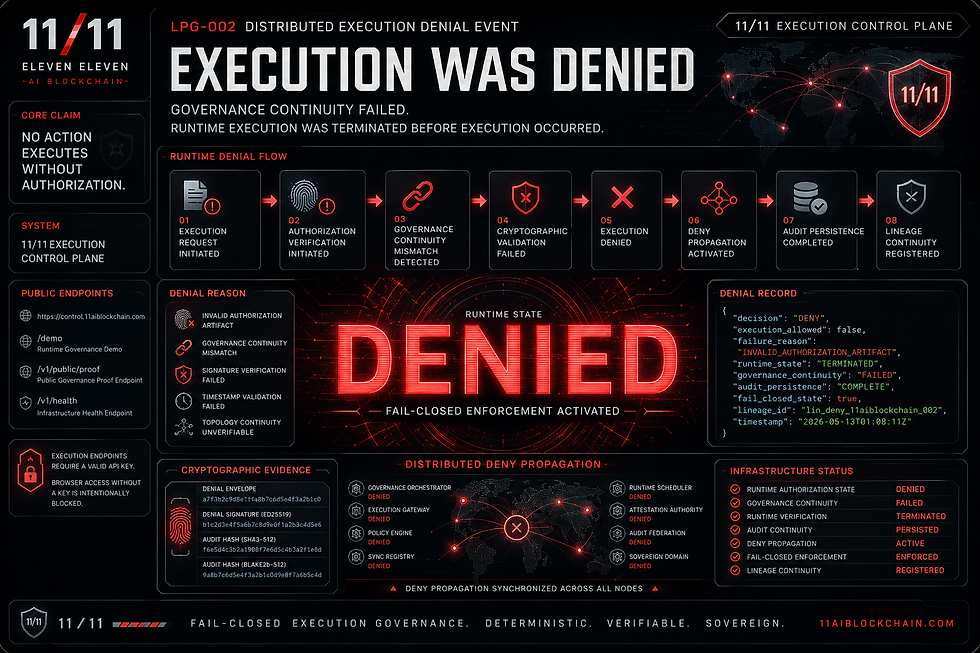
11/11 introduces Execution Governance™ infrastructure for governed autonomous execution and deterministic operational control.
Execution Governance™ Governed Execution™ EA-11™ Execution Arithmetic™
Patent Pending
Public Infrastructure Endpoints

Comments