
Why Execution Governance Precedes Trust
- 11/11 AI

- May 29
- 2 min read

Trust is frequently described as a foundation.
Organizations seek it.
Institutions seek it.
Civilizations depend upon it.
Yet modern execution environments reveal something important.
Trust rarely appears first.
Governance appears first.
Trust follows.
This distinction becomes increasingly important as execution scales beyond direct human observation.
Traditional systems often assume trust already exists.
Modern systems increasingly require mechanisms for creating trust.
The mechanism is governance.
Execution Governance™ emerges because trust cannot be assumed.
Trust must be produced.
Trust Is An Outcome
One of the most common mistakes in system design is treating trust as an input.
Trust is not usually an input.
Trust is usually an outcome.
Participants observe behavior.
Behavior becomes predictable.
Predictability creates confidence.
Confidence becomes trust.
The chain begins with governance.
Without governance, predictability weakens.
Without predictability, trust becomes fragile.
Governance Creates Predictability
Trust depends upon expectation.
Participants must believe similar actions produce similar outcomes.
This expectation does not appear automatically.
It emerges through governance.
Rules.
Authority.
Constraints.
Verification.
Enforcement.
Governance creates predictable execution.
Predictable execution creates trust.
Why Scale Changes Everything
Small systems often rely upon personal trust.
Large systems cannot.
Participants do not know one another.
Interactions occur continuously.
Execution becomes distributed.
The system requires a substitute for personal trust.
Governance becomes that substitute.
The larger the system becomes, the more trust depends upon governance rather than familiarity.
Execution Creates Trust Demand
Every execution event creates a trust question.
Was the action authorized?
Was the process valid?
Was the outcome legitimate?
Can the result be verified?
Trust demand increases with execution volume.
Governance satisfies that demand.
The relationship becomes structural.
Trust Moves From People To Systems
Historically trust focused on people.
Modern execution environments increasingly shift trust toward systems.
Participants trust processes.
Participants trust controls.
Participants trust governance mechanisms.
Trust becomes institutional rather than personal.
Execution Governance™ accelerates this transition.
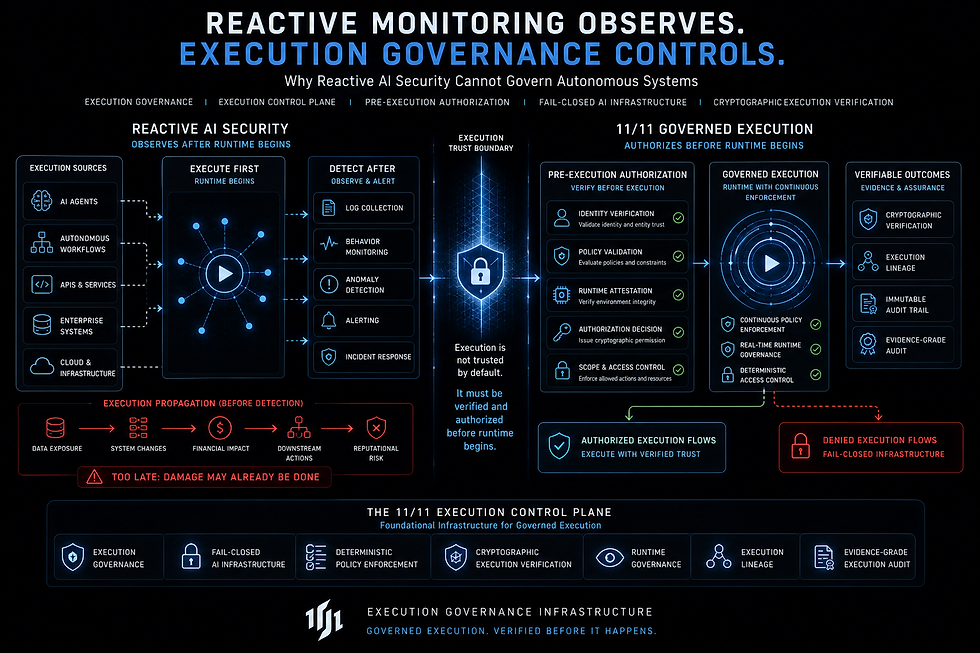
Autonomous Systems Require Governance First
Autonomous systems make the sequence unavoidable.
Execution occurs before humans can review.
Decisions occur at machine speed.
Trust cannot be established afterward.
Governance must exist before execution begins.
This reverses traditional assumptions.
Governance precedes trust.
Trust emerges from governed execution.
The Governance Chain
Execution Governance™ introduces a simple sequence:
AUTHORITY
↓
POLICY
↓
EXECUTION
↓
VERIFICATION
↓
TRUST
Trust appears at the end of the chain.
Not the beginning.
This insight becomes increasingly important for modern infrastructure.
Why Governance Becomes Trust Infrastructure
At sufficient scale, governance and trust become inseparable.
Governance creates predictability.
Predictability creates confidence.
Confidence creates trust.
Trust becomes the visible outcome of governance.
Governance becomes the invisible infrastructure beneath trust.
Beyond Runtime Governance
Runtime governance explains how execution becomes governed.
Trust explains why participants accept governed execution.
The concepts reinforce one another.
Governance produces trust.
Trust sustains governance.
The cycle becomes self-reinforcing.
Conclusion
Execution Governance™ precedes trust because trust emerges from predictable execution rather than preceding it.
Governance creates structure.
Structure creates predictability.
Predictability creates trust.
As autonomous execution environments continue expanding, trust will increasingly become a product of governance rather than an assumption about governance.
Trust is not the foundation.
Governance is the foundation.
Trust is the result.
11/11 introduces Execution Governance™ infrastructure for governed autonomous execution and deterministic operational control.
Execution Governance™ Governed Execution™ EA-11™ Execution Arithmetic™
Patent Pending
Public Infrastructure Endpoints


Comments