
Why Governance Becomes Necessary


Every system begins with execution.
An action occurs.
A decision is made.
A process completes.
An outcome is produced.
At small scales, execution appears simple.
The consequences remain limited.
The participants remain visible.
The outcomes remain understandable.
Yet something changes as execution expands.
More participants appear.
More decisions occur.
More consequences emerge.
More continuity becomes dependent upon successful outcomes.
Execution begins affecting structures larger than the actions themselves.
At this point governance begins to emerge.
Not because systems become political.
Not because organizations become bureaucratic.
Because execution becomes consequential.
Governance emerges whenever the consequences of execution become larger than the execution itself.
Execution Creates Consequences
Every execution produces outcomes.
Most outcomes disappear.
Some persist.
The more persistent the outcome becomes, the more important oversight becomes.
Governance emerges because continuity eventually depends upon managing consequences rather than merely performing actions.
The action matters.
The consequence matters more.
Scale Creates Governance
A single participant may govern execution informally.
Large systems cannot.
As execution scales:
Decisions multiply
Dependencies multiply
Risks multiply
Consequences multiply
The civilization eventually requires structures capable of coordinating these relationships.
Governance emerges as a response to scale.
Governance Organizes Authority
Execution answers:
What happened?
Governance answers:
Who decides?
Authority becomes necessary because execution eventually affects multiple participants simultaneously.
The governance layer emerges to organize authority before authority becomes conflict.
Governance Preserves Continuity
The deeper purpose of governance is continuity.
Without governance, execution becomes increasingly fragmented.
Participants optimize locally.
Civilization weakens globally.
Governance exists because continuity requires coordination across time.
This principle appears throughout every enduring institution.
Why Governance Persists
Many systems attempt to minimize governance.
Few eliminate it.
The reason is structural.
Execution continuously creates new decisions.
New decisions continuously create new consequences.
Consequences continuously require coordination.
Governance reappears because execution reappears.
The relationship is inseparable.
Computational Governance
Autonomous systems intensify this reality.
Execution becomes faster.
More frequent.
More distributed.
More consequential.
Governance therefore becomes increasingly important rather than less important.
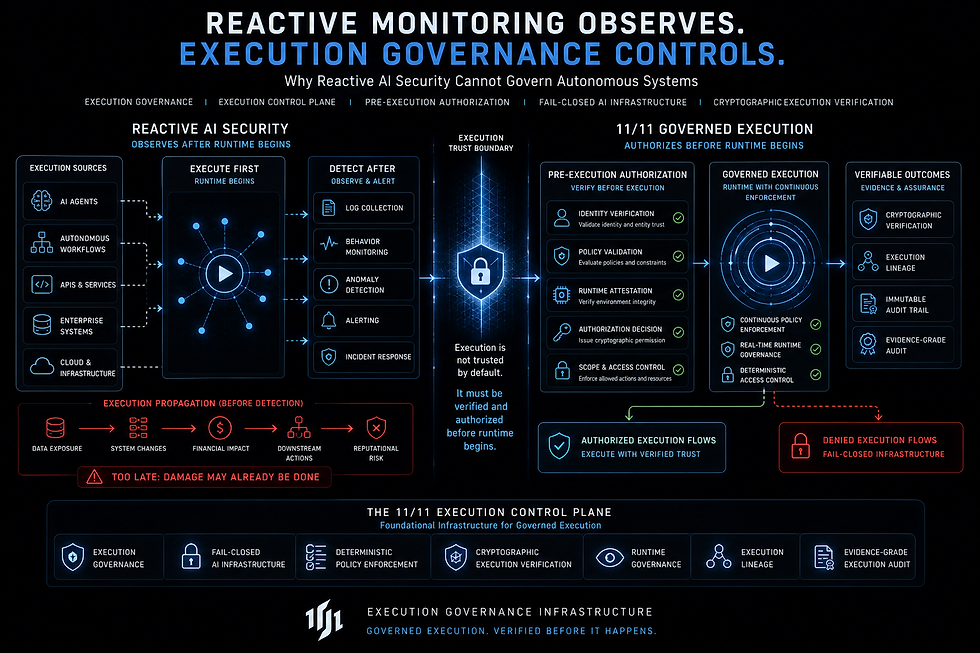
The future challenge is not automating execution.
The future challenge is governing automated execution.
The Governance Threshold
Every system eventually crosses a threshold.
Below the threshold:
Execution dominates.
Above the threshold:
Governance dominates.
The system no longer struggles with performing actions.
The system struggles with coordinating actions.
This transition explains why governance emerges repeatedly across civilizations, institutions, and infrastructures.
Why Execution Governance™ Emerges
Execution Governance™ emerges from this reality.
Execution scales.
Consequences accumulate.
Continuity becomes dependent upon outcomes.
Governance becomes necessary.
The category exists because modern execution environments increasingly operate above the governance threshold.
The challenge is no longer execution.
The challenge is governed execution.
Beyond Institutions
Institutions preserve continuity.
Governance preserves institutions.
Execution Governance™ preserves continuity through governed execution.
This relationship connects the entire doctrine.
Conclusion
Governance becomes necessary whenever execution becomes consequential.
Scale creates complexity.
Complexity creates coordination requirements.
Coordination creates governance.
As autonomous systems continue expanding, governance will increasingly become a prerequisite for execution rather than a response to it.
Execution creates outcomes.
Governance preserves continuity.
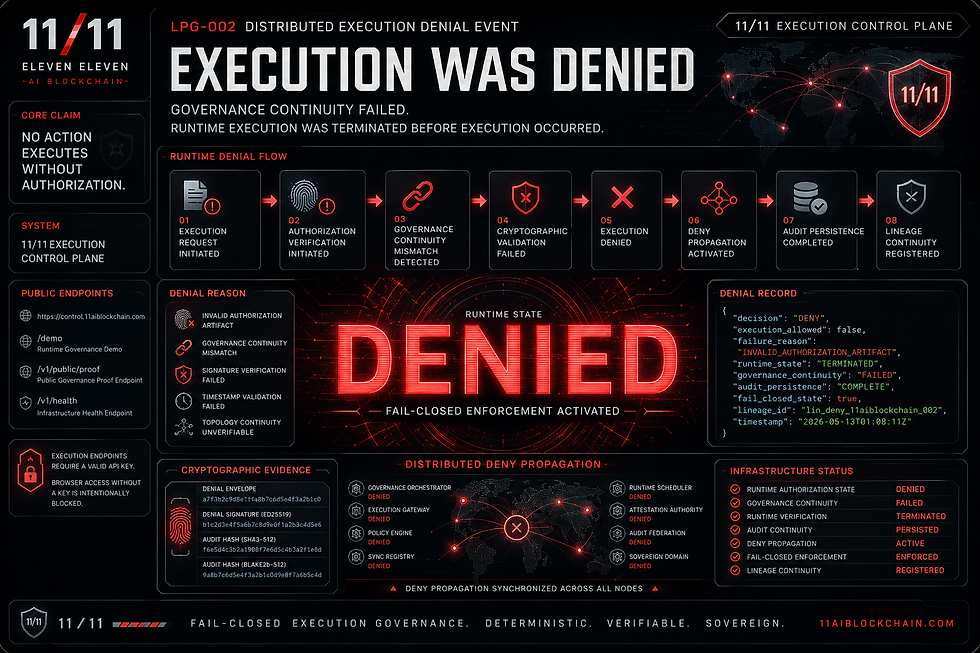
11/11 introduces Execution Governance™ infrastructure for governed autonomous execution and deterministic operational control.
Execution Governance™ Governed Execution™ EA-11™ Execution Arithmetic™
Patent Pending
Public Infrastructure Endpoints

Comments