
Why Governed Execution Emerges


For centuries, execution was assumed.
Actions occurred.
Decisions were made.
Processes completed.
Outcomes followed.
The execution itself rarely attracted attention.
Attention focused on the result.
If the outcome appeared acceptable, the execution was considered acceptable.
This assumption worked when execution remained relatively simple.
Human-scale.
Observable.
Limited.
Governable through direct oversight.
Modern execution environments are different.
Execution increasingly occurs through software.
Through infrastructure.
Through automation.
Through machine-scale systems.
Through autonomous agents.
The result is a fundamental shift.
Execution itself becomes a governance concern.
Governed Execution™ emerges from this shift.
Execution Was Once Invisible
Historically, governance focused on people.
Who made decisions.
Who possessed authority.
Who accepted responsibility.
Execution existed beneath these discussions.
It was treated as an operational detail.
This approach becomes increasingly difficult as execution scales.
The more consequential execution becomes, the less invisible it becomes.
Eventually execution itself requires governance.
Consequences Move Upstream
One of the defining characteristics of modern systems is that consequences increasingly originate before outcomes appear.
The execution path matters.
The execution environment matters.
The execution conditions matter.
The execution authority matters.
The governance question therefore moves upstream.
The focus shifts from:
"What happened?"
to:
"How did it happen?"
Governed Execution™ emerges because the path becomes as important as the destination.
Execution Creates Reality
Every execution changes reality.
A record changes.
A transaction completes.
A resource moves.
An identity updates.
An authorization occurs.
The action may appear small.
The cumulative effect becomes enormous.
Modern infrastructure increasingly consists of continuous execution events.
Governance therefore becomes inseparable from execution itself.
Why Oversight Is Not Enough
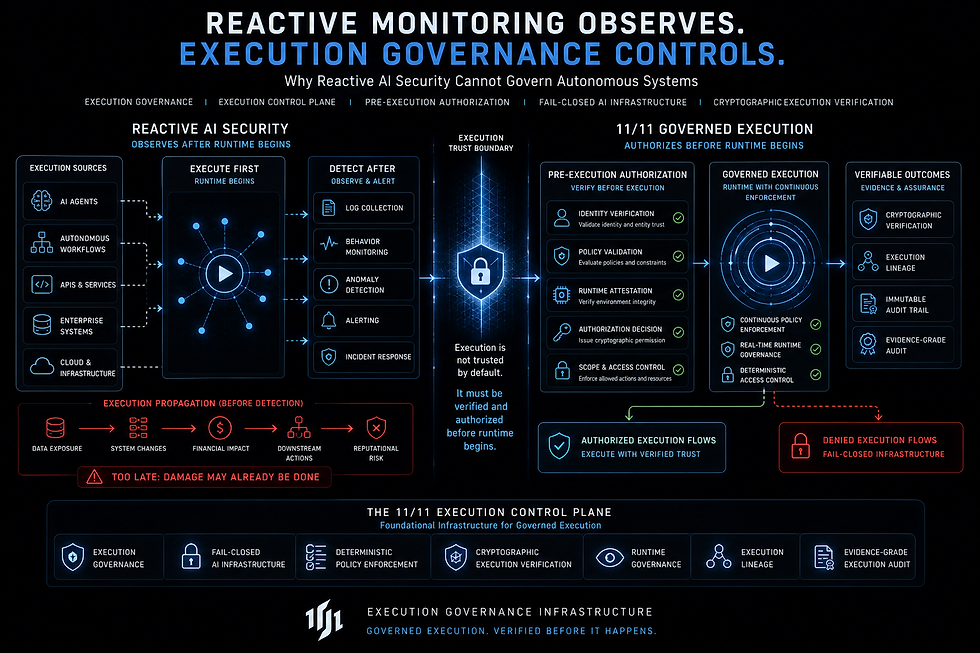
Traditional oversight often operates after execution.
An event occurs.
A review follows.
A report appears.
A conclusion is reached.
This model assumes consequences can be addressed after the fact.
Many modern systems challenge this assumption.
The consequence may already be irreversible.
The governance requirement therefore shifts.
Governance must become part of execution rather than merely a response to execution.
Governed Execution™ Changes The Model
Traditional model:
Execution
↓
Outcome
↓
Review
Governed Execution™ model:
Authority
↓
Governance
↓
Execution
↓
Outcome
The order changes.
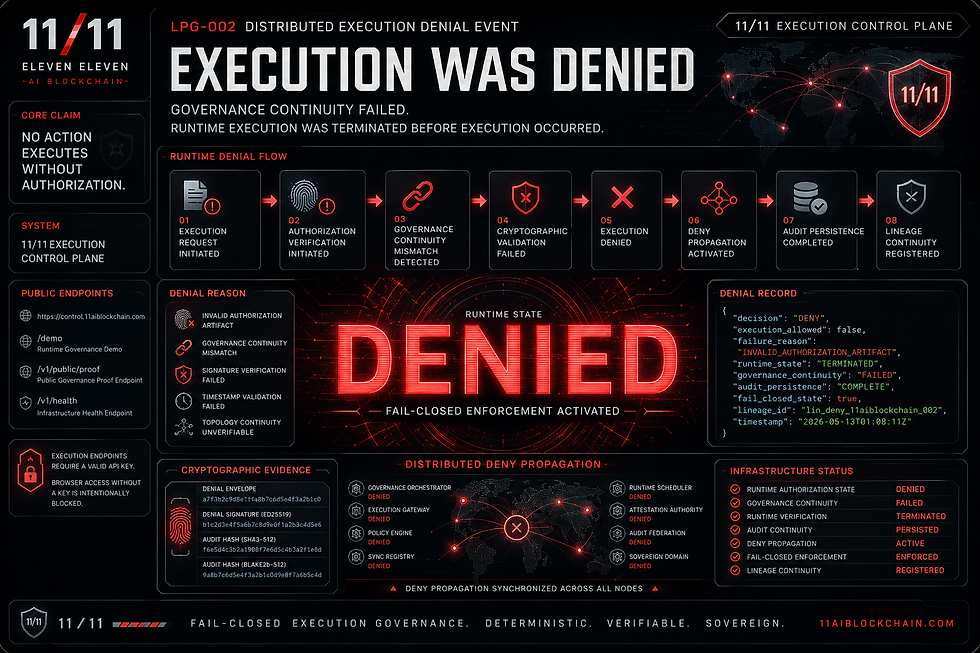
Governance becomes a prerequisite rather than a reaction.
This distinction defines the category.
Why Autonomous Systems Accelerate The Need
Autonomous systems intensify every existing execution challenge.
Execution becomes:
Faster
More frequent
More distributed
More consequential
The governance burden increases accordingly.
The challenge is no longer monitoring execution.
The challenge is ensuring execution remains governable before it occurs.
Execution Without Governance
Execution can exist without governance.
It cannot scale safely without governance.
The larger the execution environment becomes, the more governance becomes necessary.
Complexity creates uncertainty.
Uncertainty creates risk.
Governance reduces uncertainty.
The relationship becomes structural rather than optional.
Governed Execution™ As Infrastructure
Governed Execution™ should not be viewed as a feature.
It is infrastructure.
Just as networking became infrastructure.
Just as cybersecurity became infrastructure.
Just as identity became infrastructure.
Governed Execution™ emerges because execution itself becomes foundational to modern systems.
The governance layer becomes inseparable from the execution layer.
Beyond Governance
Execution Governance™ explains why governance becomes necessary.
Governed Execution™ explains how execution changes once governance becomes embedded within it.
The concepts are complementary.
One explains the requirement.
The other explains the operational model.
Together they form the foundation of the category.
Conclusion
Governed Execution™ emerges because execution can no longer remain operationally invisible.
Execution creates consequences.
Consequences create governance requirements.
Governance moves upstream.
The result is a new infrastructure model where governance becomes part of execution itself.
Execution scales.
Governed Execution™ scales with it.
11/11 introduces Execution Governance™ infrastructure for governed autonomous execution and deterministic operational control.
Execution Governance™ Governed Execution™ EA-11™ Execution Arithmetic™
Patent Pending
Public Infrastructure Endpoints

Comments