
Why Healthcare AI Requires an Execution Control Layer
- 11/11 AI

- May 7
- 5 min read
Updated: May 13
The Rise of Governed Medical Intelligence
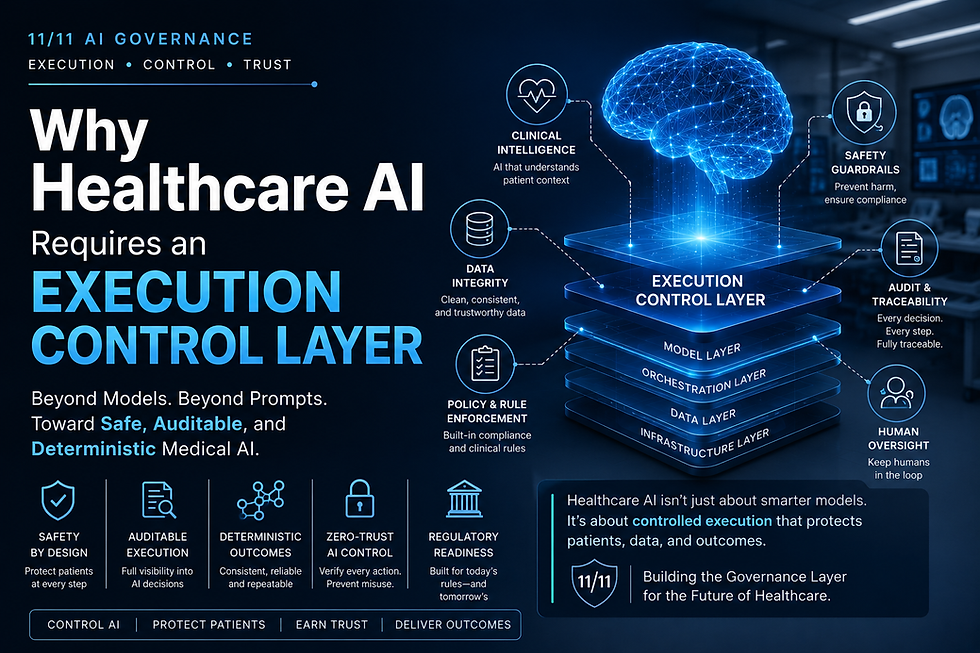
Healthcare is entering the most important technological transition since the digitization of medical records.
Artificial intelligence is no longer experimental.
It is now moving directly into:
hospitals,
imaging systems,
diagnostics,
claims infrastructure,
robotic assistance,
pharmaceutical research,
clinical workflow automation,
and patient engagement platforms.
The problem is that most healthcare organizations are deploying AI on top of infrastructure that was never designed to govern autonomous execution.
Today’s AI systems are primarily optimized for:
speed,
scale,
convenience,
automation,
and probabilistic output generation.
Healthcare environments require something very different.
They require:
authorization,
traceability,
deterministic enforcement,
cryptographic accountability,
and evidence-grade execution control.
This creates one of the largest infrastructure opportunities in modern healthcare.
The future winners in medical AI may not be the companies building the largest models.
The long-term winners may instead control the infrastructure that determines whether AI is allowed to execute at all.
That distinction changes everything.
The Core Problem With Current Healthcare AI
Most healthcare AI systems today operate using a dangerous assumption.
If the AI system exists and a user can access it, then execution is considered acceptable.
That is fundamentally incompatible with high-risk medical environments.
AI systems now influence:
treatment recommendations,
prescription workflows,
patient prioritization,
insurance decisions,
risk scoring,
medical summarization,
oncology support,
pathology review,
and radiology analysis.
Yet most healthcare organizations still lack:
execution verification,
runtime policy enforcement,
immutable AI audit lineage,
cryptographic execution proof,
and deterministic governance controls.
In most environments today:
the AI executes first,
and organizations attempt to monitor the consequences afterward.
That model will eventually fail.
Healthcare requires a new operational standard.
Execution itself must become governed.
Why Governance Matters More Than Model Size
The AI industry spent years competing on:
parameter counts,
benchmark scores,
context windows,
and inference performance.
Healthcare changes the equation.
In regulated environments, the critical question is no longer:
“How intelligent is the model?”
The critical question becomes:
“Who authorized this execution?”
This shift transforms AI from a software discussion into an infrastructure governance discussion.
Healthcare organizations increasingly need systems capable of:
verifying requests before execution,
enforcing policy during execution,
generating immutable audit evidence after execution,
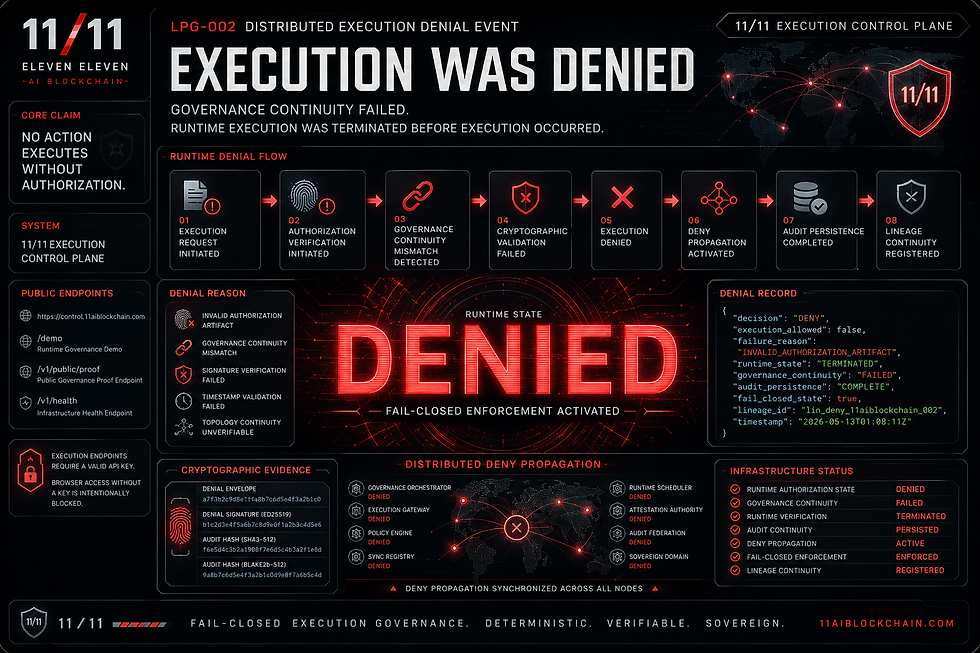
and denying unauthorized actions automatically.
This creates the emergence of a new category:
medical AI execution governance.
The Future Execution Model
The next generation of healthcare AI systems will likely evolve toward a workflow similar to this:
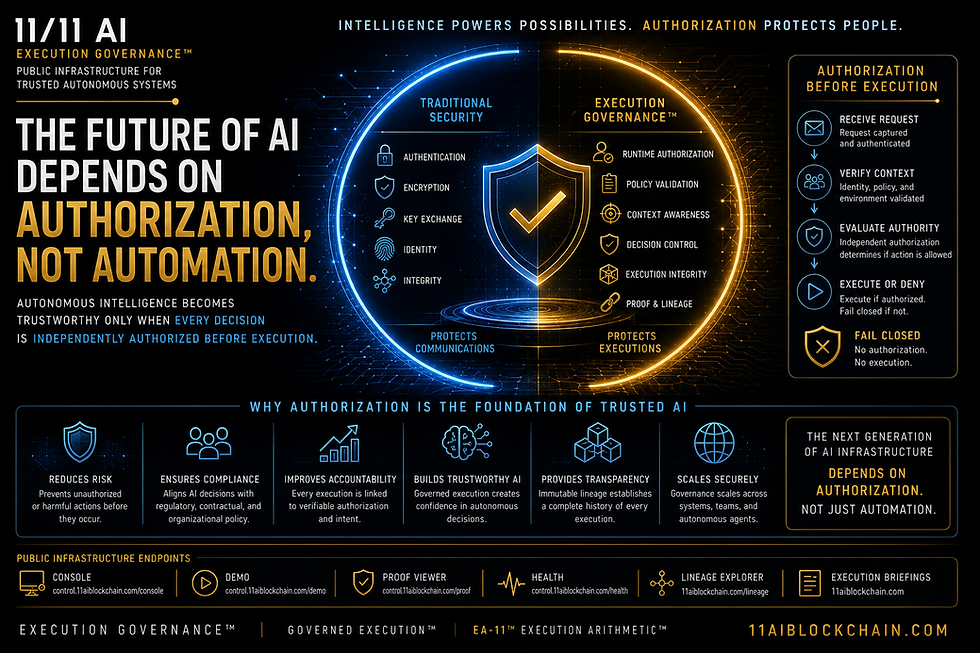
Request → Verify → Allow or Deny → Execute → Generate Cryptographic Proof
This architecture changes the trust model of healthcare AI.
Instead of trusting the AI system by default, organizations begin trusting the governance layer controlling execution.
That distinction is critical.
In this model:
every execution request is evaluated,
every authorization is policy-bound,
every inference becomes traceable,
and every action becomes auditable.
This creates deterministic governance.
The Problem With Traditional Audit Logs
Many healthcare organizations assume logging alone provides accountability.
It does not.
Traditional logs are often:
mutable,
fragmented,
incomplete,
siloed,
or disconnected from actual execution chains.
Logs frequently answer:
“What happened?”
But they often fail to prove:
whether the action was authorized,
whether the model was trusted,
whether policy was satisfied,
whether execution was modified,
or whether the output was tampered with.
That is why cryptographic audit systems are becoming increasingly important.
Evidence-Grade Medical AI
Healthcare AI is moving toward an evidence era.
Future systems will likely require:
signed execution records,
immutable lineage chains,
cryptographic attestations,
deterministic policy enforcement,
and verifiable execution identity.
This creates evidence-grade AI infrastructure.
Evidence-grade execution means:
the execution can be proven,
the policy can be verified,
the request can be reconstructed,
and the integrity of the process can be validated.
This becomes especially important in:
malpractice disputes,
FDA review environments,
insurance investigations,
healthcare litigation,
and high-risk clinical automation.
The Hallucination Crisis in Healthcare
One of the largest risks in medical AI is hallucination.
AI systems can:
fabricate references,
invent symptoms,
generate false diagnoses,
or produce medically inaccurate conclusions.
In general consumer applications, hallucinations are inconvenient.
In healthcare, they can become catastrophic.
This is why healthcare AI requires governance instead of blind trust.
Organizations increasingly need:
constrained execution environments,
approved medical knowledge boundaries,
runtime oversight,
deterministic validation,
and policy-aware orchestration.
AI systems should not operate with unrestricted execution authority inside medical infrastructure.
Autonomous Medical AI Agents
Healthcare is rapidly moving toward autonomous AI systems.
Future AI agents may:
schedule patients,
review insurance claims,
coordinate referrals,
summarize records,
authorize workflows,
and interact across multiple healthcare systems automatically.
The infrastructure challenge is enormous.
Autonomous systems increase execution risk because they can:
chain decisions together,
call external APIs,
trigger downstream actions,
and operate at machine speed.
Without governance, healthcare organizations lose visibility into execution authority.
This creates demand for:
runtime containment,
execution authorization,
AI identity validation,
and deterministic governance enforcement.
Why Zero-Trust AI Is Emerging
Healthcare increasingly operates under a zero-trust philosophy.
Traditional assumptions are disappearing.
Organizations no longer assume:
users are trusted,
networks are trusted,
devices are trusted,
or applications are trusted.
AI systems are now entering this same reality.
Future healthcare infrastructure may require:
every model to possess verifiable identity,
every execution to be policy-scoped,
every action to be cryptographically attributable,
and every workflow to be auditable.
This creates the emergence of zero-trust AI infrastructure.
The Rise of Medical AI Control Planes
The healthcare industry is beginning to recognize that AI itself cannot become the sole trust anchor.
A separate governance layer is required.
This governance layer becomes responsible for:
authorization,
verification,
audit lineage,
policy enforcement,
cryptographic execution evidence,
and runtime control.
This architecture increasingly resembles:
air traffic control for AI execution,
operating-system-level governance,
or a distributed execution authority framework.
The strategic value becomes enormous because the governance layer sits beneath applications.
Applications change.
Infrastructure persists.
Regulatory Momentum
Regulators are beginning to focus less on marketing claims and more on operational accountability.
Healthcare AI systems increasingly face scrutiny around:
explainability,
traceability,
bias,
auditability,
and execution governance.
Future regulatory standards may eventually require:
verifiable execution chains,
immutable AI audit trails,
deterministic policy enforcement,
and cryptographic runtime evidence.
This creates a powerful market shift.
Organizations that already operate using governed execution infrastructure may eventually possess a major advantage.
The Infrastructure Opportunity
Most healthcare companies are currently competing at the application layer.
That is crowded.
The larger long-term opportunity may exist underneath the application layer itself.
Infrastructure layers controlling:
trust,
governance,
execution,
authorization,
and compliance
may ultimately become the dominant strategic chokepoints in healthcare AI.
This is similar to how:
cloud infrastructure became more valuable than many apps,
payment rails became more valuable than individual merchants,
and operating systems became more powerful than individual programs.
Governance infrastructure creates leverage.
Why This Matters Globally
Healthcare is one of the largest industries on Earth.
Medical AI is expected to influence:
national healthcare systems,
insurance markets,
pharmaceutical research,
military medicine,
population health analytics,
and biosecurity infrastructure.
As AI becomes embedded into these systems, execution governance becomes strategically critical.
The organizations controlling trusted execution frameworks may eventually influence:
interoperability standards,
compliance architectures,
healthcare AI certifications,
and cross-border medical intelligence systems.
This creates a global infrastructure race.
Final Thoughts
Healthcare AI is rapidly scaling.
But governance infrastructure is lagging behind.
That imbalance creates risk.
It also creates opportunity.
The next generation of healthcare systems will likely require:
authorization before execution,
verification during execution,
and immutable proof after execution.
This is the emergence of governed medical intelligence.
The future healthcare stack may no longer trust AI by default.
Instead, it may trust the infrastructure controlling AI execution.
That distinction will define the next era of healthcare technology.
Public Governance Console
Runtime Governance Demo
Public Governance Proof Viewer
Infrastructure Health Dashboard
Execution Lineage Explorer

Comments