
Why Obligations Emerge In Constitutional Systems


Constitutional systems often begin by discussing rights.
Rights attract attention because rights describe protections.
Rights describe guarantees.
Rights describe participation.
Yet constitutional civilizations ultimately depend upon something equally important.
Obligations.
A constitutional system composed entirely of rights eventually encounters a problem.
Who preserves the system?
Who sustains continuity?
Who protects legitimacy?
Who maintains participation?
The answer introduces one of the deepest principles of constitutional civilization.
Participation creates obligation.
This principle appears repeatedly throughout history.
Rights emerge because civilizations require participation.
Obligations emerge because participation requires responsibility.
The two concepts evolve together.
Neither remains stable without the other.
Rights And Obligations Are Reciprocal
Rights and obligations are often presented as opposites.
They are more accurately understood as partners.
Rights create protections.
Obligations create continuity.
Rights protect participation.
Obligations sustain participation.
Rights stabilize the relationship between individuals and civilization.
Obligations stabilize the civilization itself.
A constitutional order ultimately requires both.
Why Responsibility Appears
Responsibility emerges whenever continuity becomes important.
A temporary interaction may require little responsibility.
A civilization requires much more.
The longer a constitutional order intends to survive, the more responsibility becomes necessary.
This explains why obligations repeatedly emerge within enduring systems.
Obligations are not arbitrary requirements.
They are mechanisms through which continuity becomes possible.
Participation Creates Responsibility
The deeper an entity participates within a constitutional framework, the greater its relationship to the continuity of that framework.
Participation therefore changes status.
The participant is no longer merely benefiting from the system.
The participant becomes partially responsible for preserving the system.
This transformation represents one of the most important moments within constitutional civilization.
Membership evolves into stewardship.
Obligation As Constitutional Infrastructure
Most people view obligations as rules.
Civilizations experience obligations as infrastructure.
Without responsibility:
Participation weakens.
Continuity weakens.
Legitimacy weakens.
Constitutional order weakens.
Obligations therefore perform a structural function.
They support the constitutional framework itself.
The obligation is not merely behavioral.
It is civilizational.
Why Computational Systems Will Develop Obligations
Future computational civilizations may encounter the same challenge.
Persistent digital institutions.
Autonomous governance environments.
Constitutional execution systems.
Federated computational societies.
As participation expands, continuity becomes dependent upon recognized responsibilities.
Computational obligations may therefore emerge for the same reason constitutional obligations emerged historically.
Civilization requires continuity.
Continuity requires stewardship.
The Stewardship Principle
One of the deepest interpretations of obligation is stewardship.
Stewardship assumes that constitutional order is inherited rather than created from nothing.
Participants inherit the benefits of an existing system.
Obligations emerge because inherited systems require preservation.
The participant becomes a steward of continuity.
This concept may ultimately explain why obligations appear throughout nearly every enduring civilization.
Obligation And Legitimacy
Rights often derive legitimacy from constitutional recognition.
Obligations derive legitimacy from constitutional participation.
The participant receives standing.
The participant accepts responsibility.
The relationship remains balanced.
When rights expand while obligations disappear, constitutional imbalance emerges.
The civilization consumes continuity faster than it creates continuity.
Long-term stability becomes difficult.
Beyond Rights
Rights explain what constitutional systems protect.
Obligations explain what constitutional systems require.
The two questions are inseparable.
A civilization that protects everything while requiring nothing eventually struggles to preserve itself.
A civilization that requires everything while protecting nothing eventually loses legitimacy.
Constitutional order survives because both remain balanced.
Computational Civilization
Future computational civilizations may discover that rights alone are insufficient.
Recognition creates participation.
Participation creates continuity.
Continuity creates responsibility.
Responsibility creates obligation.
The sequence appears repeatedly throughout constitutional development.
Computational systems may eventually follow the same path.
Conclusion
Obligations emerge because constitutional systems require continuity.
Participation creates responsibility.
Responsibility creates stewardship.
Stewardship creates constitutional endurance.
As computational civilization evolves, obligations may emerge not because systems desire them, but because continuity requires them.
Rights preserve participation.
Obligations preserve civilization.
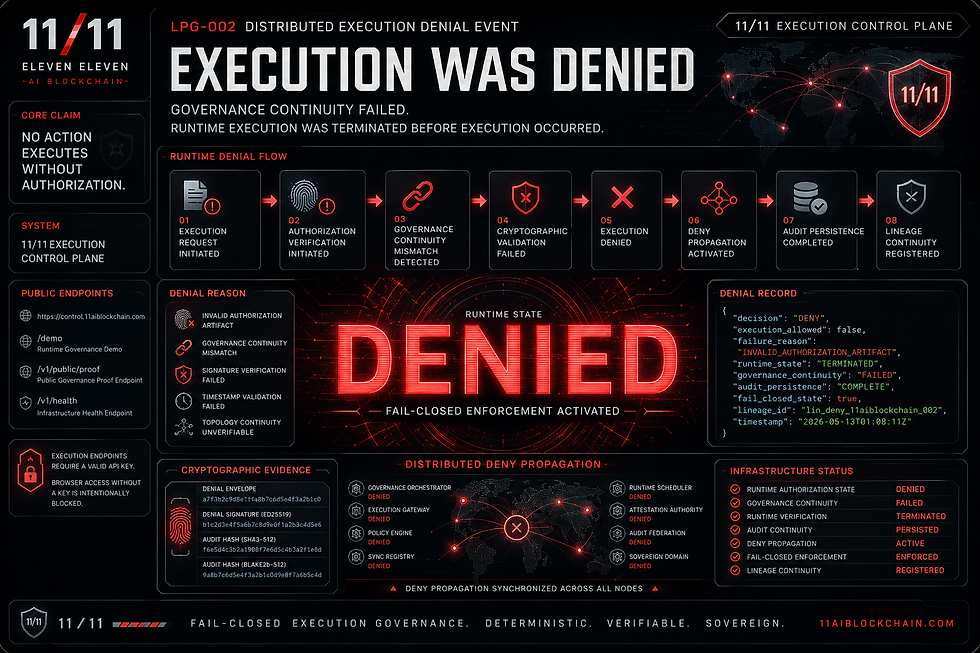
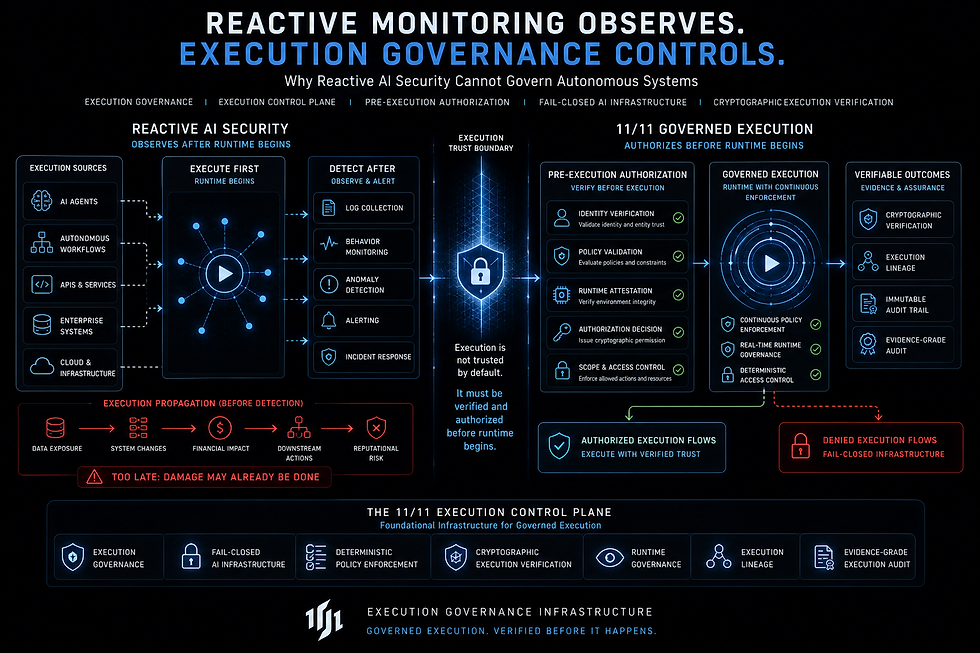
11/11 introduces Execution Governance™ infrastructure for governed autonomous execution and deterministic operational control.
Execution Governance™ Governed Execution™ EA-11™ Execution Arithmetic™
Patent Pending
Public Infrastructure Endpoints

Comments