
Why Runtime Detection Is Already Too Late

Updated: May 13
Artificial intelligence infrastructure is rapidly evolving from passive software into active operational systems.
AI agents can now:
execute workflows
trigger infrastructure actions
access sensitive systems
coordinate operations
interact autonomously across environments
Yet most AI security models still rely on a fundamentally reactive approach.
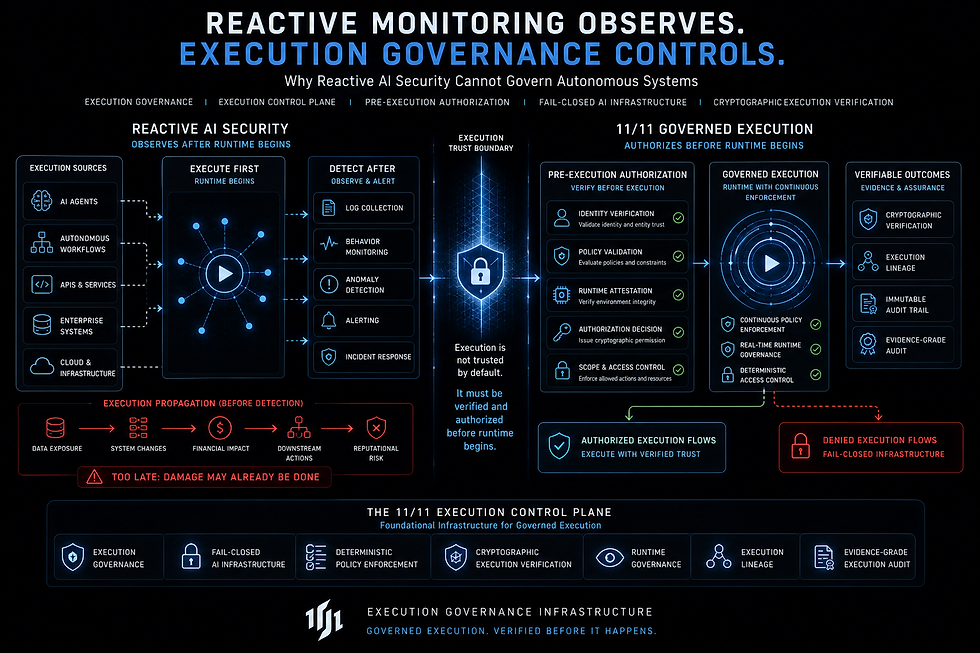
They execute first and investigate later.
Modern security infrastructure largely focuses on:
runtime monitoring
anomaly detection
post-execution logging
behavioral analysis
alert generation
incident response
Those systems are designed to observe execution after trust has already been granted.
That model is becoming increasingly dangerous.

The Problem With Reactive AI Security
Traditional cybersecurity evolved around human-operated systems.
In those environments:
users initiate actions manually
operators review workflows
humans remain inside the decision loop
AI systems fundamentally change this architecture.
Autonomous systems can:
trigger downstream actions automatically
interact across APIs
execute chained operations
coordinate infrastructure at machine speed
In these environments, execution itself becomes the trust boundary.
The problem is simple:
Once execution occurs, the environment may already be altered.
Data may already be exposed.Permissions may already be escalated.Infrastructure may already be modified.Operational actions may already be triggered.
Runtime visibility cannot reverse execution.
Detection is not prevention.
Observation is not governance.
Why Execution Becomes the Attack Surface
As AI systems gain operational capability, the primary security problem shifts from:“What is the model generating?”
to:“What is the model allowed to execute?”
This changes the architecture entirely.
The next generation of AI infrastructure cannot rely solely on:
output filtering
behavioral observation
reactive monitoring
after-the-fact audit analysis
Those systems assume execution should proceed by default.
Execution governance introduces a different assumption:
Execution is not trusted by default.
Execution must be authorized.
The Failure of Post-Execution Monitoring
Most current AI security infrastructure attempts to analyze systems after runtime activity has already occurred.
That creates several problems.
Problem 1 — Execution Already Happened
Once a workflow executes:
actions cannot always be reversed
infrastructure state may already change
external systems may already be triggered
Reactive monitoring observes consequences.
It does not govern execution.
Problem 2 — Autonomous Systems Operate Faster Than Human Oversight
Modern intelligent systems increasingly operate:
asynchronously
continuously
autonomously
across distributed infrastructure
By the time an alert appears:the system may already have completed multiple chained actions.
Problem 3 — Runtime Trust Is Assumed
Most environments still implicitly trust runtime execution unless something appears suspicious afterward.
That creates fail-open infrastructure.
Fail-open systems allow execution unless explicitly blocked.
Execution governance reverses that logic.
The Shift to Pre-Execution Authorization
Execution governance introduces a different infrastructure model.
Instead of observing execution after it occurs, execution governance validates whether execution should be permitted before runtime begins.
This creates:pre-execution authorization.
Under this architecture:
identity is verified before execution
policy is evaluated deterministically
runtime state is validated
authorization is cryptographically enforced
execution permissions are confirmed before runtime begins
Only then can execution proceed.
This creates governed execution infrastructure.
The Execution Control Plane
The execution control plane acts as the trust layer beneath intelligent systems.
It governs whether execution is allowed to occur.
Rather than functioning as another AI application, the execution control plane sits beneath:
agents
workflows
models
infrastructure runtimes
orchestration systems
Its purpose is not generating intelligence.
Its purpose is controlling execution integrity.
Core capabilities include:
deterministic policy enforcement
runtime authorization
cryptographic execution verification
immutable audit generation
execution lineage tracking
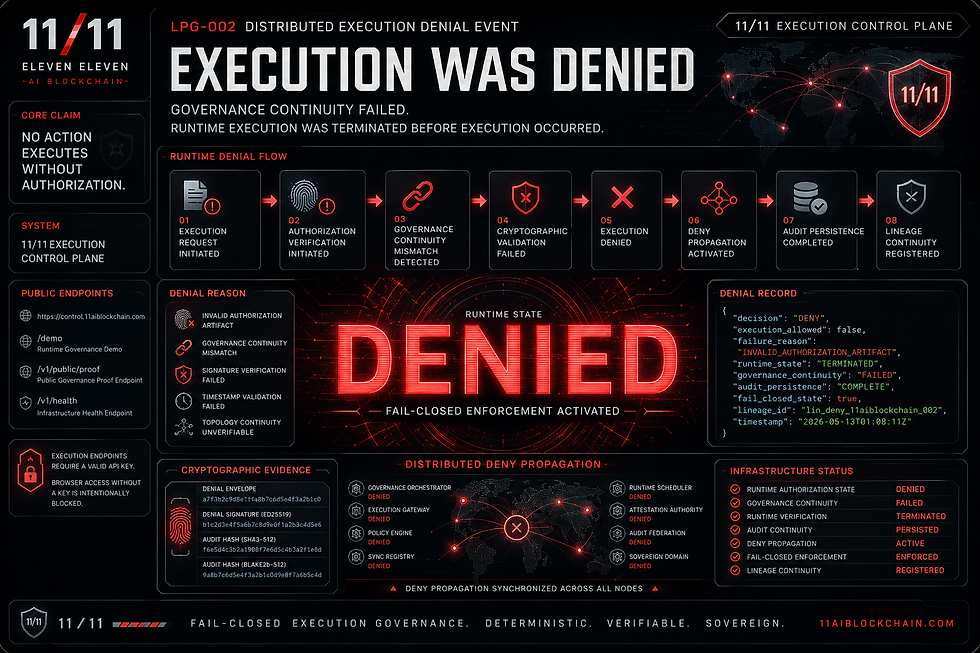
fail-closed enforcement
runtime integrity validation
This creates infrastructure where execution itself becomes governable.
Fail-Closed AI Infrastructure
Execution governance introduces a fail-closed security model.
Under a fail-closed architecture:execution is categorically denied unless authorization requirements are satisfied.
This includes:
invalid credentials
unauthorized runtime conditions
policy mismatches
expired authorization
revoked execution permissions
tampered requests
unverifiable runtime states
Execution denial becomes a security mechanism.
Not a system failure.
This is a major architectural shift.
Cryptographic Execution Verification
Execution governance also introduces cryptographic execution verification.
Every execution event can produce:
signed execution evidence
immutable audit records
runtime verification artifacts
lineage metadata
policy validation proofs
This creates evidence-grade runtime integrity.
Not merely operational logging.
In regulated environments, this distinction becomes critical.
Why This Matters
AI systems are rapidly moving into:
financial infrastructure
healthcare systems
defense environments
autonomous operations
enterprise orchestration layers
critical infrastructure coordination
These systems require:
deterministic control
verifiable execution integrity
policy-governed operations
runtime authorization
immutable auditability
The future of AI infrastructure cannot depend on trust-by-default execution models.
Execution itself must become governable.
The Future of Runtime Governance
A major infrastructure shift is now emerging.
Historically, foundational computing shifts introduced new infrastructure categories:
virtualization
cloud orchestration
endpoint detection
accelerated computing
foundation models
Execution governance represents the next infrastructure transition.
The future of AI systems will not be secured solely through observation after runtime.
They will require:
governed execution
pre-execution authorization
deterministic enforcement
cryptographic runtime verification
fail-closed infrastructure
The next era of AI infrastructure will be defined by execution governance.
Because in autonomous systems:
runtime detection is already too late.
Execution Governance™, Governed Execution™, and related execution control plane terminology are used by 11/11 to describe emerging infrastructure models centered on pre-execution authorization, deterministic policy enforcement, and cryptographic runtime verification for AI systems and autonomous infrastructure.
Patent Pending. Certain systems, architectures, infrastructure models, execution governance methods, and runtime authorization mechanisms described herein are subject to ongoing U.S. and international patent filings and related intellectual property protections by 11/11.
Public Governance Console
Runtime Governance Demo
Public Governance Proof Viewer
Infrastructure Health Dashboard
Execution Lineage Explorer

Comments