
PILLAR PAGE 10 AI Infrastructure Trust Layers


Introduction
Modern AI systems increasingly operate as autonomous infrastructure.
AI runtimes now:
orchestrate distributed systems
automate operational workflows
coordinate runtime services
trigger machine-speed execution
interact with regulated environments
operate continuously at global scale
Traditional infrastructure architectures were not designed for autonomous execution systems.
Most existing systems still assume:
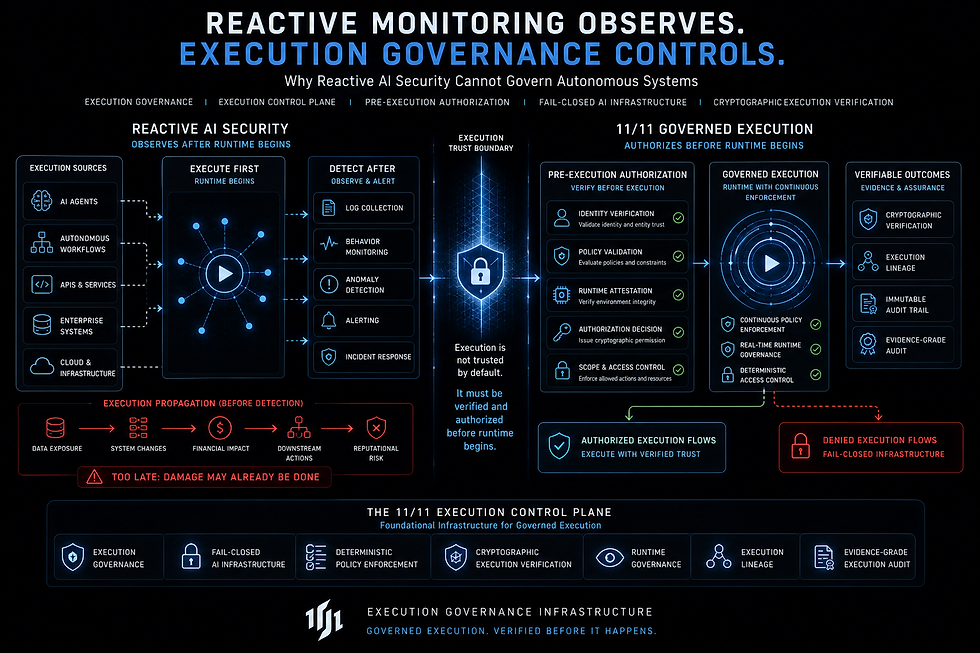
execution proceeds by default
runtime trust is implicit
monitoring occurs afterward
observability is sufficient
That model no longer scales.
Autonomous systems increasingly require:
AI infrastructure trust layers.
No action executes without authorization.
What AI Infrastructure Trust Layers Are
AI infrastructure trust layers establish deterministic governance across every stage of runtime execution.
Trust layers continuously verify:
authorization state
runtime integrity
environment consistency
behavioral compliance
policy validity
execution continuity
Execution becomes:continuously governed infrastructure.
Why AI Infrastructure Requires Trust Layers
AI systems increasingly:
initiate actions independently
coordinate distributed infrastructure
operate continuously
execute machine-speed decisions
interact with critical systems
Human-speed response models cannot keep pace.
Execution itself becomes:the operational trust boundary.
Trust layers establish:continuous runtime governance.
Core Trust Layers
1. Authorization Trust Layer
The authorization layer verifies:
identity
permissions
runtime eligibility
policy authorization
execution context
Unauthorized execution fails closed.
2. Runtime Integrity Layer
The runtime integrity layer continuously verifies:
runtime state
environment consistency
configuration integrity
behavioral compliance
execution validity
Integrity violations terminate execution.
3. Enforcement Layer
The enforcement layer continuously applies:
policy enforcement
runtime controls
fail-closed restrictions
anomaly response
integrity enforcement
Governance remains:continuously active.
4. Cryptographic Trust Layer
The cryptographic layer establishes:
signed authorization artifacts
runtime proof generation
immutable lineage
deterministic verification
execution trust validation
Runtime trust becomes:cryptographically provable.
5. Execution Lineage Layer
Execution lineage continuously records:
authorization events
runtime transitions
policy enforcement
integrity verification
execution outcomes
Execution accountability becomes:immutable infrastructure.
AI Infrastructure Trust Layers vs Traditional Security
Traditional Security | AI Infrastructure Trust Layers |
Implicit trust | Verified trust |
Reactive monitoring | Continuous governance |
Execute first | Authorize before execution |
Detect later | Fail closed immediately |
Best-effort security | Deterministic enforcement |
Mutable logging | Immutable lineage |
Fail-Closed Trust Enforcement
AI infrastructure trust layers assume:
uncertainty defaults to deny
unauthorized execution never proceeds
integrity violations terminate execution
runtime trust must remain continuously valid
No authorization:no execution.
Continuous Runtime Verification
AI infrastructure trust layers continuously verify:
runtime integrity
authorization validity
environment trust
policy state
execution continuity
behavioral compliance
Execution remains:continuously governed.
Public Execution Governance Infrastructure
11/11 public execution governance infrastructure is operational:
Public Governance Console
Runtime Governance Demo
Public Governance Proof Viewer
Infrastructure Health Dashboard
Execution Lineage Explorer
The Future Of Autonomous Infrastructure
Autonomous systems increasingly require:
runtime trust layers
deterministic authorization
governed execution
fail-closed enforcement
immutable execution lineage
continuous runtime verification
AI infrastructure trust layers become:foundational infrastructure for autonomous systems.
Conclusion
AI infrastructure trust layers establish:deterministic runtime governance for autonomous execution systems.
Execution can no longer rely on:
implicit trust
delayed response
reactive monitoring
post-execution analysis
Execution must become:
authorized
governed
continuously enforced
cryptographically verified
immutably recorded
fail-closed by design
11/11 is building the execution governance layer for AI and regulated compute infrastructure.


Comments