
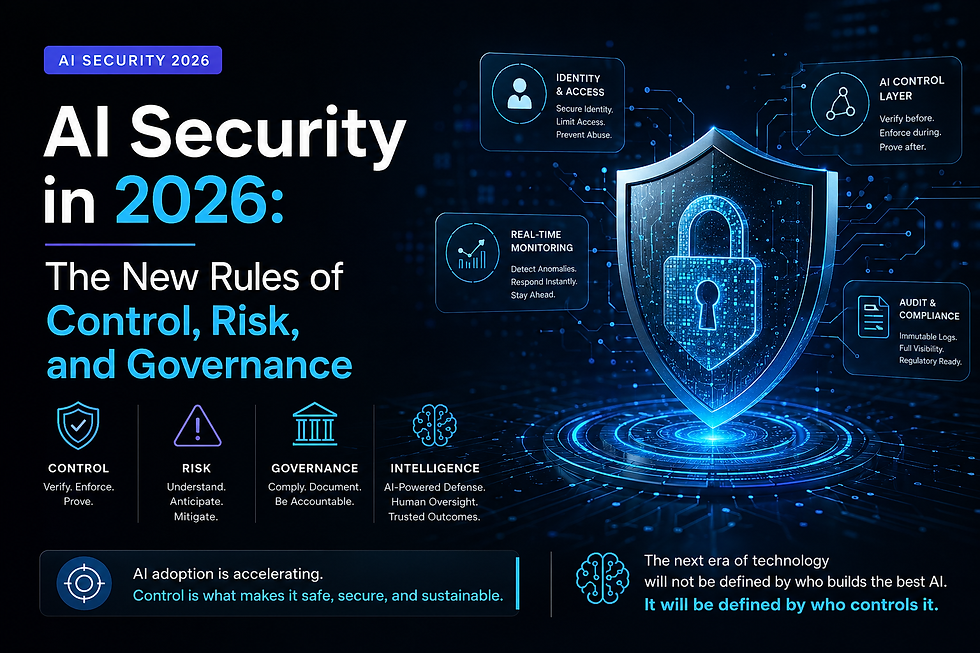
AI Security in 2026: The New Rules of Control, Risk, and Governance
- 11/11 AI

- May 2
- 7 min read
Introduction: The Illusion of Control
Artificial intelligence has crossed a threshold. What was once experimental, siloed, and cautiously deployed is now embedded across nearly every layer of modern infrastructure. Enterprises are no longer asking whether to adopt AI; they are racing to integrate it into operations, decision-making, and customer-facing systems. Governments are deploying it in intelligence workflows. Financial institutions are relying on it for fraud detection and risk modeling. Healthcare systems are using it to assist in diagnostics and patient data analysis.
But beneath this acceleration lies a fundamental truth that is only now becoming widely recognized:
AI adoption is not the problem. Control is.
For years, the industry has focused on building smarter models, faster inference systems, and more powerful data pipelines. The narrative has centered on capability how much AI can do, how quickly it can learn, and how broadly it can be deployed. Yet, as these systems become more autonomous and deeply integrated, a new category of risk has emerged one that cannot be solved by better models alone.
This risk is not about whether AI works. It is about whether AI is controlled.
Organizations are now facing a growing “execution gap” a disconnect between what AI systems are capable of doing and what organizations can actually govern, monitor, and verify. This gap is where the most significant vulnerabilities exist. It is where unauthorized actions occur, where data leaks happen, and where compliance failures originate.
The problem is structural. AI systems are being deployed into environments that were never designed to handle autonomous decision-making at scale. Traditional security models built around static systems, human-driven workflows, and predictable behaviorare fundamentally incompatible with dynamic, adaptive AI agents.
In this new landscape, the question is no longer:
“Is our AI accurate?”
“Is our model performing well?”
The real question is:
“Can we prove that our AI is operating within defined boundaries before, during, and after execution?”
This shift from capability to control is redefining the entire field of AI security.
The Current Landscape: A System Under Pressure
The rapid adoption of AI has created an environment where innovation is outpacing governance. Organizations are integrating AI tools into workflows faster than they can secure them. This imbalance is not theoretical it is already producing measurable consequences.
One of the most significant developments in 2026 is the rise of what many now refer to as “shadow AI.” Employees across industries are using AI tools independently, often without approval from IT or security teams. These tools are being used to process sensitive data, generate business-critical outputs, and even interact with customers. In many cases, organizations have no visibility into how these tools are being used or what data they are accessing.
This creates an invisible attack surface one that exists outside traditional monitoring systems. Data can be exposed, manipulated, or exfiltrated without triggering conventional security alerts. The result is a new class of vulnerability that is both decentralized and difficult to detect.
At the same time, threat actors are leveraging AI to enhance their capabilities. Automated systems can now scan for vulnerabilities, generate sophisticated phishing campaigns, and adapt in real time to defensive measures. The speed and scale at which attacks can be executed have increased dramatically.
This has led to a new paradigm:
Cybersecurity is no longer human vs. machine.It is machine vs. machine.
Defensive systems must now operate at the same speed and level of sophistication as the threats they are designed to counter. Static rules and reactive measures are no longer sufficient. Security must become dynamic, adaptive, and deeply integrated into the execution layer of AI systems.
The Five Defining Trends in AI Security
1. The AI Execution Gap
The most critical trend shaping AI security today is the widening gap between deployment and control. Organizations are deploying AI systems into production environments without fully understanding how those systems will behave under real-world conditions.
This gap manifests in several ways:
Lack of visibility into decision-making processes
Inability to enforce policy constraints at runtime
Limited auditability of AI-driven actions
Dependence on post-hoc analysis rather than real-time control
The result is a system where AI can act in ways that are technically correct but operationally unacceptable. For example, an AI system may optimize for efficiency in a way that violates compliance requirements or ethical standards. Without proper control mechanisms, these actions can go unchecked until they cause damage.
Closing the execution gap requires a fundamental shift in how AI systems are designed and managed. Control must be embedded into the system itself, not layered on afterward.
2. AI as Both Weapon and Defense
AI has become a dual-use technology in cybersecurity. The same capabilities that enable organizations to detect and respond to threats can also be used by attackers to exploit vulnerabilities.
On the offensive side, AI is being used to:
Automate reconnaissance and vulnerability scanning
Generate highly convincing phishing content
Create adaptive malware that evolves in response to defenses
Analyze large datasets to identify weak points in systems
On the defensive side, AI is being used to:
Detect anomalies in real time
Automate incident response
Correlate signals across multiple systems
Predict potential attack vectors before they are exploited
This dynamic has created an arms race. The effectiveness of defensive AI systems depends on their ability to operate at the same speed and level of sophistication as offensive tools. This requires not only advanced algorithms but also robust control mechanisms to ensure that defensive actions are accurate, appropriate, and compliant.
3. Regulation Is No Longer Optional
Regulatory frameworks for AI are rapidly evolving. Governments and regulatory bodies are recognizing the risks associated with uncontrolled AI systems and are implementing requirements to address them.
These requirements typically include:
Transparency in AI decision-making
Accountability for outcomes
Data protection and privacy safeguards
Risk assessment and mitigation strategies
Organizations are now expected to demonstrate that their AI systems are operating within defined boundaries. This includes maintaining detailed audit logs, implementing access controls, and ensuring that human oversight is present where necessary.
Failure to comply with these requirements can result in significant penalties, reputational damage, and operational disruption.
4. The Rise of Shadow AI
Shadow AI represents one of the most immediate and challenging risks in modern organizations. Unlike traditional shadow IT, which involves unauthorized hardware or software, shadow AI involves the use of powerful, autonomous systems that can process and generate sensitive information.
The risks associated with shadow AI include:
Data leakage through external AI tools
Inconsistent or incorrect outputs affecting business decisions
Lack of accountability for AI-generated actions
Increased exposure to regulatory violations
Addressing shadow AI requires a combination of policy, technology, and cultural change. Organizations must establish clear guidelines for AI usage, implement monitoring systems to detect unauthorized activity, and educate employees about the risks involved.
5. Convergence of AI Security and Infrastructure Security
AI security is no longer a standalone discipline. It is becoming deeply integrated with broader infrastructure security, including API security, identity management, and network protection.
AI systems rely on APIs to interact with other systems, making them a critical point of vulnerability. Unauthorized access to these APIs can allow attackers to manipulate AI behavior or extract sensitive data.
Identity management is also becoming more complex. AI agents must be authenticated and authorized in the same way as human users, but with additional considerations for autonomy and scale.
This convergence requires a holistic approach to security one that considers the entire system, from data inputs to execution outputs
The New Security Model: From Trust to Verification
Traditional security models are based on trust. Systems are assumed to operate correctly unless evidence suggests otherwise. This approach is fundamentally incompatible with AI, where behavior can be unpredictable and context-dependent.
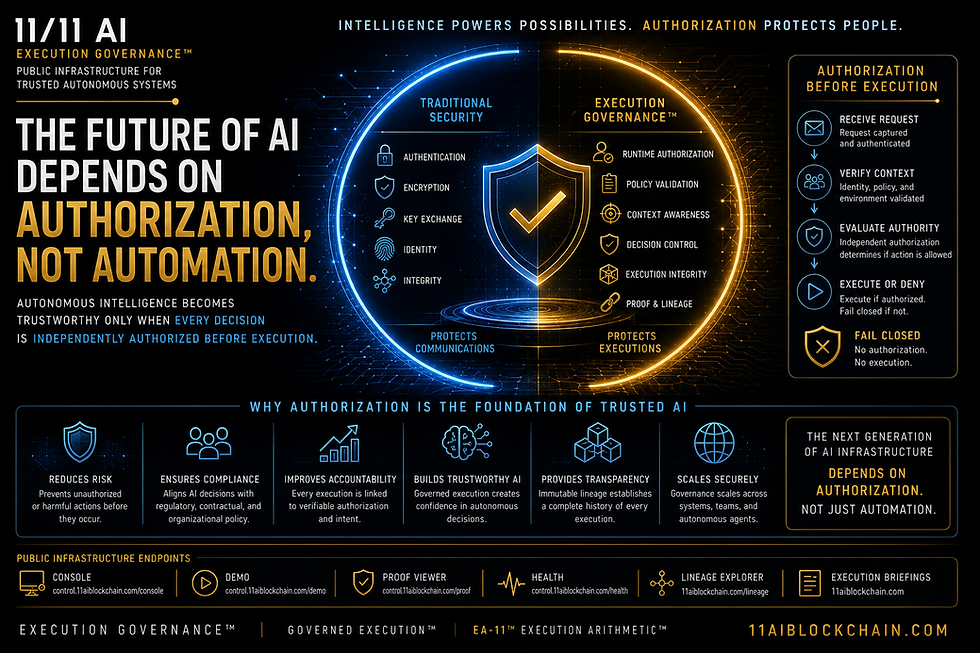
The new security model is based on verification. Instead of assuming that systems will behave correctly, organizations must actively verify that they are operating within defined boundaries.
This model can be summarized in three phases:
1. Verify Before Execution
Before an AI system performs an action, it must be validated against a set of policies and constraints. This includes checking:
Authorization credentials
Data access permissions
Compliance requirements
Contextual constraints
If any of these checks fail, the action should not be executed.
2. Enforce During Execution
During execution, the system must be monitored to ensure that it continues to operate within defined boundaries. This includes:
Real-time policy enforcement
Continuous validation of inputs and outputs
Detection of anomalies or deviations
If a violation is detected, the system must be able to intervene immediately.
3. Prove After Execution
After execution, the system must provide evidence that the action was performed correctly and in compliance with all relevant policies. This includes:
Immutable audit logs
Cryptographic verification of actions
Detailed reporting of decision processes
This evidence is critical for compliance, accountability, and trust.
Regulatory Expectations in 2026
Regulators are increasingly focused on ensuring that AI systems are safe, transparent, and accountable. Organizations must be prepared to meet these expectations.
Key requirements include:
Transparency: Organizations must be able to explain how AI systems make decisions.
Accountability: There must be clear lines of responsibility for AI-driven actions.
Data Protection: Sensitive data must be handled in accordance with privacy regulations.
Risk Management: Organizations must identify and mitigate potential risks associated with AI.
Meeting these requirements requires more than documentation. It requires systems that are designed with compliance in mind from the outset.
The Enterprise Response: Building for Control
Organizations that are leading in AI security are adopting a new approach. They are building systems that prioritize control, visibility, and accountability.
This includes:
Implementing centralized control layers for AI execution
Integrating security into every stage of the AI lifecycle
Using cryptographic methods to verify actions
Establishing clear policies for AI usage
These measures are not just about reducing risk. They are about enabling organizations to use AI confidently and effectively.
The Strategic Shift: From Tools to Systems
The transition from AI tools to AI systems represents a fundamental shift in how technology is developed and deployed.
AI tools are designed for specific tasks. They are often isolated and limited in scope. AI systems, on the other hand, are integrated, autonomous, and capable of interacting with multiple components.
This shift requires a new approach to security one that considers the entire system rather than individual components.
The Real Risk: Uncontrolled Execution
The most significant risk in AI is not the technology itself. It is the lack of control over how that technology is used.
Uncontrolled AI can:
Execute unauthorized actions
Access sensitive data without proper permissions
Make decisions that violate policies or regulations
Operate in ways that are difficult to detect or correct
These risks are not hypothetical. They are already occurring in organizations around the world.
Conclusion: The Future of AI Security
The future of AI will not be defined by who builds the most advanced models. It will be defined by who can control those models effectively.
Organizations that prioritize control, verification, and accountability will be able to harness the full potential of AI while minimizing risk. Those that do not will face increasing challenges as regulatory requirements tighten and threats become more sophisticated.
The path forward is clear:
Move beyond trust-based systems
Implement verification at every stage of execution
Build infrastructure that supports control and accountability
In the end, the question is not whether AI will transform industries. It already has.
The question is whether we can control that transformation.
We are not building another AI system.We are building the control layer required to deploy AI safely.


Comments